
Reviewed · ARCHITECTURE TOURS
Rotterdam Architecture: Centre and South Bank with watertaxi
Rotterdam makes the most sense when you see its buildings as a timeline. This three-hour tour walks you from the city’s postwar modernist center to its newest waterfront districts, then adds a watertaxi ride beneath the Erasmus Bridge for a sharp change of pace.
I like the architect-led route and the way it links famous sights rather than treating them as isolated photo stops. I also like the practical city advice, including recommendations for the rest of your visit. The main drawback is the 4-kilometer walk, which makes comfortable shoes essential and may be too much for anyone with mobility or visual impairments.
Key points
- Central Station meeting point: Find the guide beneath the station clock outside the main entrance.
- Architecture with a story: See Lijnbaan, Timmerhuis, Markthal, the Cube Houses, and St. Laurens Church in one connected route.
- Fast river crossing: Your watertaxi fee is included, with a ride beneath the Erasmus Bridge to the South Bank.
- A look at new Rotterdam: Learn how former harbor land became a district of apartments, restaurants, cultural spaces, and modern offices.
- Useful local guidance: Guide Tania has provided advice on future developments and places to see after the tour.
- Good fit for active sightseers: The tour lasts three hours, is conducted in English, and includes a substantial walk.
Rotterdam’s city center as an open-air architecture lesson
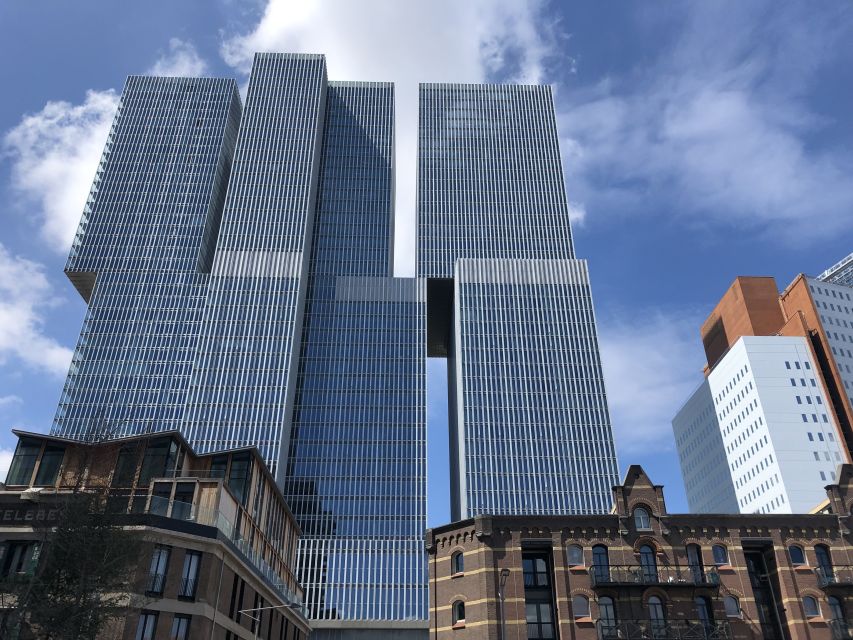
Rotterdam is not a city where the oldest building always gets the most attention. Much of its center was rebuilt after wartime destruction, and the result is a city of sharp contrasts: postwar shopping streets, daring new construction, medieval remnants, and experimental housing all sit within a short walk.
This tour uses that contrast well. Instead of sending you from one attraction to another by vehicle, it lets you watch Rotterdam change as you walk. Your guide is an architect, so the focus is not only on what a building looks like. You can expect attention to design, urban planning, how people use public space, and what may come next.
That matters in Rotterdam. A standard sightseeing walk can leave you with a stack of unusual building photos. An architect-led route gives you a way to connect them. I would choose this tour early in a Rotterdam visit, since it can help you understand the city before you explore on your own.
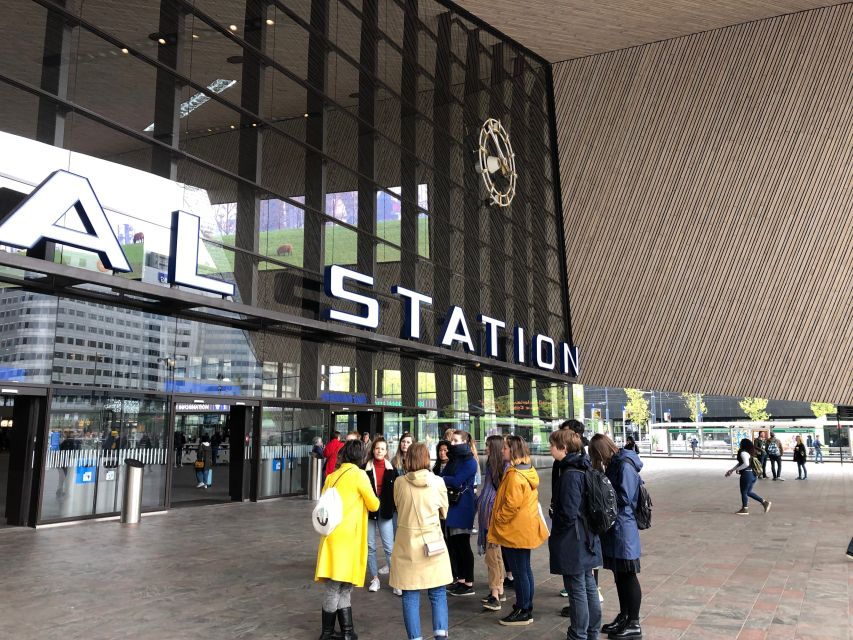
The meeting point is beneath the station clock, next to the main entrance of the newly built Rotterdam Central Station. That is a practical place to begin, especially if you arrive by train. Be careful to meet outside, under the clock, rather than wandering inside the station looking for the guide.
More Architecture Tours in Rotterdam
- Rotterdam: Architectural Highlights Guided Walking Tour
★ 4.8 · 215 reviews - Rotterdam Walk: Hilights, Gems, Architecture & WWII | 2 or 3hrs
★ 5.0 · 149 reviews - Rotterdam Architecture Highlights Walking Tour
★ 5.0 · 66 reviews
From Lijnbaan’s postwar design to Timmerhuis
The first part of the route moves through the central shopping district and introduces one of Rotterdam’s key architectural chapters: postwar modernism.
Lijnbaan is not simply a place to shop. Its design reflects a new approach to city centers after the Second World War, with pedestrian space separated from traffic and a layout meant to make shopping more open and accessible. The area is a useful reminder that architecture is often about movement and daily life, not only dramatic façades.
From there, the route reaches Timmerhuis, a striking building designed by OMA, the Rotterdam-based architectural practice known around the world. Timmerhuis has a modular, pixel-like appearance that gives it a very different feel from the lower, more orderly structures around Lijnbaan.
I like this pairing because you see two different answers to the same city problem. Lijnbaan represents a postwar vision of a modern shopping center. Timmerhuis shows how contemporary design can add offices, homes, and public functions to a tight urban site.
Your guide can also place these buildings in the context of Rotterdam’s future. Guide Tania, who has led this experience, is noted for explaining planned developments as well as existing architecture. That makes the tour more useful than a simple list of construction dates and architects.
St. Laurens Church and a surviving piece of old Rotterdam
St. Laurens Church brings an older layer into the route. In a city strongly associated with reconstruction and new design, the church provides a direct link to Rotterdam’s prewar past.
Its inclusion is important because it keeps the tour from becoming a parade of glass, steel, and concrete. You get a sense of the city that existed before its center was remade, then see how that past now fits into a much newer urban setting.
The tour description does not promise an extended interior visit, so you should think of St. Laurens primarily as a stop within the walking route rather than a separate church tour. Your guide’s architectural focus should help explain its place in the surrounding city, but the exact amount of time at each stop can vary.
For me, this is one of the route’s strongest choices. Rotterdam’s appeal comes from its mixture of eras. The old church is not treated as a relic isolated from modern life. It sits within the same city as Timmerhuis, the Markthal, and the Cube Houses.
Markthal and the Cube Houses, Rotterdam’s most playful side

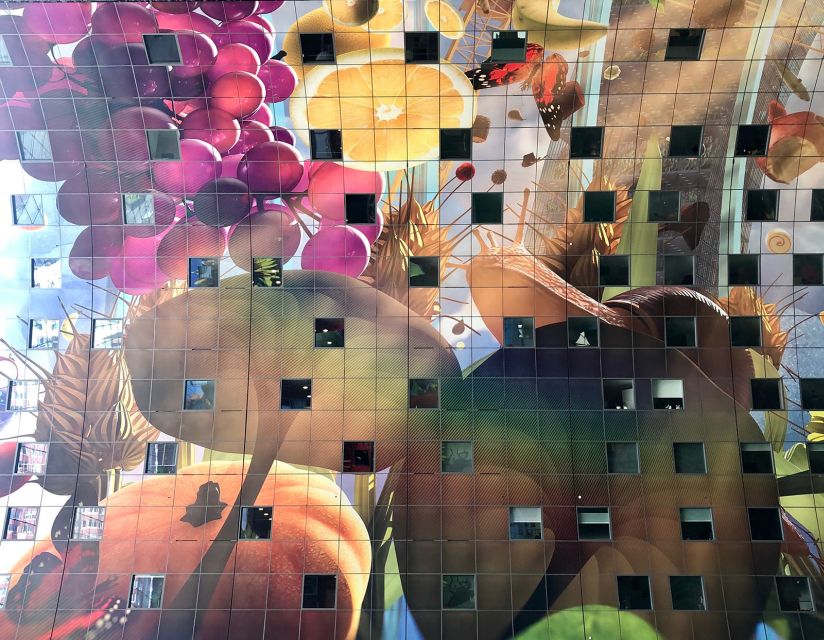
The Markthal is one of Rotterdam’s easiest buildings to recognize. Its large arched form houses an indoor market, and the building is often described as one of Europe’s most distinctive covered markets.
You can expect the guide to explain both the building’s appearance and its role in the city. The Markthal is a functioning public place, not just an architectural shell. That gives you a chance to connect design with food, shopping, and ordinary city activity.
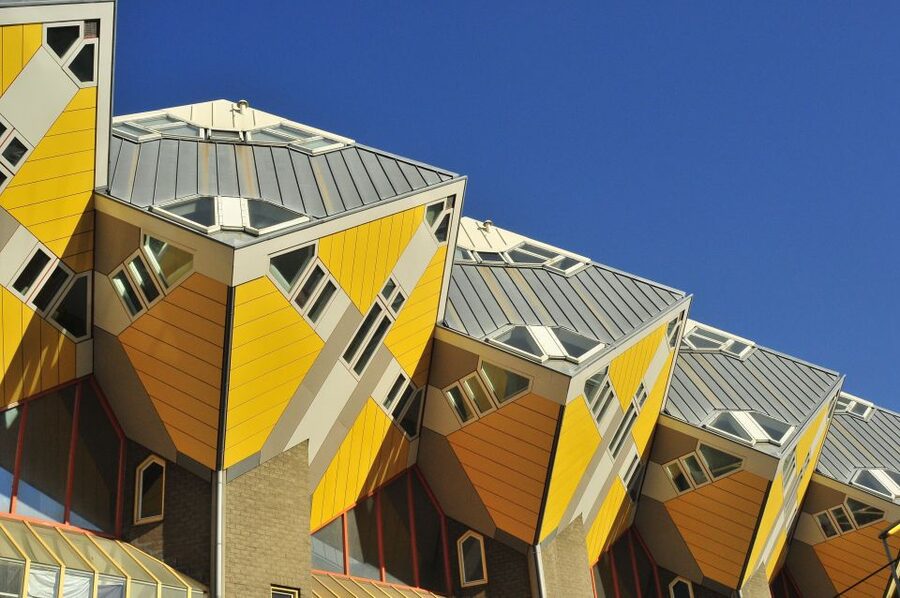
The tour then reaches the Cube Houses, another of Rotterdam’s famous experiments. Their tilted forms make a simple question surprisingly difficult: how do you live comfortably in a house that appears to be turned on its side?
The Cube Houses are ideal for an architect-led explanation because their novelty is easy to see, while their practical compromises are less obvious. You may find yourself paying as much attention to how the houses meet the street as to the unusual angles overhead.
These stops are popular and highly photographed, so they may feel more familiar than Lijnbaan or Timmerhuis. That is not a weakness. They are included because they help explain Rotterdam’s willingness to test new ideas in full view of the public.
If you have already visited Markthal and the Cube Houses, the guide’s interpretation can still add value. You will see the buildings in relation to the rest of the center instead of treating them as separate attractions.
Same base, a completely different sort of day:
- Rotterdam: Harbor Sightseeing Cruise
★ 4.3 · 7,599 reviews - Rotterdam: 1-Hour Sightseeing Splash Tour
★ 4.5 · 3,299 reviews - Rotterdam: Rotterdam Zoo Blijdorp Entry Ticket
★ 4.6 · 2,754 reviews - Rotterdam: Euromast Lookout Tower Ticket
★ 4.4 · 2,549 reviews
Boarding the watertaxi beside the Maas
At the riverside, the walking tour changes character. You board a watertaxi for a speedboat ride across the Maas to Rotterdam’s South Bank.
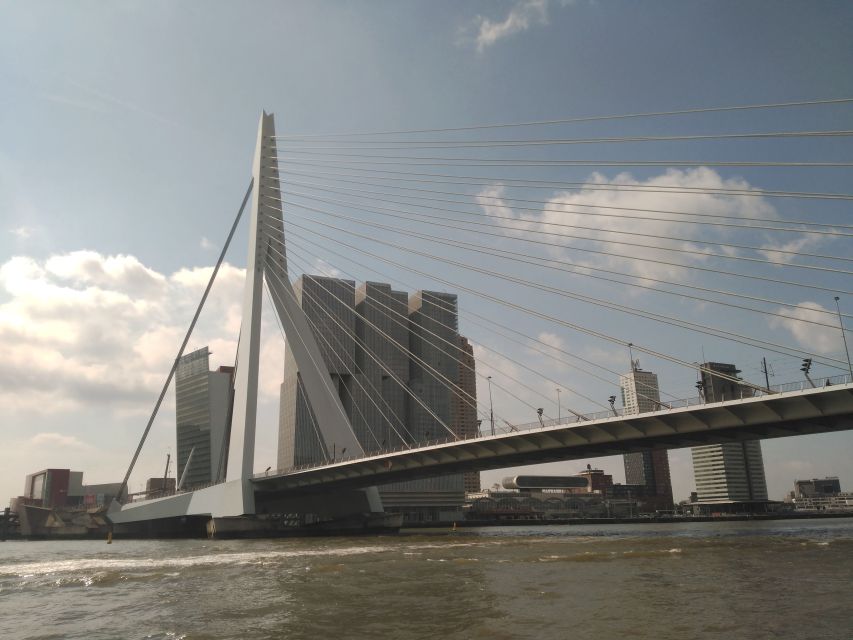
The crossing is short enough to fit into a three-hour tour, but it adds a memorable physical experience. From the water, the city opens up. You get a different angle on the waterfront and pass beneath the Erasmus Bridge, Rotterdam’s most recognizable modern landmark.
This is more than a convenient transfer. The river has shaped Rotterdam’s growth, trade, industry, and neighborhoods. Crossing it by boat helps you understand why the city’s two banks feel connected yet distinct.
The watertaxi fee is included in the $82 price, so you do not have to arrange or pay for this part separately. It also means the tour is not only a walking lecture. You get a change from pavement to water at just about the point when a long city walk could begin to feel repetitive.
The ride is described as a speedboat experience, so expect movement and open views rather than a slow sightseeing cruise. If you prefer quiet, steady transport, this may feel more thrilling than necessary. For most people, though, it is the tour’s clearest change of pace.
The South Bank, from port district to stylish neighborhood
The South Bank section focuses on former harbor areas that have taken on new uses. This is where the tour shifts from Rotterdam’s central landmarks to the city’s ongoing redevelopment.
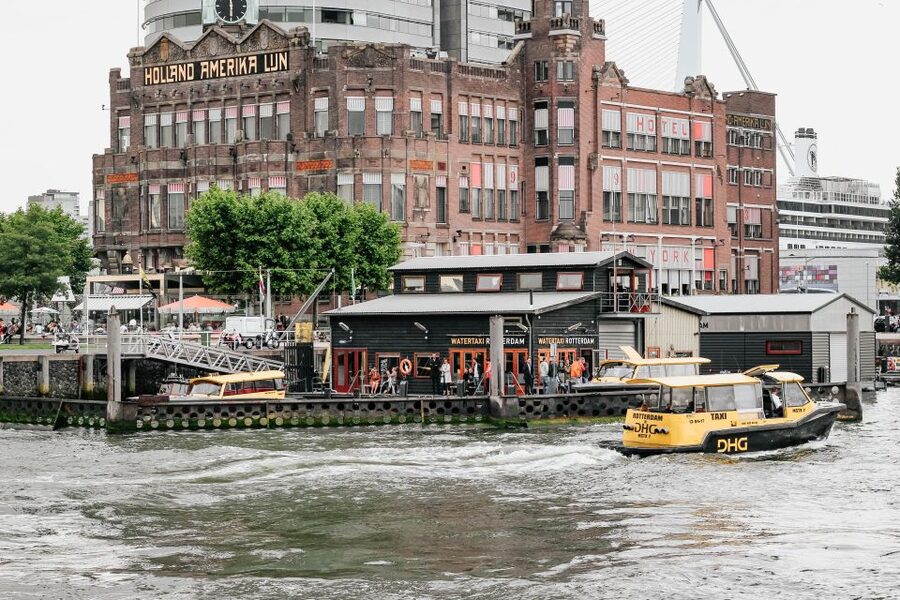
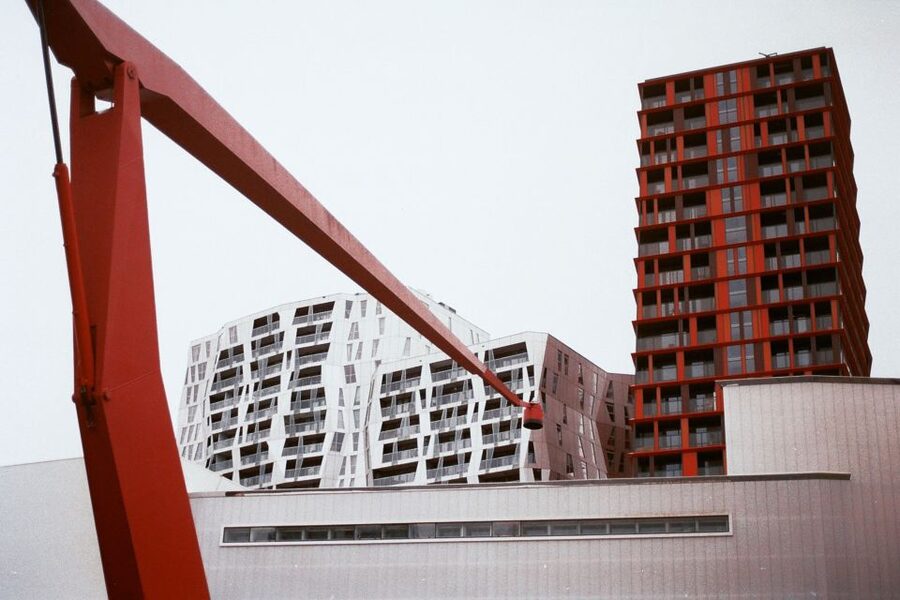
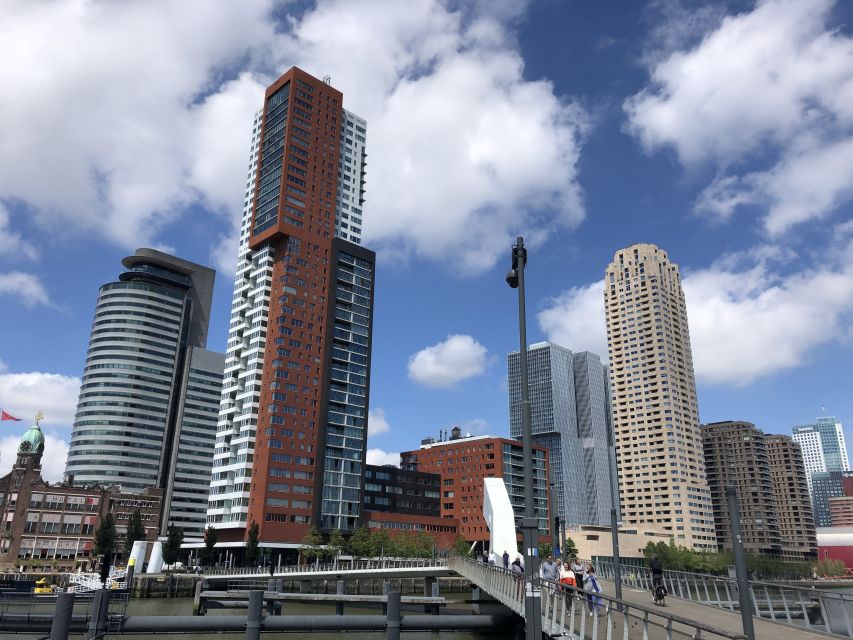
You will see the Rotterdam OMA building, historic Hotel New York, Fenixloods, and Fenix Food Factory. Together, these places show several sides of the district: contemporary architecture, maritime connections, converted industrial space, and food culture.
Hotel New York is especially useful as a reference point. Its name and setting recall Rotterdam’s port links and its historic connection with long-distance travel. Nearby modern buildings make the area feel like a conversation between the city’s working past and its newer residential and cultural life.
Fenixloods and Fenix Food Factory add a more informal side to the South Bank. These are not grand monuments in the traditional sense. They help show how old harbor spaces can become places for food, creative work, and social activity.
I like that the route does not stop at the central cluster of famous buildings. You get to see how Rotterdam is still changing, and you can leave the tour with a better sense of where to eat or continue exploring.
Your guide can also explain future plans for the former harbor area. That is valuable here because the South Bank is not presented as a finished district. Rotterdam continues to build, adapt, and rethink its waterfront.
What $82 buys you in three hours
At $82 per person, this tour is not the cheapest way to see Rotterdam. You are paying for a live architect guide, a structured four-kilometer route, and the included watertaxi crossing.
The value depends on how you like to visit cities. If you prefer to wander alone and read signs at your own pace, you may find the price high. Rotterdam’s center is walkable, and several of these sights can be seen without booking a tour.
I think the price makes more sense if you want interpretation rather than transportation alone. The route connects architecture, urban planning, the river, and neighborhood change. You also save the effort of planning a route that crosses from the central station area to the South Bank.
The experience is particularly useful at the start of a visit. Guide Tania has offered practical sightseeing suggestions for the rest of a stay, and that kind of advice can help you decide where to spend your free time afterward.
Children under 12 can join the tour free of charge, but the listed price still covers their speedboat fee. That makes the family cost more manageable, though the walk and architecture-heavy subject may suit older children better.
Who should book, and who should think twice
I would recommend this tour to anyone who enjoys buildings but wants more than a photo checklist. It also suits first-time visitors who want a quick orientation to Rotterdam’s central and southern districts.
You do not need to be an architect. The route includes famous sights, a market, a church, a historic hotel, food spaces, and a boat ride. The architectural angle gives those places a common thread without requiring specialist knowledge.
It is also a good option if you have only one day in Rotterdam and want to cover a broad range of highlights. In three hours, you see the central station area, postwar city planning, newer landmark buildings, the river, and the South Bank.
The tour is less suitable if you want a slow pace or a deep visit inside every attraction. The itinerary is broad, so stops are likely to be focused rather than lengthy. Drinks are not included, and hotel pickup and drop-off are not provided.
There is also a clear physical consideration. The advertised information says the tour is wheelchair accessible, but it also says it is not suitable for people with mobility impairments or visual impairments. Since the walk covers four kilometers and includes a speedboat transfer, contact the provider before booking if you have access needs. Do not assume that the accessibility label means every part of the route will be easy for you.
Wear comfortable shoes. Large bags and luggage are not allowed, so arrive with only what you need for three hours.
Booking details that affect your day
The tour is conducted in English with a live guide. You meet at Rotterdam Central Station under the clock outside the main entrance, which is convenient if you are arriving by train or starting your city visit there.
The duration is three hours, with starting times varying by date. Check the available time before building the rest of your day around it.
You can cancel up to 24 hours before the tour for a full refund, and the reserve-now, pay-later option keeps your plans flexible. Those policies are useful in the Netherlands, where weather can affect how enjoyable a walking and boating tour feels.
Bring comfortable shoes and avoid luggage or large bags. Drinks are not included, so plan to carry what you need within the bag restrictions or buy something before or after the experience.
Should you book the Rotterdam architecture and watertaxi tour?
Book it if you want a compact, well-connected introduction to Rotterdam, especially if modern architecture, urban change, and waterfront districts interest you. The combination of Lijnbaan, Timmerhuis, St. Laurens Church, Markthal, the Cube Houses, and the South Bank gives you a much broader picture than a short central walking tour.
The watertaxi ride is the extra touch that makes the route memorable, while the architect guide adds the context that unusual buildings often need. If you want a leisurely route, have mobility concerns, or prefer spending long periods inside individual attractions, choose a different plan.
For an active three-hour introduction, $82 is a fair price when you count the guide and boat crossing. I would book it near the beginning of your Rotterdam stay, wear good shoes, and save the guide’s suggestions for the rest of your visit.
FAQ
How long does the Rotterdam architecture tour last?
The tour lasts three hours.
How far do you walk?
The walking portion covers about 4 kilometers.
Where does the tour meet?
Meet your guide under the station clock next to the main entrance of Rotterdam Central Station, on the outside.
What language is the tour conducted in?
The live tour is conducted in English.
Is the watertaxi included in the price?
Yes. The watertaxi fee is included.
What architecture can I see in Rotterdam’s center?
The route includes Lijnbaan, Timmerhuis, St. Laurens Church, the Markthal, and the Cube Houses.
What can I see on the South Bank?
The South Bank portion includes views of the Rotterdam OMA building, Hotel New York, Fenixloods, and Fenix Food Factory.
Are children under 12 allowed to join?
Yes. Children under 12 can participate free of charge, though the listed price covers their speedboat fee.
Is the tour wheelchair accessible?
The activity information describes it as wheelchair accessible, but it also says it is not suitable for people with mobility impairments or visual impairments. Contact the provider before booking to confirm that the route meets your needs.
What should I bring?
Bring comfortable shoes. Luggage and large bags are not allowed, and drinks are not included.
Just added around Rotterdam
- The Netherlands: WW2 Private Day Trip★ 5.0 · 4 reviews
- Rotterdam: Guided Food Tour★ 4.4 · 16 reviews
- Rotterdam: UNESCO Van Nelle Factory Guided Tour★ 4.5 · 94 reviews
- Rotterdam: Trompenburg Botanical Gardens Entry Ticket★ 4.1 · 77 reviews
- Rotterdam: Summer Cocktail Cruise★ 4.7 · 18 reviews
- Rotterdam: Summer Evening Cruise with Live Entertainment★ 4.8 · 5 reviews
- Rotterdam: Pub Cruise with Drinks and Bites★ 3.8 · 16 reviews
- Rotterdam: Private Tour with a Local★ 4.7 · 47 reviews
Architecture Tours, compared.
Rotterdam Walk: Hilights, Gems, Architecture & WWII | 2 or 3hrs
Read our review →
The rise of Haarlem: Culture, History, Art and Architecture Walking Tour
Read our review →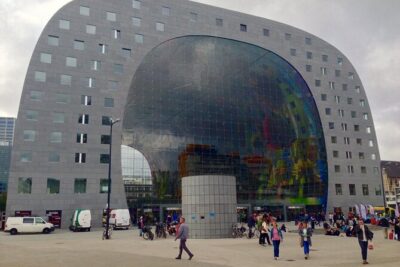
Rotterdam Must Do Tour: Highlights, History, WW2 and Architecture
Read our review →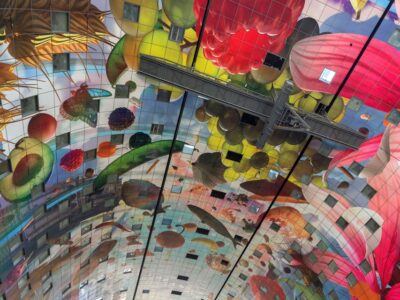
Walking Tour about Golden Age Architecture, private local guide
Read our review →
Browse the lists this tour appears in