
Reviewed · ARCHITECTURE TOURS
Rotterdam: Wilhelminapier, High-rise & floating architecture
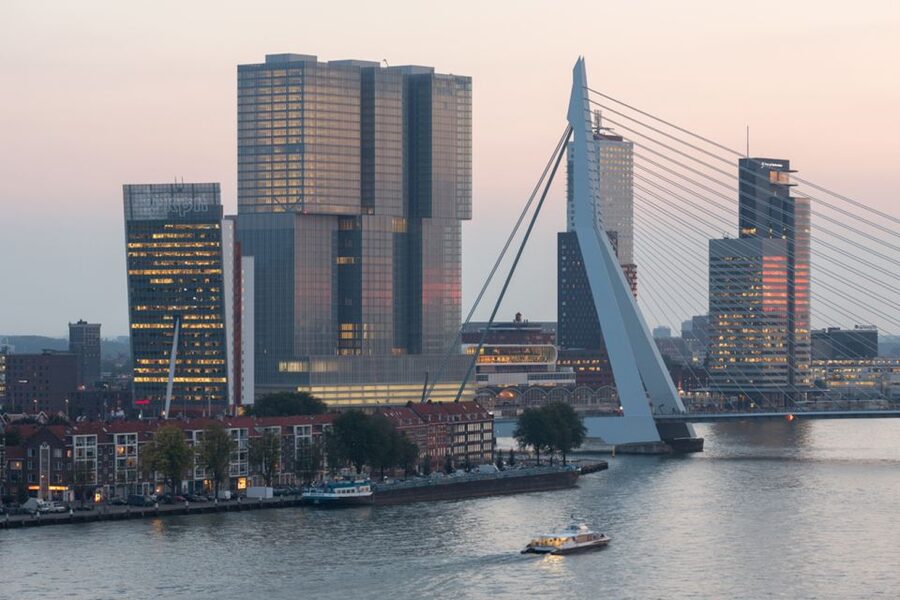
Rotterdam’s Wilhelminapier is where the city’s port past meets its boldest modern architecture. This private walk takes you from the red Het Nieuwe Luxor Theater past De Rotterdam and the former Holland America Line district to Pakhuismeesteren’s rooftop, with a city view and a close look at floating buildings along Rijnhaven.
I like the mix of harbor history and new design, and I like that the tour includes both a rooftop entrance and a Dutch treat rather than keeping you on the pavement. The main drawback is the short one-hour format. You will see a lot, but this is an introduction to the pier, not a slow architectural study.
Key points
- Wilhelminapier’s port-to-high-rise transformation: Learn how a former Holland America Line area became one of Rotterdam’s best-known architectural districts.
- Pakhuismeesteren rooftop access: Enter a former harbor warehouse, now home to a hotel and Foodhallen, then go upstairs for a broad city view.
- De Rotterdam explained on site: Hear about the concept and design of the huge building from a professional guide.
- Floating projects along Rijnhaven: See a floating hotel, park, and office as examples of Rotterdam’s practical approach to water and urban space.
- Private group format: The $286 price covers up to six people, making the cost more reasonable when shared by a full group.
- A tour in several languages: Choose from Dutch, English, German, Spanish, or French, with guides such as Willem providing the historical and architectural background.
Starting outside Het Nieuwe Luxor Theater
Your meeting point is outside Het Nieuwe Luxor Theater, the red building on the Wilhelminapier. That gives the tour a clear start in a district where Rotterdam’s cultural buildings, former port warehouses, hotels, and tall residential and office towers now sit side by side.
The location is useful because the Wilhelminapier is best understood on foot. You are not being driven between isolated sights. Instead, the guide connects the buildings as you walk, explaining how the pier changed from a shipping center into a major part of modern Rotterdam.
The one-hour length is both a strength and a limit. It fits neatly into a day of sightseeing and leaves time for the Foodhallen, the Fenix Migration Museum, or other parts of the city. At the same time, the walk moves at a purposeful pace. If you want long stops for photographs or detailed discussion of every architect, you may wish for more time.
Since the group is private, you can ask questions without trying to speak over a large crowd. That is especially useful here, since the tour deals with design ideas that can seem abstract when you only see them from the outside.
More Architecture Tours in Rotterdam
- Rotterdam: Architectural Highlights Guided Walking Tour
★ 4.8 · 215 reviews - Rotterdam Walk: Hilights, Gems, Architecture & WWII | 2 or 3hrs
★ 5.0 · 149 reviews - Rotterdam Architecture Highlights Walking Tour
★ 5.0 · 66 reviews
How the Holland America Line shaped the pier
The Wilhelminapier was once closely tied to the Holland America Line, and that connection gives the modern buildings a stronger sense of place. This was not simply an empty waterfront waiting for striking towers. It was a working harbor area with an important link to long-distance travel.
Your guide explains the former Holland America Line presence and the way the district changed over time. That background helps you read the pier as more than a collection of unusual façades. The warehouses, theater, hotels, offices, and towers belong to different chapters of Rotterdam’s story.
I find this context particularly useful for first-time visitors. Rotterdam is known for modern architecture, but its newer buildings make more sense when you understand the port activity that came before them. The tour gives you that connection without turning the walk into a long lecture on maritime history.
The information supplied for the tour does not promise a museum-style interior visit focused on the Holland America Line. Expect the story to be part of the walking commentary, with the main emphasis on the Wilhelminapier’s transformation and its architecture.
Reading De Rotterdam from the outside
De Rotterdam is one of the major buildings on the pier, and the guide discusses its history, concept, and design. The point is not simply to photograph a tall structure. You get an explanation of how the building was planned and what makes it important within Rotterdam’s modern skyline.
A guide-led explanation matters here. Large high-rise projects can look impressive while their purpose remains unclear. The tour gives you a way to understand De Rotterdam as a designed idea, not just a mass of glass and concrete.
You should expect to view and discuss the building rather than take a full interior tour of every part of it. The exact route and time spent at each stop can vary, but the advertised focus is on the building’s background and design.
This is one reason the private format can be worthwhile for architecture fans. You can ask about the parts that interest you most, from the building’s concept to the way it fits among the other towers on the pier. With only one hour, the guide will need to keep the discussion moving, but you are not locked into a large group’s fixed questions.
Inside Pakhuismeesteren and up to the rooftop
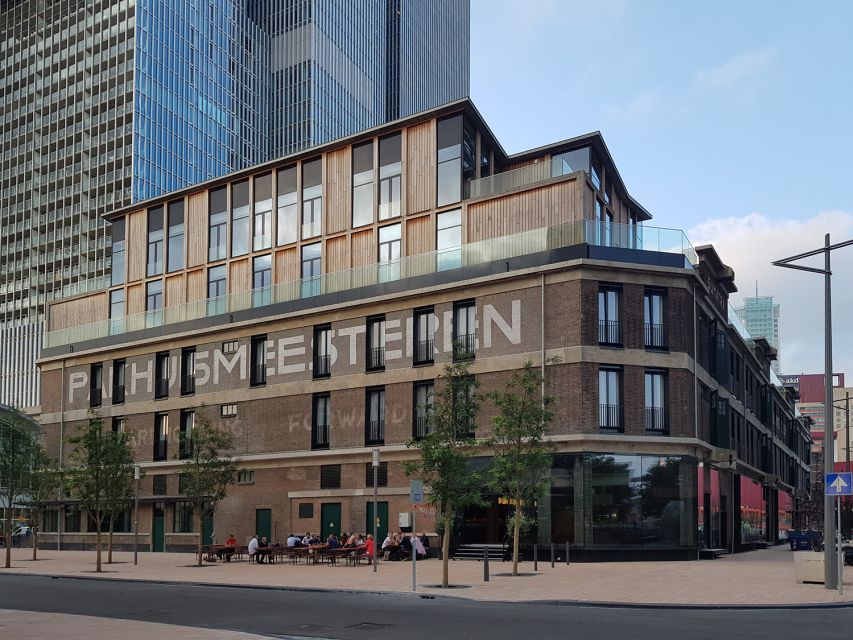
Pakhuismeesteren is one of the tour’s most appealing stops because it combines old port function with new city life. The building was formerly a harbor warehouse. It now contains a hotel and the Foodhallen, a food market that gives the building an active public use.
You enter the building and receive rooftop access as part of the tour. From above, you can look across Rotterdam and see the city’s high-rise architecture from a more useful angle than street level provides.
The rooftop view is the clearest visual payoff of the experience. On the ground, tall buildings can block one another and make it hard to understand how the pier fits together. From the roof, you get a wider view of the city and its architectural mix.
The visit is not only about the view. Pakhuismeesteren itself shows how an older industrial structure can be given a new role. That contrast is central to the Wilhelminapier: old harbor buildings remain part of the story, while new uses bring people into them.
The Foodhallen is also worth noting for anyone who wants to continue the outing with food. It is described as a must-see for food lovers, but the tour includes a visit rather than a full meal or tasting program. You receive a tasty Dutch treat, which adds a small local touch, but you should not book this as a dedicated food tour.
Same base, a completely different sort of day:
- Rotterdam: Harbor Sightseeing Cruise
★ 4.3 · 7,599 reviews - Rotterdam: 1-Hour Sightseeing Splash Tour
★ 4.5 · 3,299 reviews - Rotterdam: Rotterdam Zoo Blijdorp Entry Ticket
★ 4.6 · 2,754 reviews - Rotterdam: Euromast Lookout Tower Ticket
★ 4.4 · 2,549 reviews
Floating hotel, park, and office along Rijnhaven
After Pakhuismeesteren, the walk continues along Rijnhaven to see Rotterdam’s floating projects. The tour includes a floating hotel, a floating park, and a floating office.
These projects give the walk a practical side. Rotterdam is closely tied to water, so floating buildings are not just oddities for photographs. They raise questions about how a city can use its waterways and respond to limited urban space. Your guide introduces the concepts behind the projects, helping you see them as experiments in city design.
The floating hotel, park, and office are viewed from the route, and the supplied details do not promise entry into each one. Plan on an exterior look and an explanation rather than a full tour of their interiors.
This part is also a nice change of pace after the towers and warehouse. You move from high-rise architecture to structures that sit directly on the water. If you enjoy urban planning, sustainable design, or unusual buildings, this may be the most distinctive part of the walk.
The tour ends near the Fenix Migration Museum, described as Rotterdam’s newest icon. That is a convenient finish. You can stop there afterward if you have time, though admission to the museum is not included in this experience.
What the one-hour format really gives you
A one-hour tour can sound brief for a district with this much to see. I would treat it as a well-focused orientation rather than a complete tour of Rotterdam’s architecture.
You receive several different experiences in a short period:
- A guide-led introduction to the Wilhelminapier
- Background on the Holland America Line
- Commentary on De Rotterdam’s design
- Entry into Pakhuismeesteren
- A rooftop view
- A look at Foodhallen
- An explanation of three floating projects
- A Dutch treat and a Rotterdam architecture postcard by photographer Ossip van Duivenbode
That is a good amount for sixty minutes, but the pace will matter. You may not have much time to linger at each building. I would bring a camera, listen for the design details that interest you, and save a longer food stop or museum visit for after the tour.
The postcard is a thoughtful extra for anyone who likes architecture photography. It is not a major part of the value, but it gives you a physical reminder of the district beyond the usual phone pictures.
The guide’s role is important. One confirmed guide name connected with the experience is Willem, and the feedback about his tour points to a relaxed walk with humor and useful information. The tour is offered in Dutch, English, German, Spanish, and French, so check the language you need when selecting a departure.
Is $286 good value for your group?
The price is $286 per private group of up to six people. At the maximum group size, that works out to about $47.67 per person. For two people, the same price becomes $143 each, so the value depends heavily on how many people share the booking.
The price includes the guide, rooftop entrance, Dutch treat, and the Rotterdam architecture postcard. It does not include a meal at Foodhallen or entry to the Fenix Migration Museum.
I think the price makes the most sense for a group of four to six people that wants a private guide and a focused introduction to the pier. It is harder to justify for one or two people if you are happy to walk around independently and read about the buildings yourself.
The rooftop access helps support the cost, since you are not paying only for a street walk. The private format also gives you a quieter way to ask questions and set the emphasis. Still, the experience lasts only one hour, so anyone comparing prices should judge it as a compact architectural tour rather than a half-day outing.
Who will get the most from this walk?
I would recommend this experience to you if you want an easy introduction to Rotterdam’s modern architecture and prefer explanations to self-guided sightseeing. It suits visitors who enjoy city planning, waterfront redevelopment, unusual buildings, and good viewpoints.
It is also a practical choice for a small family or group of friends. The private booking avoids a large tour group, and the one-hour schedule is manageable when you have several other plans in Rotterdam.
Food lovers may enjoy the Foodhallen stop, but I would not book the tour solely for eating. The food market is part of the architectural experience, and the included Dutch treat is modest rather than a complete tasting session.
You may want another option if your main goal is detailed architectural photography. The tour has many stops, but the short duration may limit the time available for careful shots. It is also not the right fit if you expect long interior visits at the floating projects or a full museum tour.
Wheelchair users can book this experience, as it is listed as wheelchair accessible. If you need a particular route arrangement, it is still sensible to confirm details when booking, especially because the walk includes multiple buildings and waterfront areas.
Practical details before you book
Meet your guide outside Het Nieuwe Luxor Theater, the red building. The tour lasts one hour, and starting times depend on availability.
You can reserve now and pay later, which is helpful if your Rotterdam schedule is still taking shape. Free cancellation is available up to 24 hours before the experience for a full refund.
The group is private and can include up to six people. Available tour languages are Dutch, English, German, Spanish, and French.
The tour finishes near the Fenix Migration Museum. Plan your next stop before you begin, since the ending point gives you a useful chance to continue exploring the Wilhelminapier and Rijnhaven on your own.
Should you book the Wilhelminapier tour?
Book it if you want a short, private introduction to Rotterdam’s most striking waterfront architecture, especially if your group can share the $286 price. The rooftop at Pakhuismeesteren, the former warehouse setting, De Rotterdam commentary, and floating projects give the hour a clear sense of variety.
I would skip it if you want a long food tour, extensive museum time, or a slow technical study of every building. The best reason to book is the combination of access and interpretation: you see the pier from the street, from a rooftop, and beside the water, while a guide explains why the district looks the way it does.
FAQ
Where does the tour meet?
Meet your guide outside Het Nieuwe Luxor Theater, the red building on the Wilhelminapier.
How long does the tour last?
The tour lasts one hour.
How much does the private tour cost?
The price is $286 per private group of up to six people.
Is the rooftop entrance included?
Yes. Rooftop entrance at Pakhuismeesteren is included.
Which languages are available?
The tour is available in Dutch, English, German, Spanish, and French.
Is the tour wheelchair accessible?
Yes, the experience is listed as wheelchair accessible.
Where does the tour finish?
The walk ends near the Fenix Migration Museum.
Just added around Rotterdam
- The Netherlands: WW2 Private Day Trip★ 5.0 · 4 reviews
- Rotterdam: Guided Food Tour★ 4.4 · 16 reviews
- Rotterdam: UNESCO Van Nelle Factory Guided Tour★ 4.5 · 94 reviews
- Rotterdam: Summer Cocktail Cruise★ 4.7 · 18 reviews
- Rotterdam: Summer Evening Cruise with Live Entertainment★ 4.8 · 5 reviews
- Rotterdam: Trompenburg Botanical Gardens Entry Ticket★ 4.1 · 77 reviews
- Rotterdam: Pub Cruise with Drinks and Bites★ 3.8 · 16 reviews
- Rotterdam: Private Tour with a Local★ 4.7 · 47 reviews
Architecture Tours, compared.
Rotterdam Walk: Hilights, Gems, Architecture & WWII | 2 or 3hrs
Read our review →
The rise of Haarlem: Culture, History, Art and Architecture Walking Tour
Read our review →
Rotterdam Must Do Tour: Highlights, History, WW2 and Architecture
Read our review →
Walking Tour about Golden Age Architecture, private local guide
Read our review →
Browse the lists this tour appears in