
Reviewed · WALKING TOURS
Haarlem: City Highlights Walking Tour
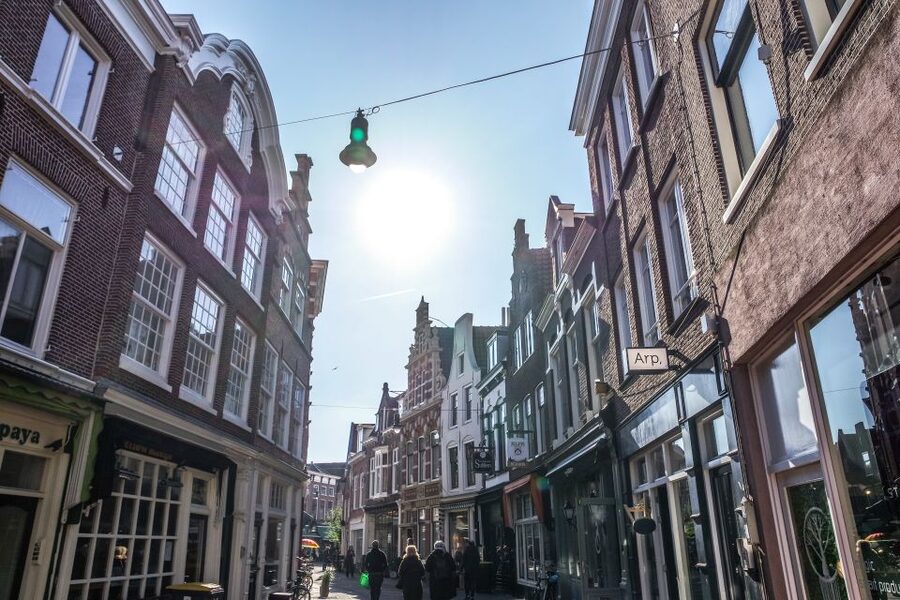
Haarlem reveals itself best on foot, where a grand church, a quiet hofje, an old city gate, and a canal-side windmill fit into one compact walk. This tour connects those sights with stories about beer, tulips, painters, printers, and the city’s more unusual characters.
I like the way the route blends famous landmarks with places you might miss on your own. I also like the personal scale: two hours and a private-group option give you room to ask questions and get tips suited to your visit. The main caution is that some stops are viewed from outside or passed by, and one local review found the tour less thorough than expected.
Key points to know before booking
- Haarlem’s central sights in one loop: The route begins and ends near Grote Markt, covering Sint Bavo Kerk, the Spaarne, Amsterdamse Poort, hofjes, and De Adriaan.
- Stories give the walk its character: You hear about Haarlem’s beer-making past, tulip traditions, and figures such as Frans Hals, Peter Teyler, Kenau Hasselaer, and Corrie ten Boom.
- A real walking tour, not a museum tour: Teylers Museum and the Ten Boom Museum are passed by rather than entered.
- The meeting point is easy to spot: Look for the guide with an orange umbrella between the Grote or Sint Bavo Kerk and the Vleeshal.
- Weather matters: The walk operates rain or shine, so comfortable shoes and a weather check are sensible.
- Good value for a first look: At $25 per person, the tour is priced as an affordable orientation, not a full visit to Haarlem’s museums and interiors.
Haarlem in two hours, with the city’s story tied together
The best part of this walk is the way it turns separate sights into one story. Haarlem is not just a pretty Dutch town with a church square and canals. Its identity comes from trade, brewing, art, printing, religion, defense, and civic pride.
Your guide begins near the center and takes you through the city’s main historical thread, from its first development in 1245 to its present-day quirks. That long time span can sound ambitious for two hours, but it gives the walk a useful shape. You are not simply stopping for photographs. You are learning why Haarlem’s streets, buildings, and institutions look the way they do.
The pace should suit most people who can comfortably walk for two hours. One review found the amount of walking just right, and that is a useful sign for anyone who wants a solid introduction without spending half a day on their feet. Still, expect a continuous city walk rather than a series of long seated explanations.
More Walking Tours in Haarlem
- The rise of Haarlem: Culture, History, Art and Architecture Walking Tour
★ 5.0 · 59 reviews - Haarlem Old Town Private Walking Tour
★ 5.0 · 24 reviews - 2 Hours Walking Tour Throughout History & Highlights of Haarlem
★ 4.5 · 18 reviews
Starting at Grote Markt and Sint Bavo Kerk
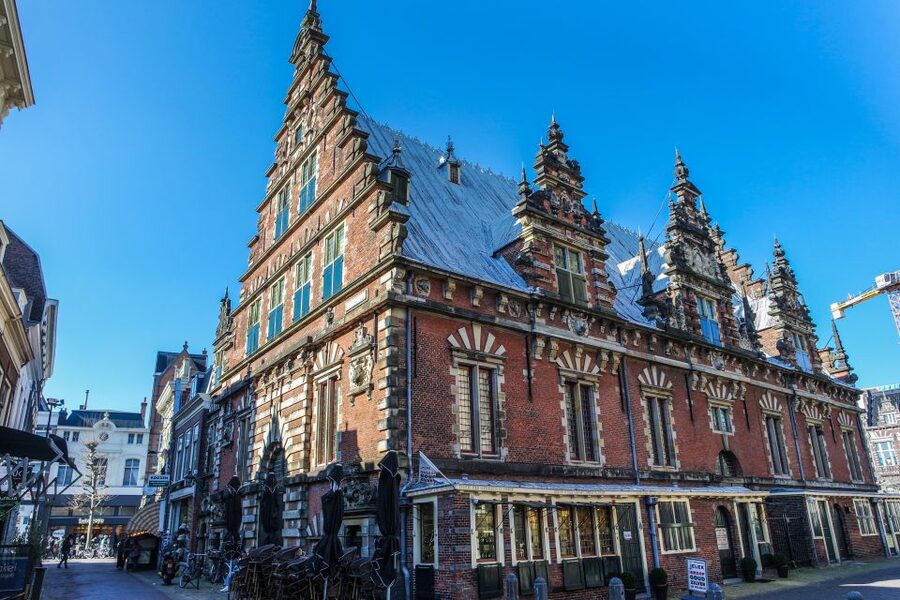
Meet between the Grote or Sint Bavo Kerk and the Vleeshal, next to the sculpture called Steekspel op ’t Haarlems Sant. The guide carries an orange umbrella, which is particularly helpful if the square is busy or the weather is poor.
Grote Markt is the right place to begin. It gives you Haarlem at a glance: civic buildings, historic façades, the church, and the open public space that has long served as the city’s social center. The guided portion here lasts about 15 minutes at the start, with another short explanation when you return near the end.
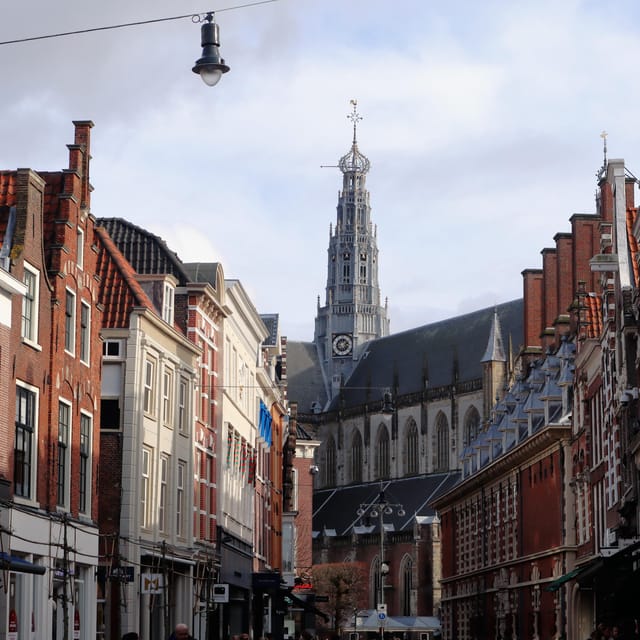
Sint Bavo Kerk is one of the tour’s major visual anchors. Even if you do not enter, its presence makes clear how much religious life shaped the city. The church also helps you get oriented, since many of the central streets lead away from this square.
A useful detail for history-minded visitors is the range of local personalities introduced during the walk. You hear about painter Frans Hals, printer Laurens Janszoon Coster, philanthropist Peter Teyler, resistance figure Kenau Hasselaer, and Corrie ten Boom. These names help keep the past human. Instead of hearing only dates and building styles, you get a sense of the people who shaped Haarlem’s public image.
Following the Spaarne and Haarlem’s working past
From the market, the route reaches the Spaarne, the waterway that gives Haarlem much of its visual appeal. The guided section here lasts around 10 minutes, enough for your guide to explain the city’s relationship with the river and point out the character of the waterfront.
I like this part because it shifts the tour from grand architecture to daily life. Water was not just a scenic feature. It helped connect Haarlem with trade and work, and it remains one of the clearest ways to understand the city’s layout.
The tour also touches on Haarlem’s beer-making traditions. That subject adds some welcome flavor to the church-and-museum material. The city’s past was not only about art and religion. Brewing and trade were part of ordinary urban life, too.
You should listen closely here. The guide’s storytelling is a major part of the experience, and the quality of the walk depends on being able to hear it. One person found it hard to follow the guide in noisy areas and wished the guide had spoken more clearly and loudly. If you are in a private group, you can solve much of that by asking the guide to pause or repeat a point. In a larger setting, stay near the guide.
Teylers Museum, seen from the outside

The route passes Teylers Museum for about 10 minutes. This is important to understand before booking: the tour does not include a museum visit.
Teylers is tied to Peter Teyler, one of the local figures discussed on the walk. Seeing the building in context gives you a reason to return later if you have time. The tour can explain its place in Haarlem’s cultural life, but it cannot cover the collections or give you an indoor visit in this two-hour format.
That limitation is not necessarily a flaw. A walking tour works well as a first orientation, especially if you want to decide which museums deserve your own time. But if your main goal is Teylers Museum, book admission separately and treat this walk as an introduction rather than a substitute.
Same base, a completely different sort of day:
- Haarlem: Sightseeing Canal Cruise through the City Center
★ 4.3 · 762 reviews - Haarlem: Sightseeing Boat Tour with Snacks and Drinks
★ 4.5 · 398 reviews - Haarlem: Guided Highlights Canal Cruise on Open Boat
★ 4.7 · 363 reviews - Haarlem: 50 minutes Boat Cruise
★ 4.5 · 272 reviews
Amsterdamse Poort and Haarlem’s old defenses
Amsterdamse Poort receives about 10 minutes of guided attention. This is one of the route’s more clearly recognizable historic structures, and it helps explain how people entered and left the old city.
The gate gives the tour a change of mood. Grote Markt and the Spaarne show Haarlem as a civic and commercial center. Amsterdamse Poort reminds you that the city also needed protection and control. Your guide can place the gate within the city’s older boundaries and connect it to Haarlem’s growth.
One point to keep in mind is that the route does not promise every major landmark in the city. A local assessment specifically wished the walk had included more points, such as an old city gate, a handsome bridge over the Spaarne, the Jopen brewery, and the former prison. Since Amsterdamse Poort is included, the comment seems to reflect a desire for an even broader route rather than a total absence of historic gates.
If you arrive expecting a complete survey of Haarlem, two hours may feel short. If you want a focused central walk, this stop does its job well.
De Koepel and the city’s less familiar side
The walk continues to De Koepel Haarlem, with about 10 minutes of guided time. This stop adds another layer to the city’s story and helps move the route beyond the standard church-and-canal circuit.
Because the tour includes places that many first-time visitors might not plan for, the route can make Haarlem feel larger and more varied than the central square suggests. You are still within a compact walking area, but the sequence of buildings and streets changes your view of the city.
This is also where the guide’s local knowledge matters most. A guide can point out what a building means, why it matters, or how it fits into Haarlem’s past. Without that context, some stops may simply look like attractive old structures.
Windmill De Adriaan beside the Spaarne
De Adriaan is passed by for about 10 minutes rather than visited inside. Its position beside the Spaarne makes it one of the easiest sights to recognize on the route, and the windmill adds the classic Dutch image many people expect from Haarlem.
The stop is especially useful for photographs and orientation. You can see how the mill relates to the water and the old city, while your guide explains its place in Haarlem’s story.
Again, keep your expectations in line with the format. You will not get a full windmill tour or a detailed mechanical explanation unless the guide has time to add it. The value here is seeing De Adriaan as part of the city, not checking off an interior visit.
Teylers Hofje and Hofje van Bakenes
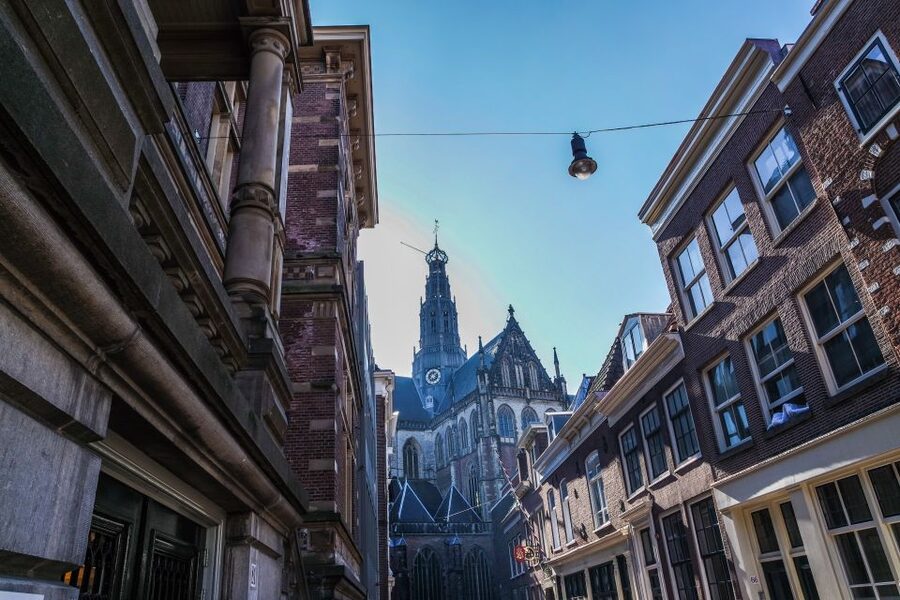
The route then turns toward Haarlem’s hofjes, including Teylers Hofje and Hofje van Bakenes. Teylers Hofje receives about five minutes of guided attention, while Hofje van Bakenes is passed by for around 10 minutes.
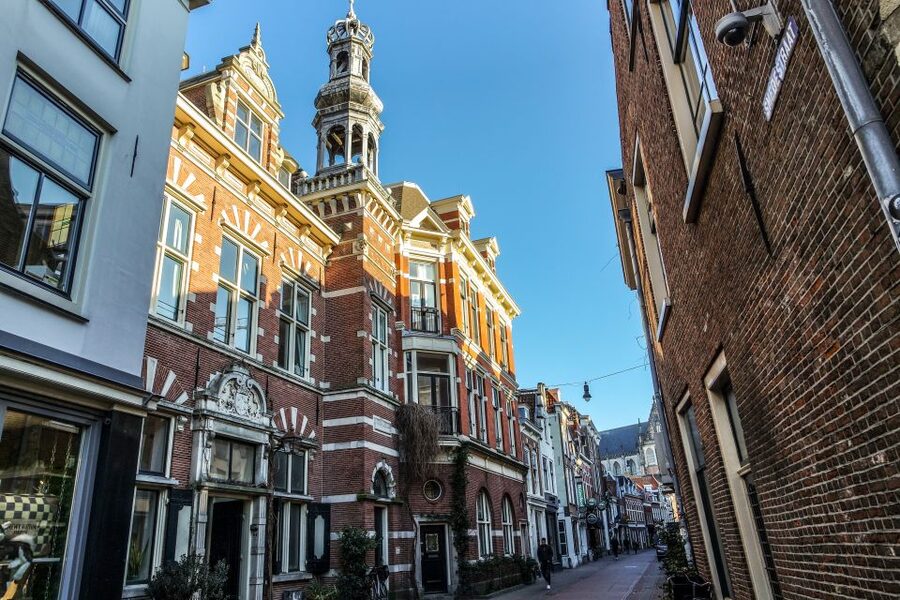
These small courtyard communities are among the most distinctive features of Haarlem. Their quiet scale contrasts with Grote Markt and the open waterfront. A hofje can look modest from the street, yet it points to an older tradition of organized housing and private charity.
This section is one of the strongest reasons to take the walk with a guide. You might pass a hofje without realizing what it is or why it matters. The tour encourages you to notice the doors, courtyards, and calm lanes that do not announce themselves with a large monument.
The route does not promise entry to every courtyard. Some are viewed from outside, and access may depend on local conditions. That is a sensible approach in residential spaces. You get the story without treating a quiet community as a public attraction.
Tulips, local figures, and a secret stop
Haarlem’s tulip traditions also enter the conversation. The flower is strongly linked with the Netherlands, but the tour places that familiar national symbol within Haarlem’s own story.
There is also a secret stop listed along the route. No details are given in advance, so you should think of it as a small surprise rather than a guaranteed major attraction. It may appeal to you if you enjoy leaving room for a guide’s local choice. If you prefer a strict schedule with every stop named, this part is less predictable.
The personalities introduced during the tour give the city extra dimension. Frans Hals connects Haarlem with painting. Laurens Janszoon Coster connects it with printing traditions. Peter Teyler connects it with science, culture, and civic generosity. Kenau Hasselaer brings a strong local historical figure into the story, while Corrie ten Boom links Haarlem to the more recent past.
You do not need to memorize these names. The point is to leave with a few human reference points that help you recognize Haarlem as a place shaped by people, not only façades.
Corrie ten Boom House, viewed on the route

The tour passes the Ten Boom Museum for about 15 minutes. Like Teylers Museum, this is an exterior stop rather than a museum visit.
Corrie ten Boom is one of the people included in the city’s story, so the stop has more weight than a quick photo opportunity. It links Haarlem’s older streets with a much more recent chapter in European history.
If the museum is a priority, plan separate time for it and check its opening information independently. The walking tour can give you setting and context, but it does not include an admission or an indoor tour.
This is a good example of the experience’s limits and strengths. You will see a wide range of places and subjects, but you will not receive a full treatment of any one museum. Think of the walk as a map for deciding where to spend more time afterward.
Returning to Grote Markt with better bearings
The route returns to Grote Markt and ends where it began at Lepelstraat 2. The final guided segment lasts about 10 minutes, which gives you a chance to connect the opening view of the square with everything you have seen.
That return is practical. You finish in the center, close to the same landmarks that helped you find the meeting point. You can then continue exploring, return to a museum, or use the guide’s local suggestions to shape the rest of your day.
The walk is conducted in English, with a live guide. Manuel led one especially well-received version, described as engaging and personable, and he made the city more meaningful for that group. Guides can vary, so I would treat Manuel’s name as useful information if you see him assigned, not as a promise that he will lead every departure.
Is $25 a fair price for this walk?
At $25 per person, the tour offers a reasonably priced way to get oriented in Haarlem. You are paying for two hours of a live guide’s time, a planned route, local stories, and the chance to ask questions. No museum admissions are included, so the price works best if you see the walk as a city introduction.
The value is strongest on a first visit. A guide can show you where the main sights are, explain the city’s background, and point out places you might otherwise miss. That can save you time later, even if you choose to return to the museums or hofjes on your own.
The value is weaker if you already know central Haarlem well or want long visits inside major attractions. You may also find the route too light if you expect every important bridge, brewery, prison, gate, and museum to receive equal attention.
A private group option can improve the experience for families or friends who want to ask many questions. It may also help with hearing the guide in noisy streets. The supplied price is per person, but no separate private-group pricing is provided, so check the total before booking.
Weather, footwear, and simple practical advice
Wear comfortable shoes. The route lasts two hours and operates rain or shine, so check the forecast before leaving and bring suitable protection.
The meeting point is specific, but the orange umbrella makes it easier to find the guide. Arrive with enough time to locate the area between Sint Bavo Kerk and the Vleeshal rather than searching at the last moment.
Do not plan to record the tour. Video and audio recording are not allowed, and alcohol and drugs are prohibited. If you want to remember a detail, take brief written notes after the guide finishes speaking.
The tour offers free cancellation up to 24 hours before departure for a full refund. You can also reserve now and pay later, which is useful when your Haarlem plans depend on weather or a changing day trip schedule.
Who should book this Haarlem walk?
I would choose this tour if you are visiting Haarlem for the first time and want a clear introduction before exploring alone. It suits people who like history told through streets and buildings, rather than spending two hours inside one museum.
It also fits visitors who want local tips and a route that includes hofjes, the Spaarne, De Adriaan, and Amsterdamse Poort. Families and private groups may appreciate the chance to ask questions at their own pace.
I would hesitate if your main goal is a detailed architectural tour, extensive museum time, or a complete list of every important sight. The route covers a lot, but some stops are brief and several are viewed from outside. If you need the guide to speak loudly in busy areas, consider a private group or stay close to the guide.
Should you book the City Highlights Walking Tour?
Book it if you want a friendly, affordable first look at Haarlem, with enough history to make the city’s streets meaningful. The mix of Grote Markt, the Spaarne, hofjes, Amsterdamse Poort, De Adriaan, tulip traditions, beer stories, and local personalities gives you a useful framework for the rest of your visit.
Skip it if you expect a full tour of Teylers Museum, the Ten Boom Museum, or De Adriaan, since these are passed by rather than entered. Also skip it if you want an exhaustive route covering every major site.
For most first-time visitors, $25 is a sensible price for two hours of orientation. Bring good shoes, dress for the weather, and treat the walk as the beginning of your Haarlem exploration rather than the entire city experience.
FAQ
Where does the Haarlem walking tour meet?
The meeting point is between the Grote or Sint Bavo Kerk and the Vleeshal, next to Steekspel op ’t Haarlems Sant. Look for the guide carrying an orange umbrella.
How long does the tour last?
The walking tour lasts two hours and begins and ends at Lepelstraat 2.
What language is the tour conducted in?
The live tour guide speaks English.
Does the tour enter Teylers Museum or the Ten Boom Museum?
No. The route passes by both museums. Museum entry is not included.
What should I bring?
Bring comfortable shoes and check the weather before leaving. The tour operates rain or shine.
Can I cancel or pay later?
Yes. You can cancel up to 24 hours in advance for a full refund, and you can reserve now and pay later.
Just added around Haarlem
- Haarlem: Personalized Private tour Highlights & History★ 4.9 · 13 reviews
- Haarlem: Self-Drive Private Electric Boat Rental★ 4.7 · 59 reviews
- Haarlem: De Adriaan Windmill Tour + Open Canal Cruise★ 4.6 · 66 reviews
- Haarlem Highlights Bike Tour★ 4.1 · 26 reviews
- Local Cheese and Wine Cruise through Haarlem★ 4.1 · 10 reviews
- BBQ on Board Haarlem Cruise★ 5.0 · 4 reviews
- Haarlem: Windmill ‘De Adriaan’ Guided Tour★ 4.7 · 197 reviews
- Haarlem Open-Boat Canal Cruise with Live Guide (Electric Boat)★ 5.0 · 233 reviews
Walking Tours, compared.
Anne Frank’s Story – Guided Walking Tour through Amsterdam
Read our review →
Life of Anne Frank and World War II Walking Tour
Read our review →
Absolutely Amsterdam – the Essential Introductory Walking Tour
Read our review →

Anne Frank Walking Tour – Guided in EN/DE/IT/ES
Read our review →

Anne Frank Walking Tour Amsterdam Including Jewish Cultural Quarter
Read our review →Browse the lists this tour appears in