
Reviewed · WALKING TOURS
The Hague : Must-See attractions Private Walking Tour
The most interesting part of this tour is how quickly The Hague’s power, art, monarchy, and political drama come together on foot. In two hours, you move from Willem of Orange and the Dutch Revolt to Vermeer, the Dutch constitution, a working royal palace, and the grisly fate of Johan de Witt.
I like the private format, since you can ask questions and shape the walk around your interests. I also like the chance to request a guide such as Dr. Elif Toposkal, whose background in history and architecture adds useful context, including visual material on an iPad. The main drawback is the price: at $88 per person, it is costly for a two-hour walk, especially if your guide does not arrange paid interior visits.
Key points to know before booking
- The route links The Hague’s top sights in a compact walk beginning and ending at Het Plein.
- You get a private guide, with no other people added to your group.
- Dr. Elif Toposkal is a strong guide request if her availability matches your date.
- The tour is best for history and architecture fans, with politics, royalty, art, and local stories at every stop.
- You may customize the walk, and the company can help arrange tickets for visits you want to add.
- The two-hour schedule is efficient but brisk, so expect guided commentary rather than long interior visits at every sight.
Why this two-hour walk works in The Hague
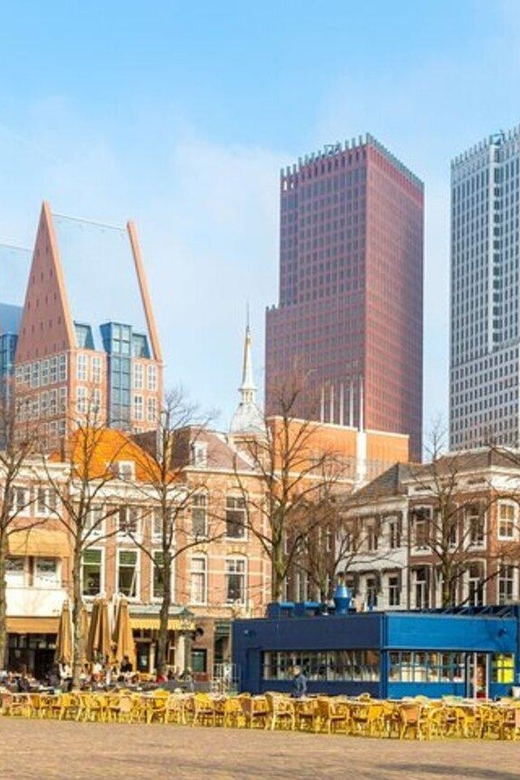
The Hague can feel less obvious than Amsterdam at first. It has no single canal district that explains the whole city. Instead, its character comes from a group of linked places: government buildings, royal residences, museums, grand avenues, churches, and monuments.
This walking tour gives those pieces a clear order. You begin at Het Plein, pass the Mauritshuis and Binnenhof, circle the Hofvijver, then head along Lange Voorhout toward Noordeinde Palace and the Grote Kerk. You finish back at Het Plein, so the route is easy to follow and useful for getting your bearings early in a stay.
I would choose this tour on a first visit if I wanted to understand why The Hague matters, not simply photograph its prettiest buildings. The guide connects the Dutch Revolt, the monarchy, parliament, the constitution, and the city’s art collections in one short outing.
The private setup matters here. The Hague’s political story includes names, dates, and competing institutions that can blur together when you explore alone. You can stop your guide to ask what still functions as government, what belongs to the royal family, and which sights are best visited later.
More Walking Tours in The Hague
- Food Walking Tour of The Hague – by Bites & Stories
★ 5.0 · 188 reviews - Centre The Hague On Foot with Wonderful Storyteller – 2hr
★ 4.4 · 175 reviews - The Hague: City Walking Tour
★ 4.5 · 156 reviews
Starting at Het Plein with Willem of Orange
Meet your guide at Het Plein, specifically at Plein 17. This square is a fitting place to begin because it introduces Willem van Oranje, often called the Father of the Fatherland, and his role in the Dutch Revolt.
The opening talk sets up the central theme of the walk: The Hague is not just a royal city or a government city. It is a place shaped by the long struggle that helped form the Netherlands as an independent state.
I like starting with a person rather than a building. Willem of Orange gives the rest of the tour a human thread, and the square makes a practical meeting point near several major sights.
Het Plein also helps you settle into the rhythm of the tour. You are not being rushed straight into a museum entrance. Instead, you begin outdoors, learn the broad story, and then move toward the buildings where that story played out.
Mauritshuis and the art of a compact royal museum
The next stop is the Mauritshuis Royal Picture Gallery. The museum is known for famous works by Johannes Vermeer, and its setting gives you a quick lesson in the connection between Dutch power, wealth, and art.
Your guide explains the building’s history and points out why the museum matters. The visit is especially useful if you have heard of the Mauritshuis but do not yet know how it fits into The Hague’s wider story.
Do not assume that the standard two-hour walk includes a full museum visit. The tour description promises guided attention at the Mauritshuis and help arranging tickets for desired visits, but it does not say that museum admission is included in the $88 price. If you want time inside the galleries, ask about tickets and timing before you book.
That distinction matters. A museum visit can easily consume much of a two-hour tour, while this route also includes several major outdoor sights. If your priority is Vermeer, you may prefer to use the walk as an introduction, then return to the Mauritshuis on your own.
Binnenhof and Ridderzaal, where national politics takes shape
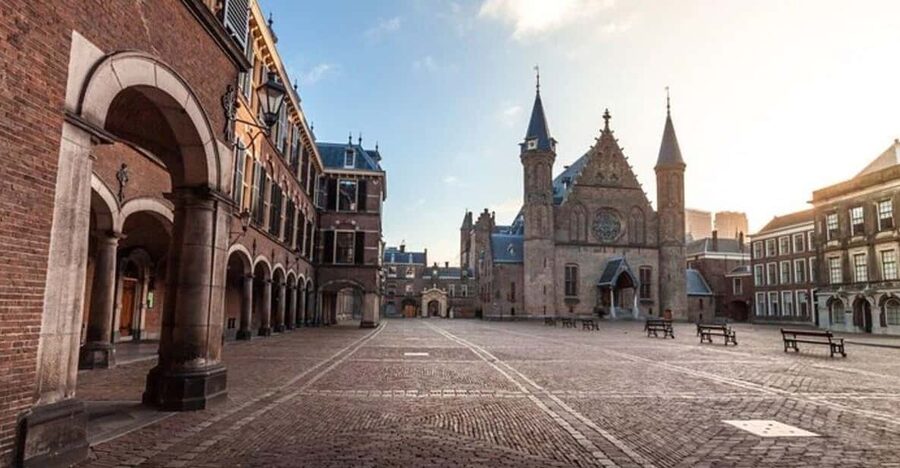
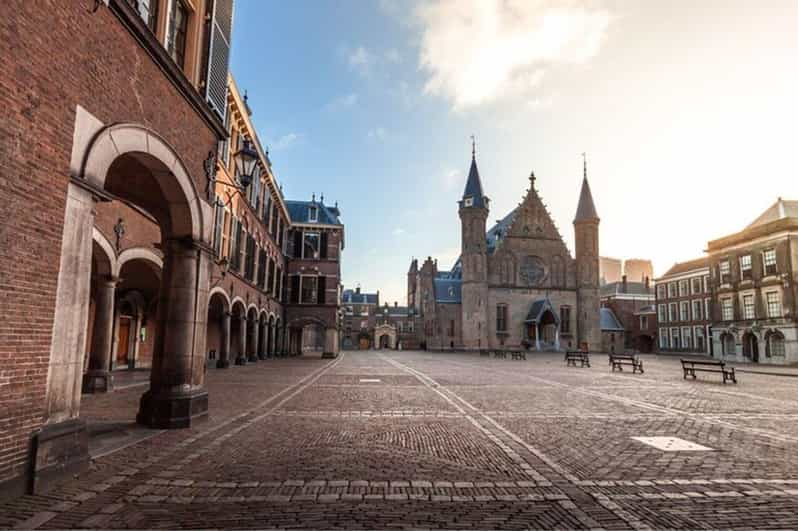
From the Mauritshuis, the route continues to the Binnenhof, the historic parliament complex, including the Ridderzaal. This is one of the tour’s most important stops because it turns abstract political history into a place you can see and understand.
You learn about the complex’s role in Dutch government and may even see ministers. The wording is suitably cautious: a minister sighting is possible, not guaranteed. Still, it adds a little live political energy to a site that can otherwise feel like an old collection of grand façades.
The Ridderzaal is especially important in the story of Dutch public life. Your guide can explain how the complex fits into the country’s political system and why The Hague, rather than Amsterdam, functions as the national seat of government.
The private format is useful here. You can ask direct questions about the Dutch parliament, royal involvement, or how the buildings are used today. A larger group would make that harder, especially if the area is busy.
Because this is a walking tour rather than a dedicated parliament tour, expect explanation and exterior sightseeing unless a separate visit has been arranged. The company can help book tickets for places you want to visit, but admission is not listed among the included services.
Same base, a completely different sort of day:
- The Hague: Mauritshuis Entrance Ticket
★ 4.7 · 2,706 reviews - The Hague: City Canal Cruise
★ 4.6 · 2,024 reviews - The Hague: Madurodam Miniature Park Entry Ticket
★ 4.6 · 1,559 reviews - The Hague: The Pier SkyView Ticket with Drink and Snack
★ 4.4 · 1,398 reviews
Hofvijver views and the Thorbecke Monument
The Hofvijver pond is next. It gives you a different view of the Binnenhof and provides one of the most recognizable city scenes on the route.
This is a good pause in the walk. After the dense political story of the parliament complex, the water opens up the view and lets you see how the historic buildings relate to one another. Your guide can point out details that are easy to miss when you simply walk past the pond.
The tour then includes the Thorbecke Monument. Johan Rudolf Thorbecke was linked to the Dutch constitution, so this stop keeps the political thread going while shifting the focus from medieval government buildings to constitutional government.
I like this pairing because the pond is visual and the monument is interpretive. One gives you a memorable setting; the other gives you a reason to think about how Dutch political life developed.
The tour is wheelchair accessible, which is helpful for anyone concerned about a city walk. Still, you should confirm the exact route and any specific building access when booking, since outdoor accessibility and interior access are not always the same thing.
Lange Voorhout, The Hague’s grand avenue
Lange Voorhout is described as The Hague’s Champs-Élysées. That comparison signals what to expect: a broad, elegant avenue lined with important buildings and a strong sense of civic ceremony.
The route passes embassies and an art museum before continuing toward Noordeinde Palace. This stretch helps explain The Hague’s polished side. It is not only a place of ministries and courtrooms. It also has diplomatic, cultural, and royal institutions close together.
I would pay attention to the change in mood here. Earlier, the route focuses on revolt and government. Along Lange Voorhout, you get architecture, international connections, and the city’s more formal public face.
The guide’s local knowledge is most useful on a street like this. A building can look impressive without telling you why it matters. Your guide can point out which places are embassies, which are cultural sites, and how the avenue fits into the city’s layout.
The pace may feel quick if you want to study every façade. Two hours is enough for an overview, but not for lingering at each building. Bring your own questions and tell the guide if architecture is your main interest.
Noordeinde Palace and the working Dutch monarchy
Noordeinde Palace is the working palace of the Dutch king. Seeing it from the outside gives you a clear link between The Hague’s government center and its royal life.
This stop is valuable because it corrects a common misunderstanding. The Hague is not simply a historic royal setting preserved for visitors. It remains connected to the working monarchy and the business of state.
Your guide can explain the palace’s place in the city and how it relates to the other royal and political sites you have already seen. Since the tour does not promise entry, plan on an exterior explanation unless you arrange something additional.
For me, this is one of the route’s most useful stops for first-time visitors. The palace is not an isolated attraction. It makes more sense after Het Plein, the Binnenhof, and the Hofvijver have established The Hague as a center of national power.
Grote Kerk and its stork
The Grote Kerk, also called the Great or St. James’ Church, adds a religious and local note to the route. It is known for the stork on top, a small detail that gives the building a memorable identity.
That stork is exactly the kind of feature a guide can make useful. Without an explanation, you might walk by a church and remember only its size. With the story attached, you have a detail that helps the building stay in your mind.
The church also gives the route another layer. You have seen art, government, monarchy, and constitutional history. Here, you get a place connected to the older civic and religious life of The Hague.
Again, the schedule seems designed for guided sightseeing rather than a long interior stop. Ask about opening arrangements if entering the church is important to you. The listed price does not include food or drinks, and no attraction admission is included in the basic package.
Johan de Witt and one of Dutch history’s darkest episodes
The final major story point is the Statue of Johan de Witt. The tour connects him with the striking fact that he was the only Dutch head of government eaten by an angry mob.
It is a grim story, but it gives the walk some bite. The Hague’s political history was not made only by calm debates, elegant palaces, and constitutional reforms. It also involved fear, public anger, and violent shifts in power.
The route information places the final stop at the Johan de Witt Scholengroep, while the experience description refers to the statue of Johan de Witt. The exact viewing point may depend on the guide’s chosen path, so ask if this monument is particularly important to you.
I like ending with Johan de Witt because it leaves you with a story rather than a list of buildings. It also reinforces the value of a local guide. A plaque may give you a name and date, but a good explanation shows why the event still matters.
What the private guide adds
The best reason to book this experience is the guide, not transportation or admission. You receive a private and customizable walk, with an English-speaking guide and no other people added to your group.
Dr. Elif Toposkal is the guide I would request if possible. Her background includes a PhD in history and architecture, and she is known for using an iPad to show historical context. That can be helpful when the modern city makes an old event hard to picture.
Other named guides include Elif and Angela, both praised for lively, informative walks. The useful takeaway is not that one guide guarantees a particular style, but that you should ask who is available and request a preferred guide when possible.
The tour also suits families. A guide has patience for questions from teenagers and can adjust the amount of detail. That is a better fit than a fixed lecture if your group includes different ages or interests.
You can ask for more architecture, politics, monarchy, art, or practical city advice. The guide also offers recommendations for other things to do in The Hague, which makes the walk more useful at the start of a visit than at the very end.
Is $88 per person good value?
At $88 per person for two hours, this is not a budget walk. For two people, the total is $176 before any food, drinks, or attraction tickets. The price works out to $44 per person per hour, so the value depends heavily on the guide and the amount of customization you use.
For a solo visitor, the cost may feel hard to justify. For a small private group, the price can make more sense because you are paying for exclusive attention and can divide the total among several people.
The strongest value comes from the historical connections. You are not merely checking off Het Plein, the Mauritshuis, Binnenhof, Hofvijver, Lange Voorhout, Noordeinde Palace, Grote Kerk, and the Johan de Witt monument. You are getting a guide to explain how those places relate.
The value is weaker if you expect long interior visits or included admission. The tour includes the walk, public transport where needed, customization, and help booking tickets, but food, drinks, and attraction tickets are not listed as included.
I would book it early in a trip, when the guide’s recommendations can shape the rest of your time in the city. If you already know The Hague well and only want a quick stroll, the price is harder to defend.
Practical details for your day
The meeting point is Het Plein, at Plein 17. The tour returns to Het Plein, which keeps the start and finish simple.
The duration is two hours, with starting times depending on availability. Wear comfortable shoes, since the experience is primarily on foot. Public transport is included as part of the walking experience, except where a selected option says otherwise.
The activity is conducted in English and is wheelchair accessible. It is offered as a private group, so tell the provider about mobility needs and your preferred focus when arranging the walk.
Cancellation is free up to 24 hours before the tour for a full refund. You can also reserve now and pay later, which gives you some flexibility while your plans are still changing.
Who should book this The Hague walking tour?
I recommend it most for first-time visitors who want a clear introduction to The Hague’s political and royal identity. It is also a good choice for anyone who prefers conversation and questions over a fixed group lecture.
History and architecture fans will get the most from it, especially if you request Dr. Elif Toposkal or another guide with a strong background in those subjects. Families with older children and teenagers may also appreciate the flexible pace and the darker Johan de Witt story.
I would be more cautious if your main goal is a long visit inside the Mauritshuis or the parliament buildings. In that case, treat this as a guided orientation and arrange separate tickets and time for the interiors.
Should you book it?
Book this tour if you want The Hague explained through its key people and institutions, not just photographed from the street. The private format, customizable route, and strong guide options make the $88 price easier to accept for a couple or small group.
Skip it if you want the cheapest possible introduction or a full museum tour with admission included. For the right visitor, though, this is an efficient way to connect Willem of Orange, Vermeer, the Dutch constitution, the monarchy, and Johan de Witt in one well-planned city walk.
FAQ
Where does the tour begin?
You meet your guide at Het Plein, at Plein 17.
How long does the walking tour last?
The tour lasts two hours.
Is the tour private?
Yes. It is a private and exclusive tour, with no other people added to your group.
What language is the tour conducted in?
The live tour guide speaks English.
Are attraction tickets included?
No attraction admission is listed as included. The tour provider can help you book tickets for visits you want to add.
Can I cancel for a full refund?
Yes. You can cancel up to 24 hours in advance for a full refund.
Just added around The Hague
- The Hague Tower Guided Tour★ 4.5 · 45 reviews
- The Hague: Powerboat Tour Scheveningen★ 4.5 · 15 reviews
- The Hague Walking Tour★ 4.5 · 16 reviews
- The Hague: Ping Pong Table Rental at a Secret Ping Pong Bar★ 4.5 · 7 reviews
- The Hague: Private Boattour up to 10 persons★ 4.9 · 37 reviews
- The Hague: Prison Gate Museum★ 4.5 · 58 reviews
- The Hague: Highlights Bike Tour★ 4.6 · 135 reviews
- The Hague: Private Custom Walking Tour With A Local Guide★ 4.5 · 13 reviews
Walking Tours, compared.
Anne Frank’s Story – Guided Walking Tour through Amsterdam
Read our review →
Life of Anne Frank and World War II Walking Tour
Read our review →
Absolutely Amsterdam – the Essential Introductory Walking Tour
Read our review →

Anne Frank Walking Tour – Guided in EN/DE/IT/ES
Read our review →

Anne Frank Walking Tour Amsterdam Including Jewish Cultural Quarter
Read our review →Browse the lists this tour appears in