
Reviewed · WWII HISTORY TOURS
Amsterdam in World War Two Cycle Tour
Amsterdam’s WWII story is written into ordinary streets, apartment blocks, school buildings, and squares. This small-group bicycle tour takes you through Amsterdam South, far from the worst crowds of the city center, and connects today’s calm neighborhoods with raids, resistance, deportation, and liberation.
I especially like the use of wartime photographs at the exact places you visit. I also like the six-person maximum, which gives Rudy or Peter room to explain difficult subjects and answer questions. The main consideration is practical: you need to bring a bike, and the subject matter is often grim rather than light sightseeing.
Key details that shape the ride
- Follow Anne Frank’s Amsterdam before the Secret Annex: See Merwedeplein, the Frank family home, the bookstore where Otto Frank bought Anne’s diary, and the nearby bar linked to musician Lex van Weren.
- Use wartime photos as visual evidence: Present-day streets become easier to understand when you compare them with images from the occupation.
- Ride through quieter Amsterdam South: You cover more ground than on foot and reach places that feel removed from the usual canal belt.
- Keep the group very small: A maximum of six riders makes it easier to hear the guide and pause at narrow or busy streets.
- Meet a guide with local ties: Rudy was born and raised in the area, and his family stories add a personal layer to the historical account.
- Expect a serious, well-paced outing: The route covers arrests, Nazi administration, resistance, retaliation, deportation, and the tense days of liberation.
Why this tour belongs in a WWII-focused Amsterdam visit
Many Amsterdam visitors go straight to the Anne Frank House, which is understandable. But Anne Frank’s story did not begin in the Secret Annex, and this bicycle route helps place her family in the city they knew before going into hiding.
You begin near the southern neighborhoods where the Frank family lived. From there, the ride links Jewish persecution with the Dutch resistance and the German occupation machine. The result is not a general city bike tour with a few wartime facts added. The entire route is built around the local story of 1940 to 1945.
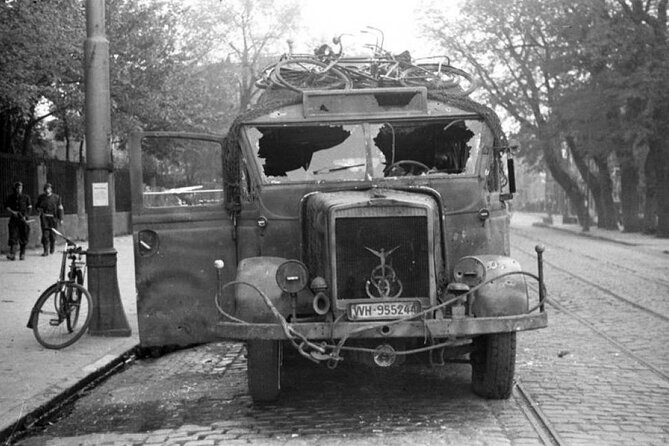
That focus matters. You are not only hearing dates and names. You are stopping outside homes, offices, schools, and squares where events took place. A quiet residential corner can carry more weight when you see a wartime photograph of the same address filled with German officials, police, or arrested Jewish residents.
Rudy is the principal guide named in the tour information, with Peter also leading some outings. Rudy grew up in these neighborhoods and is described as a history professor. That combination is useful here. You get the broad political story, but also a sense of how the streets changed during and after the war.
The group limit of six is one of the strongest features. WWII tours work best when the guide can point to a building, show a photograph, and give everyone time to look. With a large group, that can become a rushed lecture beside a cycle path. Here, the small format should feel more like a guided conversation.
More Bike Tours in Amsterdam
- Amsterdam: Guided Bike Tour City Centre in EN/DE/FR/ES
★ 4.7 · 4,187 reviews - Countryside Bike Tour from Amsterdam: Cheese, Clogs & a Windmill
★ 5.0 · 1,485 reviews - Amsterdam: Hidden Gems & Highlights Guided Bike Tour
★ 4.8 · 1,404 reviews
Starting at Victorieplein and the June 1943 raid
The historical route begins at Victorieplein, once called Daniël Willinkplein. The square is linked to the major raid of June 20, 1943, when Jewish residents were arrested in large numbers.
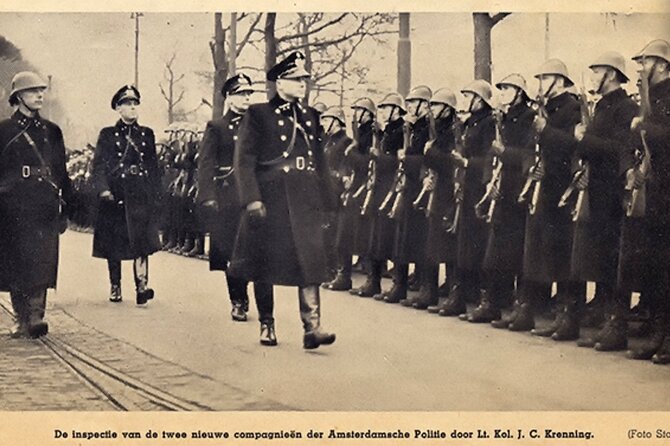
The Nazi authorities used Dutch police units and police volunteers connected with the Dutch National Socialist Movement to carry out the arrests. Many of those detained were taken to Olympiaplein for registration before being sent to Westerbork concentration camp in the east of the Netherlands.
This opening gives you an immediate sense of the tour’s approach. The guide is not presenting the occupation as something that happened only in government buildings or battle zones. The story begins in a normal city square, where police cooperation helped turn persecution into an organized process.
You should expect the tone to be direct and somber. This is not a casual sightseeing ride with WWII as background decoration.
Merwedeplein, Anne Frank’s former home, and a diary purchase
At Merwedeplein 37-II, the Frank family lived before going into hiding. The address is on the third floor by American counting, and a statue of Anne Frank now marks the square.
In the summer of 1942, Otto Frank moved his family and several acquaintances to the Secret Annex on Prinsengracht, where his company was located. Seeing the earlier family home helps you understand Anne Frank as a child who lived in a real neighborhood, not only as the author associated with one famous building.
The nearby bookstore on Waalstraat is another unusually specific stop. Jimmink is still active, and Otto Frank bought the first edition of Anne’s diary there for his daughter. The first Dutch edition, titled Het Achterhuis, was published by Contact in 1947.
I find this one of the most valuable details on the route because it connects the private family story with the later publication of the diary. You are not simply stopping at a statue. You are seeing the local setting around the family’s life and the place where Otto bought the book that Anne had wanted.
Waalstraat and the story of Lex van Weren
Across from Merwedeplein, Waalstraat 48 now houses Café Blek. During the war it was the Tilex Bar, named for Tilly and Lex van Weren.
Lex van Weren survived Auschwitz because he was forced to play his trumpet at executions. It is a disturbing story, and the stop shows how survival during the Nazi period could depend on a person’s skill being exploited by the people holding him prisoner.
This is the kind of detail that makes a neighborhood tour worthwhile. It is not a famous monument or a major museum display. It is an address with an earlier identity, and the guide uses it to tell a personal story that could easily be missed.
More WWII Tours in Amsterdam
- Amsterdam: Life of Anne Frank and World War II Walking Tour
★ 4.8 · 10,467 reviews - Amsterdam: Dutch WWII Resistance Museum Entry Ticket
★ 4.7 · 951 reviews - Small Group Tour to Nazi WWII concentration camp from Amsterdam
★ 5.0 · 112 reviews - Amsterdam: Anna Frank and World War II History Walking Tour
★ 4.8 · 86 reviews
Cornelis Troostplein and the Dutch police role
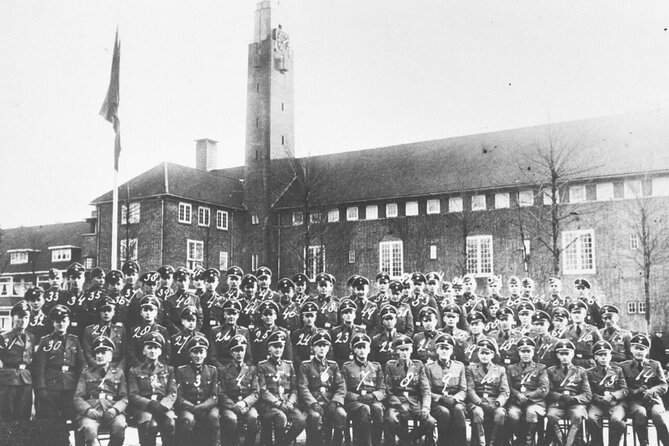
At Cornelis Troostplein 23, the building once housed the PBA barracks, the Police Battalion Amsterdam. Before the war, the Catholic complex had two convents and a school and was associated with the idea of a peace parish.
In the spring of 1942, SS officer Rauter inspected the police battalion and met Heinrich Himmler at Museumplein. The stop makes clear that Nazi control depended not only on German soldiers. Dutch police units and local collaborators also played a role in enforcing occupation policies.
That context is important if you want more than a simple good-versus-bad story. Amsterdam’s wartime history includes German command, Dutch cooperation, Jewish resistance, non-Jewish resistance, and ordinary people caught between fear and moral choice.
Museumplein, German offices, and the wartime stronghold
The Germans transformed Museumplein into a military and administrative stronghold. Facing the Concertgebouw, the buildings on the left housed German offices. The former United States consulate became the Zentralstelle für Jüdische Auswanderung, the central office for so-called Jewish emigration.
That name was a bureaucratic cover for persecution and deportation. Nearby were the Ortskommandantur, or town command, and the Feldgendarmerie, the German military police. Other buildings held Nazi Party offices and related services.
The open square in front of these buildings, known as the IJsclubterrein, was fitted with bunkers and anti-aircraft batteries. The Amsterdam NSB headquarters was next to the Concertgebouw. After the war, the bunkers were blown up.
This is a good place to use the old photographs. Museumplein can look open and peaceful today, so it helps to see how barriers, weapons, uniforms, and military buildings altered its purpose. You also get a useful reminder that occupation was managed through offices and paperwork as much as through visible force.
A short break at Roelof Hartplein
The tour pauses at Café Wildschut on Roelof Hartplein for about 10 minutes. This is the scheduled coffee and restroom stop, with no admission charge.
The break is well placed. By this point, you have covered several serious stops, and a short pause gives you time to reset before the route turns more directly toward resistance activity and retaliation.
Because the full outing lasts roughly two hours and 30 minutes to three hours and 10 minutes, this is not a long rest period. Still, it is useful to know that the tour is not one continuous ride without a planned stop.
Resistance photography on Roelof Hartstraat
Near the library building on Roelof Hartstraat, a former photo shop served as a resistance workplace. The shop was used to develop photographs, including images by resistance photographer Charles Breijer.
Those photographs documented the first roundup of Jews in Amsterdam by the SD, the Sicherheitsdienst, and the Gestapo, along with German order police. The stop adds an important visual side to the tour. Resistance was not only about armed attacks or secret messages. Recording what was happening could also be dangerous and valuable.
You may find this part especially meaningful if you enjoy photography, documentary evidence, or the history of how information moved under occupation. The guide’s archive photographs help connect the shop’s earlier function with the streets around it.
A small monument nearby remembers Jewish people taken from the neighborhood. The monument is modest, and that is part of the point. You pass through an everyday residential area where a small marker carries the memory of people removed from their homes.
Beethovenstraat, Apollolaan, and Nazi retaliation
At the corner of Beethovenstraat and Apollolaan, you stop near number 6, where SS officer and SD-Gestapo agent Herbert Oelschlägel was executed by a Dutch resistance member in late October 1944.
The German response was brutal. Two houses were burned, and 29 resistance fighters were executed. Since many house numbers remain the same as during the war, the guide can place the event with unusual precision.
This is one of the route’s strongest stops because it shows how resistance and retaliation affected people who lived close to the target. A single act against an occupation official could bring collective punishment to homes and prisoners.
The story also helps explain why resistance work was so dangerous. Courage did not guarantee a clean victory. It could bring immediate harm to families, neighbors, and fellow resistance workers.
Euterpestraat and Gerrit van der Veen
The street now known by another name was once Euterpestraat. It is associated with Gerrit van der Veen, leader of an important Dutch resistance group.
The stop is brief in the written itinerary, but its value comes from how it fits the larger route. You have already seen the machinery of German administration and the consequences of police cooperation. Here, the guide shifts attention to the organized Dutch resistance that challenged that system.
Names can blur during a history tour, especially when streets have changed. The old street name helps you picture the wartime city more accurately and gives the resistance story a physical place.
Memlingstraat and the offices behind Jewish deportation
At the corner of Memlingstraat and Rubensstraat, two important Nazi oppression offices once operated. One was the Amsterdam SD headquarters, or SD Aussenstelle, under Willy Lages. The other was the Hausraterfassungsstelle, which catalogued and stole the possessions of deported Jews.
The second office was part of the Zentralstelle für Jüdische Auswanderung. Its leader was Henneicke, a Dutch collaborator. The detail about confiscated household goods is important because deportation did not end with removal. Homes and possessions were processed and taken as part of the same system.
In November 1944, the resistance sent a secret radio request to the Royal Air Force asking it to attack the SD-Gestapo headquarters and the Hausraterfassungsstelle. Destroying files was the main aim. Group Captain Denys Gillam led the attack with 149 Typhoon Wing.
A resistance safehouse stood on the corner of Rubensstraat and Gerrit van der Veenstraat. A Stolperstein, or stumbling stone, marks the address. In June 1944, a female informant betrayed the safehouse to the SD-Gestapo.
This section may be the densest part of the tour. You are dealing with several offices, names, forms of resistance, and layers of betrayal. Rudy’s photographs and explanations should help, but you will get more from it if you accept that the route is a serious history lesson rather than a quick highlight reel.
Olympiaplein and the registration of arrested Jews
At Olympiaplein and Parnassusweg, Jewish people arrested during the June 1943 raid were registered at the sports complex. The SD and Gestapo carried out the registration with help from Jewish camp police sent from Westerbork.
The location is striking because a sports square is an ordinary public space. The history forces you to picture it being used as a holding and registration area for people who had just been taken from their homes.
The route repeatedly makes this contrast between normal city life and wartime cruelty. That is one reason cycling works well here. You move through active neighborhoods, then stop beside a monument or building and consider what happened at that exact place.
The Amsterdam Lyceum and the Luftwaffe
At Valeriusplein, the Amsterdam Lyceum served as Luftwaffe headquarters near the end of the occupation.
A school building used for military command is another example of how the occupation changed familiar civic spaces. The guide’s wartime images should help you compare the school as it appears now with its role during the final period of German control.
Queen Emma, quiet defiance, and the last shootings
At the statue of Queen Emma on Emmalaan and Prins Hendriklaan, people placed flowers in the summer of 1940 as an act of defiance against the German occupiers.
The gesture was simple, but its meaning was clear. The tour does a good job of showing that resistance could take many forms, from clandestine photography and safehouses to public symbols and small acts of refusal.
Charles Breijer photographed a guard at the Kriegsmarine headquarters in 1944 from this area. The photograph connects back to the earlier resistance photography stop and gives you another example of how carefully images had to be made during the occupation.
The final historical stop concerns May 7, 1945, when Germany surrendered. Frustrated German troops and resistance fighters created dangerous conditions, and a monument marks victims of one of the shootings on the last day.
After this point, the guide takes you through Vondelpark toward Leidseplein, where the outing began. The meeting information gives Tesselschadestraat 1 as the start and says the activity ends back at the meeting point. Since the detailed route also identifies Victorieplein as the historical starting point, I would confirm the exact cycling departure point when booking.
Price, timing, and who gets the best value
At $66.09 per person, this is not the cheapest way to see Amsterdam. The value comes from the small group, the specialist route, the guide’s local connection, the archive photographs, and the amount of ground covered in roughly three hours.
You are paying for interpretation rather than a bicycle rental or a general city orientation. If you already have a bike and want a focused WWII experience outside the central tourist circuit, the price is reasonable. If you are mainly looking for canals, architecture, or a relaxed ride, a standard city cycling tour may serve you better.
The tour is offered in English and starts at 11 a.m. Confirmation arrives at booking, and most people can participate. Free cancellation is available until 24 hours before the start time. The tour is often booked about 11 days ahead, so I would not leave it until the last morning of a short Amsterdam visit.
You should be comfortable cycling for two and a half to just over three hours, with stops for talks and one short café break. The information specifically advises you to bring your bike. The experience is best for adults and older teenagers with a real interest in WWII, Dutch resistance, Anne Frank’s early life, and the moral choices of occupation.
Should you book this Amsterdam WWII bike tour?
Book it if you want local history tied to exact addresses, prefer a small group, and are happy to ride beyond the center. Rudy’s personal connection to Amsterdam South, his family stories, and the before-and-after photos give the tour a human scale that a bus route cannot easily match.
Skip it if you want a light introduction to Amsterdam, dislike cycling, or need a fully flexible schedule. The route deals openly with arrest, deportation, execution, collaboration, and retaliation.
For the right reader, this is one of the better ways to understand how WWII shaped Amsterdam beyond the famous Anne Frank House. Bring your bike, allow a little over three hours, and prepare to look twice at streets that first seem completely ordinary.
FAQ
Where does the Amsterdam WWII Cycle Tour start?
The meeting point is listed as Tesselschadestraat 1, 1054 ET Amsterdam, with an 11 a.m. start. The historical route begins at Victorieplein, so confirm the exact cycling departure point when booking.
How long does the tour last?
The tour takes approximately two hours and 30 minutes to three hours and 10 minutes, including the scheduled stops.
How many people can join the tour?
The maximum group size is six people.
Is the tour offered in English?
Yes. The experience is offered in English.
Do I need to bring a bicycle?
Yes. The tour information advises you to bring your bike.
What is the cancellation policy?
You can cancel at least 24 hours before the local start time for a full refund. Cancellations or changes made less than 24 hours before the start are not accepted for a refund.
Just added around Amsterdam
- Private sightseeing tour to Bruges and chocolate from Amsterdam★ 5.0 · 11 reviews
- Amsterdam: Rijksmuseum (Private Tour & Priority Access)★ 5.0 · 27 reviews
- Amsterdam: Private Romantic Evening Canal Cruise + Bubbles/Snacks★ 5.0 · 46 reviews
- Amsterdam Private Shopping Experience★ 5.0 · 7 reviews
- Rijksmuseum Amsterdam Private Guided Tour★ 5.0 · 57 reviews
- Amsterdam Rijksmuseum PRIVATE TOUR with a Local Private Guide★ 5.0 · 159 reviews
- Private Photo Session in Amsterdam★ 5.0 · 15 reviews
- Private One way Transfer Amsterdam Airport to Amsterdam★ 3.5 · 42 reviews
WWII History Tours, compared.

Life of Anne Frank and World War II Walking Tour
Read our review →
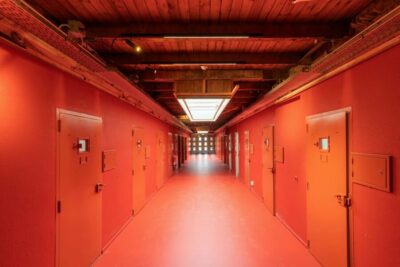
Oranjehotel World War II Prison Entrance Ticket
Read our review →
Rotterdam Walk: Hilights, Gems, Architecture & WWII | 2 or 3hrs
Read our review →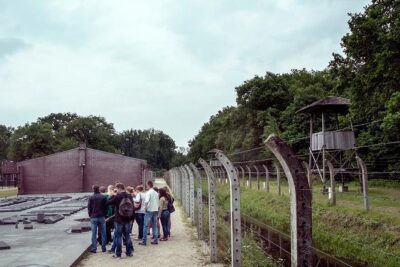
Small Group Tour to Nazi WWII concentration camp from Amsterdam
Read our review →
Anna Frank and World War II History Walking Tour
Read our review →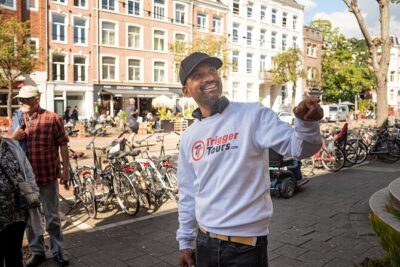
Anne Frank and World War II Walking Tour (TOP RATED)
Read our review →
Browse the lists this tour appears in