
Reviewed · WALKING TOURS
Absolutely Amsterdam – the Essential Introductory Walking Tour
Amsterdam reveals itself best at street level, where canal houses lean over the water, bicycles cut across your path, and centuries of trade, tolerance, faith, and trouble sit side by side. This tour takes you through that story in about two and a half hours, from the old harbor to the Royal Palace.
I like the small maximum of 15 people, which should make it easier to hear the guide and ask questions. I also like the range of subjects: canals and architecture sit alongside prostitution, drug policy, the Jewish Quarter, colonial trade, and Dutch cycling. The main drawback is that you mostly view major sights from outside, and the subject matter can move quickly.
Key points at a glance
- A strong first look at central Amsterdam: You cover Damrak, Chinatown, Waterlooplein, the Amstel, Oudemanhuispoort, and Dam Square in one walk.
- History without a polished gloss: The tour addresses the darker side of the Golden Age, the destruction of the Jewish Quarter, and the modern challenges of the Red Light District.
- A very low starting price: The listed cost is $5.93 per person, with the option to tip according to the value you feel you received.
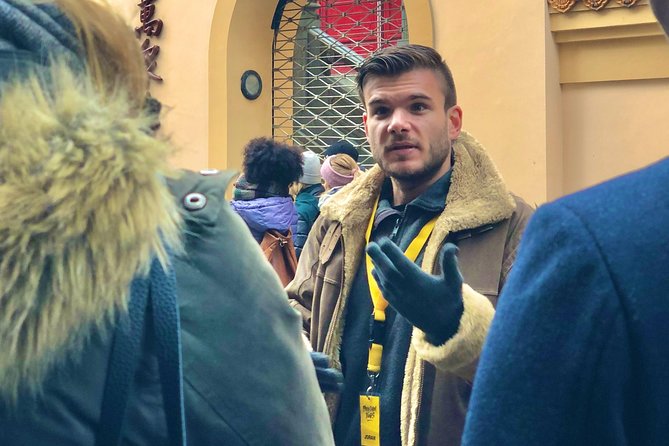
- Guides make a big difference: Jaap, Raymond, Sergio, David, Fernando, Roman, and others are noted for humor, local insight, clear storytelling, and useful suggestions for the rest of your stay.
- Comfortable shoes matter: The pace is manageable, but you cover much of the old center on foot, often among bicycles and busy streets.
- Paid interiors are not part of the visit: You discuss places such as Our Lord in the Attic Museum and the Royal Palace, but admission is not included.
Why this is a smart first walk in Amsterdam
I would use this tour near the start of a visit because it gives you a map in your head. The route connects the old harbor, central squares, canals, former religious spaces, the Jewish Quarter, and the royal center. Afterward, you can decide which places deserve a longer visit.
The tour also gives you more than postcard Amsterdam. You hear why the city grew around water and finance, how Catholic worship survived after the Reformation, why coffeeshops became part of Dutch policy, and how the Dutch East India Company helped shape modern capitalism. These are big subjects, but the walking format keeps them tied to actual streets and buildings.
The price makes this an easy choice for budget-minded visitors. At $5.93, you are paying very little for a live introduction, though the model invites you to tip as much as you like. I would judge the value by the guide you receive and by how useful the walk feels to you, rather than treating the posted price as the full measure of the experience.
Guides vary. Jaap is described as funny and strong on Dutch and Amsterdam history. Raymond is a lifelong local who keeps the pace easy and brings the group together. Sergio is praised for passion, humor, and practical help. David is energetic, and Fernando is especially useful if you want ideas for places to visit later. Roman adds Dutch food knowledge to the history.
More Walking Tours in Amsterdam
- Anne Frank’s Story – Guided Walking Tour through Amsterdam
★ 5.0 · 11,619 reviews - Amsterdam: Life of Anne Frank and World War II Walking Tour
★ 4.8 · 10,467 reviews - Amsterdam: Anne Frank Guided Small Group Walking Tour
★ 4.8 · 2,722 reviews
Beurs van Berlage and the birth of Amsterdam
The walk begins at Freedam Tours, Beursplein 5, in front of the Beurs van Berlage. This is a useful starting point because it puts Amsterdam’s growth story in a clear setting.
The exchange buildings were built where the Amstel River once flowed. Here, you learn how water shaped the city and how finance helped it grow from a settlement into a major commercial center. I like this opening because it avoids treating Amsterdam as only a collection of pretty canals. You begin with the forces that made the city wealthy and influential.
You spend about 20 minutes here. There is no admission charge for the stop, and the guide can focus on the buildings, the site, and the city’s beginnings without rushing from one attraction to another.
Damrak, the old harbor, and the Red Light District
From Beursplein, the route moves toward Damrak, the old harbor. This is one of the more complicated parts of the walk because it brings together religion, commerce, prostitution, and modern urban policy.
You discuss the origins of the Red Light District and the role of the Church. The guide explains how the holy and the profane have long operated close together, sometimes even in ways that helped both sides make money. That theme is central to Amsterdam, where tolerance has often meant practical compromise rather than simple approval.
The discussion also covers prostitution in the 20th and 21st centuries, including why it became a legal profession and how the neighborhood has changed. You hear about current challenges too, which keeps the stop from becoming a collection of sensational stories.
This section lasts about 15 minutes. Expect busy streets and plenty of distractions. You may need to position yourself carefully to hear the guide, especially at crowded times. Still, the location gives the discussion weight. You are not hearing an abstract lecture about the Red Light District. You are standing in the old harbor area where these changes took place.
Our Lord in the Attic and practical religious tolerance
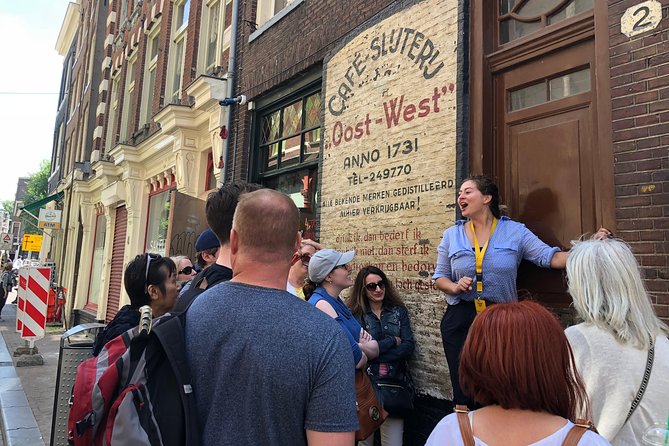
At Our Lord in the Attic Museum, you discuss how Catholic worship continued after Catholicism became illegal in the 17th century. The key idea is tolerance under strict and sometimes peculiar conditions.
You do not enter the hidden church on this tour. You see the building from outside, and the guide uses pictures of the interior to explain what is inside. That is important to know before booking. If you want to explore the museum properly, you will need a separate visit and an admission ticket.
I find this stop valuable because it connects Amsterdam’s past with a question that still matters: how does a society allow a belief or practice that it does not officially support? The guide draws a line between the arrangements of the 17th century and how tolerance works today.
Same base, a completely different sort of day:
- Amsterdam: Van Gogh Museum Ticket
★ 4.7 · 52,054 reviews - Amsterdam Classic Saloon Boat Cruise with Drinks and Cheese
★ 5.0 · 31,825 reviews - Amsterdam Luxury Canal Cruise + Unlimited Drinks & Bites option
★ 5.0 · 30,518 reviews - Amsterdam: Heineken Experience Ticket
★ 4.6 · 30,055 reviews
Chinatown and the story behind coffeeshops
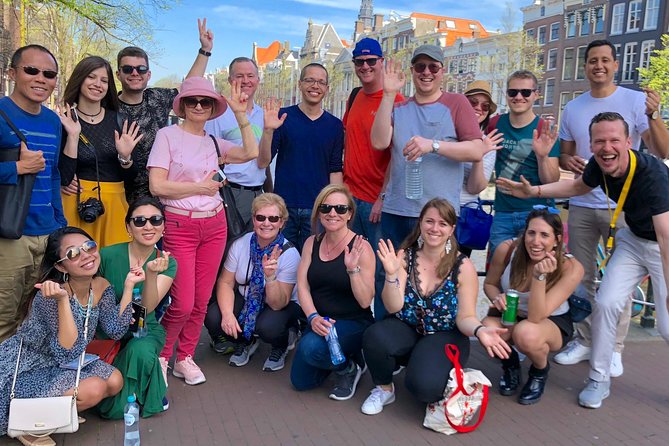
The Chinatown stop turns to Dutch drug policy. You learn how this district was viewed as a no-go area in the 1970s and how that helped spark the development of coffeeshops devoted to selling marijuana.
This is another place where the walk gives context instead of simply pointing out a famous Amsterdam institution. You hear about policy, neighborhood change, and the reasons behind a system that many people know only through stereotypes.
The stop lasts about 15 minutes and is free to visit. I would listen closely here, since Dutch drug policy is easy to misunderstand. The tour discusses how coffeeshops emerged in a particular social and political setting, not as a random feature added for visitors.
The Waag and Rembrandt’s early breakthrough
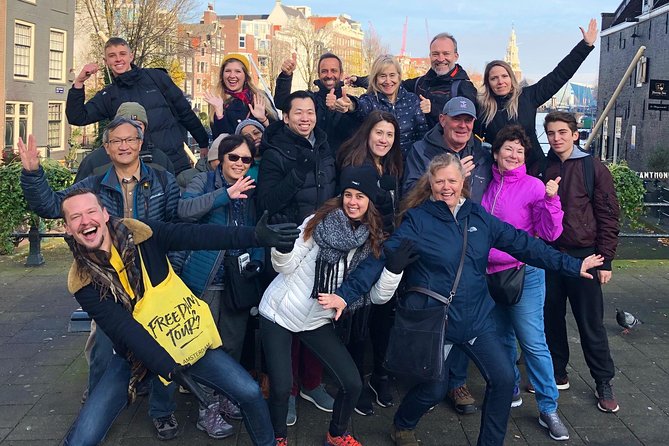
At the Waag, the focus shifts to art. You learn where Rembrandt painted his first major work and how it changed portrait painting. The guide brings a copy of the painting and points out details that are hard to appreciate from a quick glance.
This is a good change of pace after the more serious discussions of prostitution, religion, and drug policy. The Waag itself also gives you another layer of Amsterdam’s built environment, with a history tied to the city’s public and commercial life.
The stop is about 10 minutes. Admission is not included, so treat it as an exterior discussion rather than a museum visit. The copy of the painting is a useful touch because it gives the guide something concrete to show while explaining the artwork.
Oostindisch Huis and the cost of the Golden Age
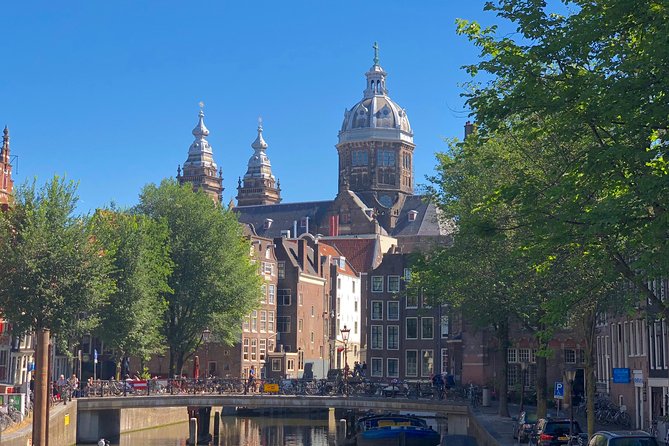
Oostindisch Huis offers one of the most important historical stops on the route. On weekdays, you can access a striking 17th-century courtyard inside the building. The guide explains how Amsterdam became the center of a global trading empire and how the Dutch East India Company helped make the city one of the richest places on earth during the Golden Age.
You also hear about the company’s role as the first and largest corporation in human history, and how its methods helped shape modern capitalism. This is not presented as a clean success story. The discussion includes the darker legacy of the period, which is essential if you want more than a celebration of Amsterdam’s wealth.
The weekday detail matters. The courtyard is only accessible during the week, so you may get a different experience depending on your tour day. The stop itself is free, and it lasts about 15 minutes.
I especially value this part because the building gives you a physical setting for a major shift in world economics. You are not simply told that Amsterdam grew wealthy through trade. You are shown where decisions were made and asked to consider who paid the price.
Waterlooplein and the Jewish Quarter during the war
At Waterlooplein Market, the tour reaches Amsterdam’s former Jewish Quarter. This is one of the most serious sections of the route.
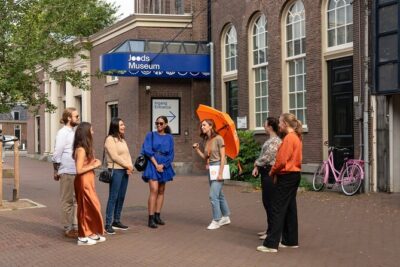
You learn about the market as Amsterdam’s oldest and about the Jewish community that once lived in the area. The guide explains how the quarter was almost completely destroyed by the end of the Second World War, the impact of the Nazi occupation, and the hunger winter that followed.
The discussion also addresses an uncomfortable point about who caused the destruction and how local people tried to survive. The tone here is not light, and it should not be. Amsterdam was a place of refuge for persecuted Jewish communities from across Europe, yet the war brought catastrophic loss.
You spend about 15 minutes at the stop. I would not expect every detail of this history to fit into one short visit. What the tour can do is give you enough context to approach Amsterdam’s Jewish history with care, then return later to museums and memorials if you want more time.
Canals, leaning houses, hooks, and open curtains
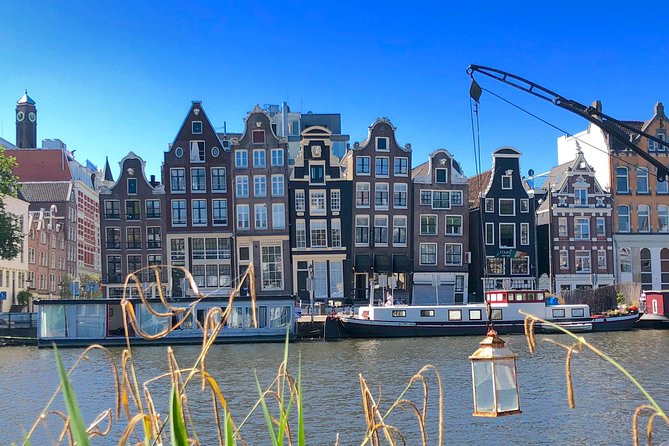
At the Amstel, or at another canal if weather or the guide requires a change, the subject becomes everyday Amsterdam. You learn why the city has canals and why the canal houses are so narrow.
The guide also explains why many houses lean, which parts of that leaning are intentional, and why buildings have hooks near the roof. The open curtains of Dutch homes get attention too. These details may look small, but they help you read the city as you walk through it.
This is one of the most useful sections for first-time visitors. Amsterdam’s architecture can seem charming but strange until someone explains the practical reasons behind it. I like the way this stop turns familiar postcard views into clues about housing, trade, construction, and daily life.
Oudemanhuispoort and Amsterdam’s bicycle culture
Oudemanhuispoort is a former monastery that became a hospital and now forms part of the University of Amsterdam. It is also easy to miss, which makes it a rewarding place to pause.
Here the guide explains Dutch bike culture, including why there are more bicycles than people and why so many Amsterdam bikes look plain, old, or even ugly. The point is practical: in a city where bikes are everyday transport, appearance matters less than function.
You may also learn to pay closer attention to the street around you. One guide was praised for explaining the city well while noting that dodging bicycles is part of doing almost anything in Amsterdam. That is sound advice. Keep your eyes up, stay out of bike lanes, and do not stop in the middle of a cycling route for a photograph.
The Royal Palace and Dam Square finish
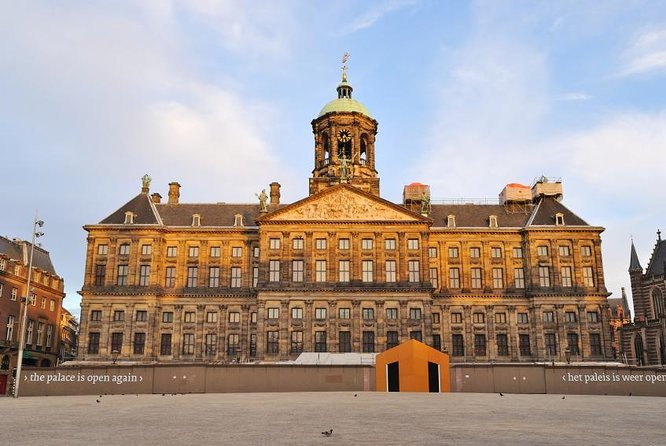
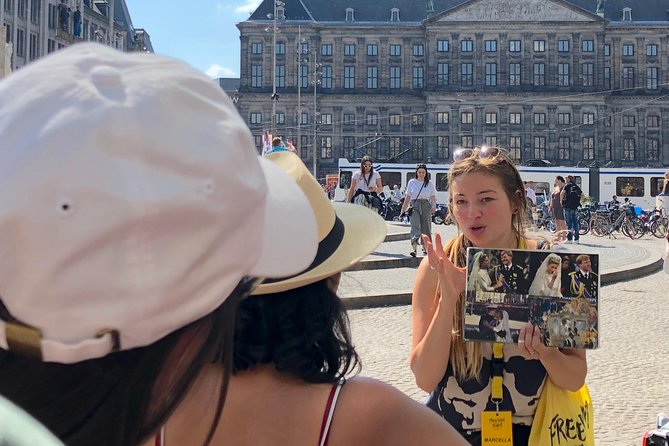
The final major stop is the Royal Palace Amsterdam on Dam Square. You learn how the Netherlands moved from a republic to a monarchy and get an introduction to the current royal family through photographs and stories about recent royal life.
The tour ends at Dam Square, near the palace. The itinerary lists the activity as ending back at the meeting point, so confirm the precise end arrangement when you book, but Dam Square is the clear final area described for the walk.
The palace stop lasts about 15 minutes. Admission is not included, so you should not expect an interior visit as part of this experience. That is fine for an introductory walk. You get the political story and a chance to see the building, then you can decide if you want to return for a paid visit.
Pace, group size, language, and comfort
The tour is offered in English and has a maximum of 15 people. That is a useful size for city streets. It should be more personal than a large coach-style group while still giving the guide enough energy for conversation.
The total time is about two hours and 30 minutes, though several sections are listed at 10 or 15 minutes. You cover plenty of ground, but the pace is described as easy and manageable. I would still wear good walking shoes and carry water.
Amsterdam’s streets bring a few practical challenges. Bicycles move quickly, crowds can fill the central lanes, and weather can affect where the guide stops. The route is outdoors for most of its length, so bring suitable clothing for the forecast.
The tour is near public transportation, service animals are allowed, and most people can participate. No special mobility details are supplied, so if you have specific access needs, ask before booking rather than assuming every narrow street or passage will be easy.
Who will get the most from this walk
I would recommend it most strongly to first-time visitors who want a broad introduction before choosing individual museums and neighborhoods. It is also useful for people who have visited Amsterdam before but want more context for places they have already seen.
This suits you if you enjoy:
- History linked to real buildings and streets
- Guides who use humor and visual aids
- A mix of famous sights and difficult subjects
- A low-cost way to get your bearings
- Practical suggestions for the rest of your stay
It may suit you less if you want long interior visits, a slow photography walk, or a narrow focus on art, canals, or architecture. You will see many key sites, but you will not spend enough time at any one of them for a full museum experience.
Is $5.93 good value?
At $5.93 per person, the starting price is unusually low for a 2.5-hour guided walk. The value comes from the structure: one route introduces you to central Amsterdam’s geography, history, social policy, art, architecture, and royal past.
The tip-based format also means the listed price is not necessarily the whole amount you may choose to pay. If Jaap, Raymond, Sergio, David, Fernando, Roman, or another guide gives you a useful and engaging morning, you can adjust your tip to match your experience.
I would not book this expecting luxury or extensive access to paid attractions. I would book it as a low-risk orientation walk with a live guide, then spend more time and money on the places that catch your interest.
Should you book Absolutely Amsterdam?
Book it if you want to get your bearings fast and prefer stories over a simple checklist of sights. The route is broad, the pace is manageable, and the guide’s role is central. Strong guides such as Raymond, Jaap, Sergio, and David add humor and local perspective, while Fernando and Roman are especially useful for onward suggestions and Dutch food context.
Skip it if your main goal is to enter the Royal Palace, the hidden Catholic church, or other paid sites. Those places are discussed from outside or through images, and admission is not included.
For most first visits, I think this is a very practical opening walk. Wear comfortable shoes, watch for bicycles, and arrive ready for both the attractive and uncomfortable parts of Amsterdam’s story.
FAQ
How long does the Absolutely Amsterdam walking tour last?
The tour lasts approximately two hours and 30 minutes.
What language is the tour offered in?
The tour is offered in English.
Where does the tour start?
It starts at Freedam Tours, Beursplein 5, 1012 GZ Amsterdam, Netherlands.
How many people can join the tour?
The tour has a maximum of 15 travelers.
Are admission tickets included?
Admission is not included for stops such as Our Lord in the Attic Museum and the Royal Palace. The hidden church is discussed from outside, with pictures of its interior.
Can I cancel for a full refund?
Yes. You can cancel at least 24 hours before the experience start time for a full refund. Cancellations or changes made within 24 hours are not refunded or accepted.
Just added around Amsterdam
- Private sightseeing tour to Bruges and chocolate from Amsterdam★ 5.0 · 11 reviews
- Amsterdam: Rijksmuseum (Private Tour & Priority Access)★ 5.0 · 27 reviews
- Amsterdam: Private Romantic Evening Canal Cruise + Bubbles/Snacks★ 5.0 · 46 reviews
- Amsterdam Private Shopping Experience★ 5.0 · 7 reviews
- Rijksmuseum Amsterdam Private Guided Tour★ 5.0 · 57 reviews
- Amsterdam Rijksmuseum PRIVATE TOUR with a Local Private Guide★ 5.0 · 159 reviews
- Private Photo Session in Amsterdam★ 5.0 · 15 reviews
- Private One way Transfer Amsterdam Airport to Amsterdam★ 3.5 · 42 reviews
Walking Tours, compared.
Anne Frank’s Story – Guided Walking Tour through Amsterdam
Read our review →
Life of Anne Frank and World War II Walking Tour
Read our review →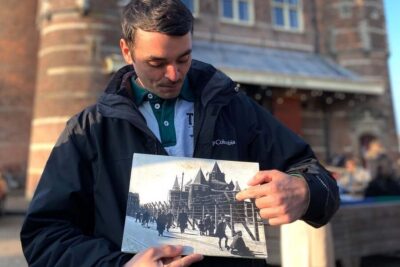

Anne Frank Walking Tour – Guided in EN/DE/IT/ES
Read our review →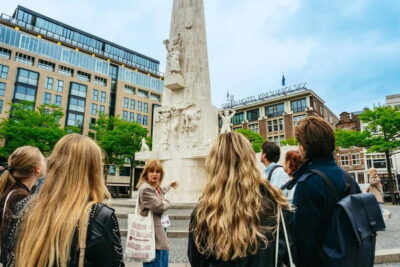

Anne Frank Walking Tour Amsterdam Including Jewish Cultural Quarter
Read our review →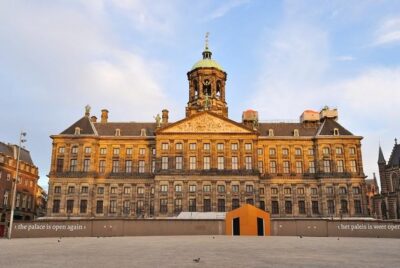
Amsterdam Highlights Walking Tour: Small Group Experience
Read our review →Browse the lists this tour appears in