
Reviewed · DUTCH MASTERS ART TOURS
Delft: Vermeer Centrum Delft Museum Entry Ticket
The most interesting thing here is that you can see 37 full-size reproductions of Johannes Vermeer’s paintings in one compact museum, then test the optical ideas linked to his working method. A camera obscura, 17th-century lenses, goggle boxes, and perspective displays turn a quiet art visit into something you can handle and explore.
I especially like the short film on Vermeer and Delft, plus the exhibit on hidden love messages. The audioguide comes in eight languages, and the friendly welcome helps you get oriented quickly. The main drawback is simple: the visit takes about an hour, so this is a focused stop rather than a full afternoon museum outing.
Key points to know
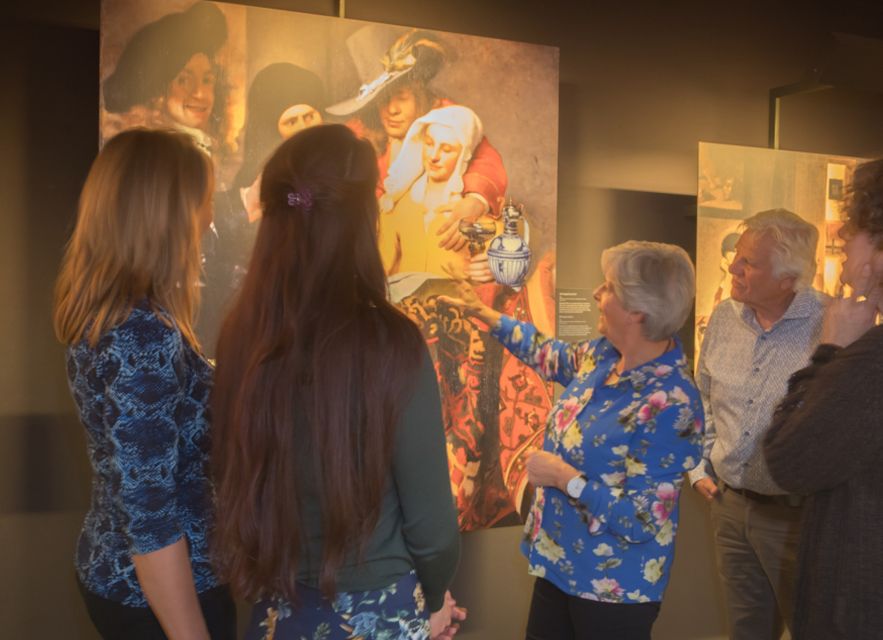
- See 37 full-size reproductions: The museum brings Vermeer’s known body of work together in one place, even though the originals are spread across museums.
- Follow a clear three-part visit: Start with a film in the basement, study the paintings, then explore technique and symbolism upstairs.
- Try historic optical tools: Lenses, goggle boxes, and a camera obscura make Vermeer’s use of light and perspective easier to understand.
- Listen in your language: Audioguides are available in Dutch, English, German, French, Spanish, Italian, Japanese, and Chinese.
- Allow about one hour: The museum works well between Delft’s canals, churches, and other central sights.
- Pay about $14: The price is reasonable if you want context and interpretation, but less so if you only want to glance at reproductions.
Why the Vermeer Centrum works in Delft
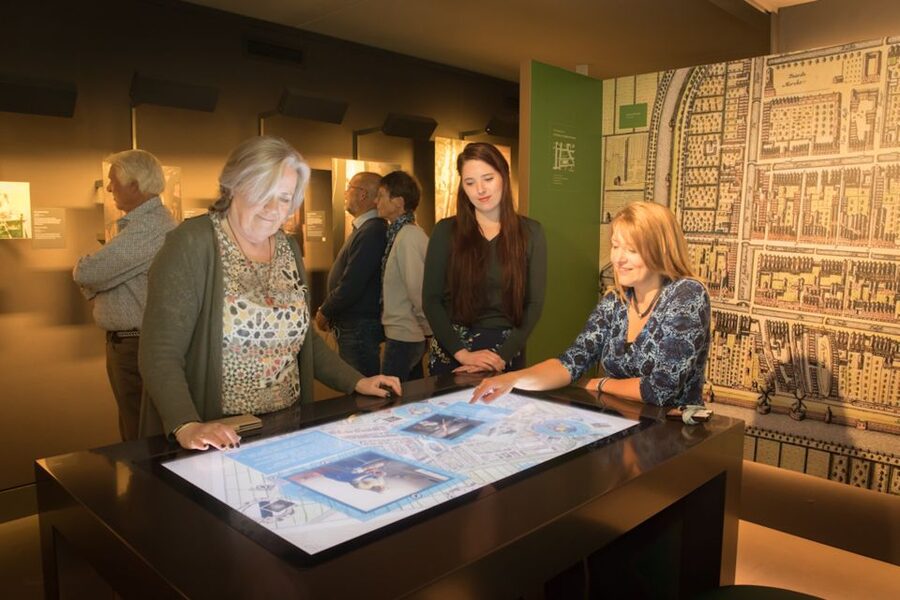
Delft is not just a convenient address for a Vermeer museum. It was the city where the painter lived and worked, and the museum connects his pictures with the 17th-century city around him. That setting gives the visit a useful sense of place before you return to Delft’s streets.
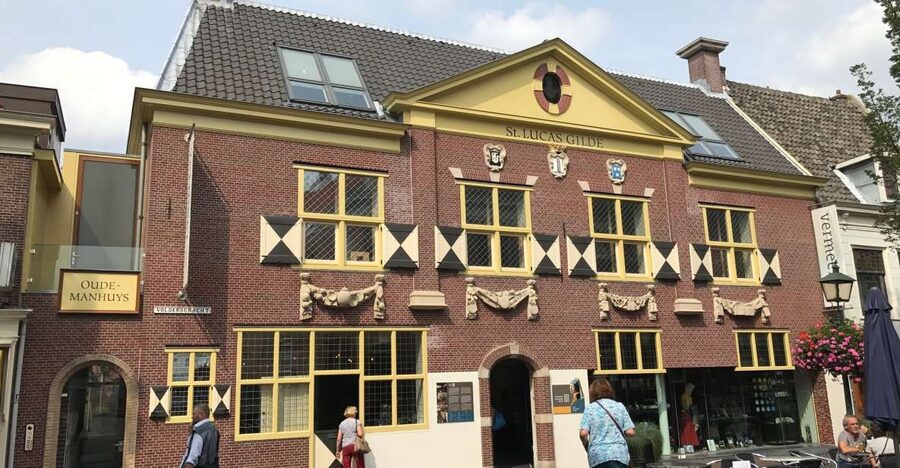
The museum occupies a former Guild of St. Luke building. That detail matters because the guild was tied to the local art world, and the building gives the visit a more intimate feel than a large national museum. You are not walking through a vast gallery with dozens of unrelated artists. You are following one painter’s world in a small, focused setting.
I like this approach for a first introduction to Vermeer. The museum does not ask you to know art history in advance. It gives you a short film, a multilingual audioguide, reproductions, and hands-on displays that make the main ideas easy to follow.
The setting also helps you place Vermeer in the Dutch Baroque period. You will learn about his family, his city, and the way his paintings fit into 17th-century Delft. The material is educational without requiring a long lecture or a specialist vocabulary.
More Dutch Masters art visits:
- Delft: Dive into the Golden Age on a Private Walking Tour
★ 4.6 · 16 reviews - The Hague: Mauritshuis Entrance Ticket
★ 4.7 · 2,706 reviews - Amsterdam: Fabrique des Lumières Dutch Masters Ticket
★ 4.6 · 2,373 reviews
Begin below ground with Delft and Vermeer
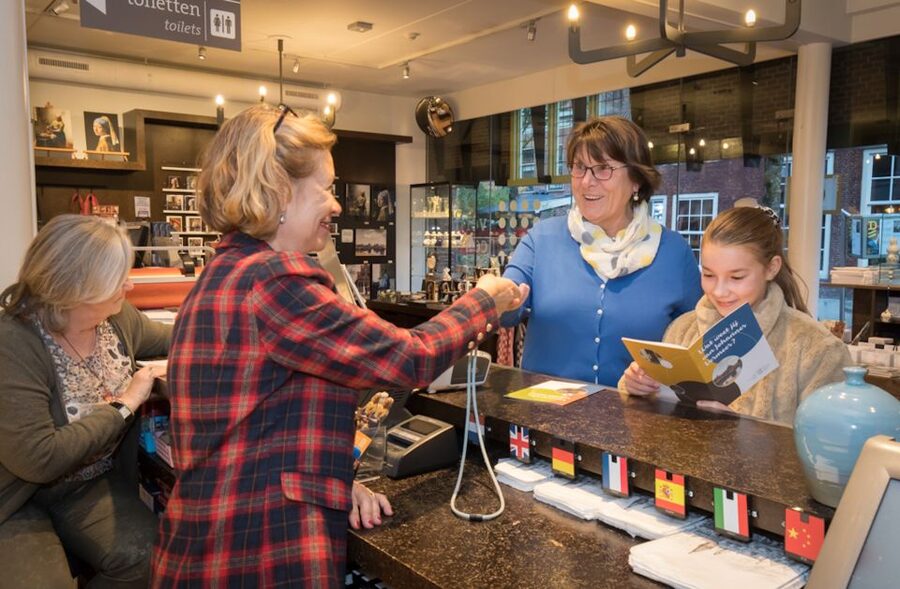
Your visit starts with an orientation from a museum volunteer, followed by an audioguide. You then head to the basement for a short film about Vermeer and Delft in the 17th century.
This is a smart opening. Vermeer’s paintings can look effortless, but the small interiors, quiet figures, and carefully placed light make more sense when you first get a little context. The film gives you a basic frame before you begin studying the reproductions.
I would pay attention to the Delft setting here. The museum is not presenting Vermeer as an isolated genius who appeared from nowhere. It introduces the city and the period that shaped his working life. That context adds value to the ticket, especially if you have already spent time walking through central Delft.
The basement portion is brief, so you will not lose much time before reaching the paintings. If you prefer to move quickly, you can treat it as a concise introduction. If you want to understand the pictures rather than simply recognize them, it is worth listening carefully.
Thirty-seven reproductions in one compact collection
The central attraction is the set of 37 full-size reproductions of Vermeer’s paintings. Seeing them together gives you something that is difficult to arrange during a normal museum visit: a broad look at his subjects, composition, light, and repeated visual concerns in one place.
The reproductions are not original paintings, and that distinction matters. You will not get the texture, surface, or historical presence of an authentic Vermeer. If your main goal is to see original works, this museum cannot replace larger art institutions that hold them.
Still, the reproductions have a practical advantage. You can compare pictures side by side in a way that helps you notice patterns. Look at how Vermeer uses a small room, a figure near a window, a quiet activity, or an object placed with care. The museum lets you step back and think about the whole body of work rather than spending your time searching for one famous image.
I find this particularly useful for anyone who knows only a few of Vermeer’s best-known paintings. The display can help you see that his appeal is not limited to one or two familiar scenes. You get a wider view of his choices and the changes in his subjects.
The audioguide adds structure without forcing you to read every panel. You can use it to learn about the paintings, Vermeer’s family, and Delft itself. Since it is available in eight languages, the museum is accessible to an international audience, not just Dutch or English speakers.
The first floor turns painting into a practical experiment
The first floor focuses on Vermeer’s working method. This is the most hands-on part of the museum, and it is likely to be the section that keeps a short visit from feeling like a wall-to-wall reproduction display.
You can experiment with 17th-century lenses, goggle boxes, and a camera obscura. These tools help explain how light, color, scale, and perspective can be controlled. You do not have to be an artist to understand the appeal. The displays make abstract ideas visible through simple experiments.
The camera obscura is the key feature. It lets you play with colors and perspective, and the museum describes the experience as a way to step into a Vermeer painting. I would give this section time instead of rushing straight upstairs. The point is not to prove one simple theory about how Vermeer painted. It is to help you think about the visual problems he was solving.
This is also a good stop for families and for anyone who finds conventional art displays too passive. The equipment gives you something to do with your eyes and hands. It makes the contrast between an ordinary room and a carefully composed painting easier to grasp.
The limitation is space. The museum is described as quaint and the full visit lasts about an hour, so do not expect a large science museum with many elaborate stations. Think of the optics section as a compact set of demonstrations that supports the paintings.
More Museum Tickets in Delft:
- Royal Delft: Delftblue Factory and Museum
★ 4.6 · 588 reviews - Royal Delft: Delftblue Factory and Museum Admission Ticket
★ 4.5 · 145 reviews - Delft: Canal House Museum ‘Paul Tetar van Elven’ Ticket
★ 4.5 · 6 reviews - Private Tour of Delft + Visit to Royal Delft Museum
★ 5.0 · 4 reviews
Upstairs, look for love messages in small objects
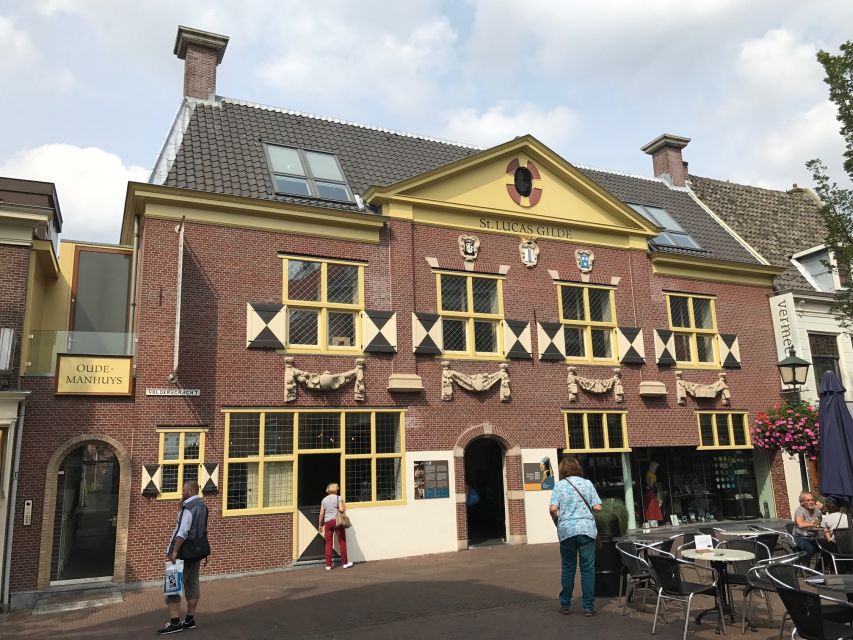
The second floor presents the special exhibition Love Messages from Vermeer. It examines the meaning and symbolism of objects and details in his paintings, with a focus on the ways love and relationships can be suggested without being stated openly.
This section rewards patience. Vermeer’s interiors may appear calm and simple, but a letter, musical instrument, household object, or gesture can change the meaning of a scene. The exhibition encourages you to look beyond the main figure and notice the small clues around the room.
I like this part because it gives you a method for looking. Instead of simply deciding that a painting feels peaceful or beautiful, you begin asking why a particular item is present and what it might communicate. You can then carry that habit into other Dutch paintings, even outside this museum.
The theme also adds variety after the technical displays downstairs. First you consider how an image may have been constructed. Then you consider how objects within that image may have communicated ideas to a 17th-century audience.
As with the rest of the museum, the exhibit is focused rather than enormous. If you enjoy long labels and extended academic discussion, you might wish for more depth. For a one-hour stop in Delft, however, the section gives you an engaging final layer before the gift shop.
Is $14 good value for an hour?
At about $14 per person, I see this as a fair purchase for the right kind of visit. You are paying for more than access to reproductions. The ticket includes the museum, the audioguide, the short film, the working-method displays, and the love-message exhibition.
The value is strongest if you want an introduction to Vermeer and prefer interpretation to a quick photo opportunity. The optical displays and the clear route through the building give the visit more substance than a simple gallery of copied images.
The value is weaker if you have limited time and only want to see original art. In that case, the reproduction-based format may not match your expectations. You should also remember that the museum takes approximately one hour, so the price is not buying a half-day attraction.
I would compare the ticket with your wider Delft plans. If you are already spending time in the city and want a compact indoor stop connected directly to its most famous painter, $14 is easy to justify. If your schedule is packed with major museums, churches, and canal walks, you may want to decide how much Vermeer context you need.
Planning the visit around your Delft day
The ticket is valid for one day, and you can check availability for starting times when booking. The museum is best treated as a flexible stop rather than a full-day commitment.
I would allow at least an hour, even though the visit may be completed in roughly that time. You will want enough room for the film, the audioguide, the paintings, and the interactive tools. If you rush through the optical displays, you lose one of the main reasons to choose this museum over a basic image collection.
Food and drinks are not allowed inside, and large bags or luggage are not allowed. Plan to leave those items elsewhere before entering. The museum is wheelchair accessible, which makes the compact format practical for many visitors with mobility needs.
The audioguide is included, so you do not need to arrange a separate guide. It is offered in Dutch, English, German, French, Spanish, Italian, Japanese, and Chinese. That range is useful if you are visiting with people who prefer different languages.
The booking terms are also flexible. You can cancel up to 24 hours in advance for a full refund, and a reserve-now, pay-later option is available. Those details matter if your Delft plans depend on weather, train connections, or a changing day itinerary.
Who will enjoy this museum most?
I would recommend the Vermeer Centrum to you if you want a focused introduction to one painter and his city. It is a good fit for art lovers who want to compare many works, families who appreciate hands-on displays, and curious visitors who do not usually spend hours in galleries.
It also suits a short Delft stop. You can learn about Vermeer without committing half a day, then return to the city’s streets. The audioguide makes the museum easy to follow, and the film gives you a starting point even if your knowledge of Vermeer is limited.
I would be more cautious if original paintings are essential to your visit. The museum presents reproductions, not Vermeer’s original canvases. You should also reconsider if you want a large, slow-moving museum experience with extensive rooms and long scholarly displays.
The strongest parts are the clear route, the friendly welcome, the practical optical demonstrations, and the chance to consider symbolism in the paintings. The main weakness is the short visit and the lack of originals. Knowing that before you book will help the museum meet your expectations.
Should you book the Vermeer Centrum Delft?
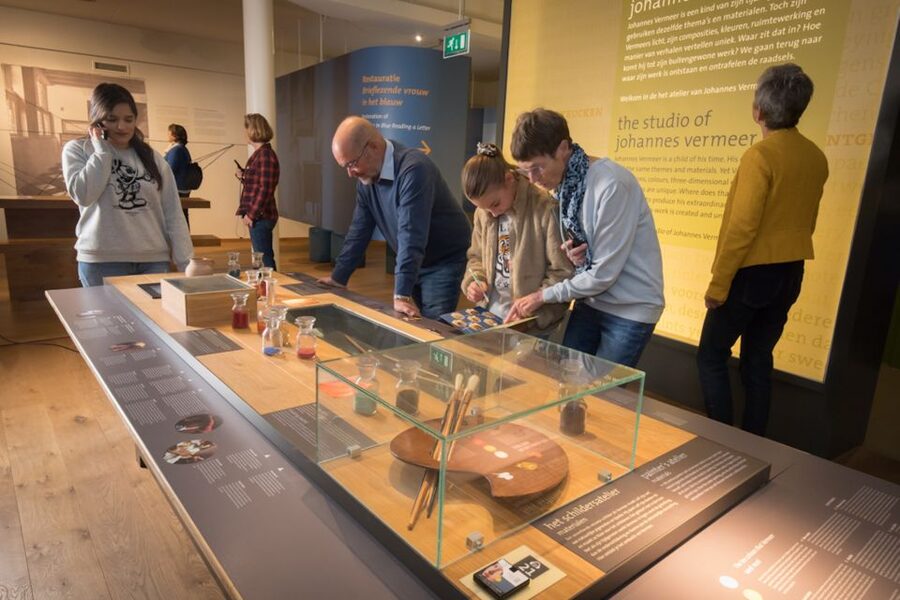
Book it if you want to see 37 full-size reproductions, understand Vermeer’s connection with Delft, and explore the ideas behind his use of light and perspective. The camera obscura and lens displays give the visit a useful physical element, while the love-message exhibition helps you read the small details in his scenes.
Skip it if you only want original paintings or need a major museum to fill several hours. For most people with an interest in Vermeer, though, this is a well-sized, reasonably priced stop that adds meaning to a walk through Delft. I would place it on a day when you want one hour of art, context, and a little hands-on experimentation without overloading your schedule.
FAQ
How long does the museum visit take?
The museum takes approximately one hour to visit. You may want to use the full hour so you have time for the film, audioguide, reproductions, interactive displays, and special exhibition.
What is included with the ticket?
The ticket includes museum entry and an audioguide.
Which languages are available for the audioguide?
The audioguide is available in Dutch, English, German, French, Spanish, Italian, Japanese, and Chinese.
Does the museum show original Vermeer paintings?
The museum presents full-size reproductions of Vermeer’s paintings. It does not state that original paintings are displayed.
How many Vermeer reproductions can I see?
The museum displays 37 reproductions of Vermeer’s paintings.
What can I do with the interactive displays?
You can explore 17th-century lenses, goggle boxes, and a camera obscura. The displays focus on color, perspective, and Vermeer’s working method.
Is there a film at the start of the visit?
Yes. You watch a short film about Vermeer and Delft in the 17th century in the basement.
What is the Love Messages from Vermeer exhibition?
It is an exhibition about the meaning and symbolism of objects and details in Vermeer’s paintings, with a focus on hidden messages about love.
Is the museum wheelchair accessible?
Yes, the museum is wheelchair accessible.
Can I bring food, drinks, or large luggage?
Food and drinks are not allowed, and large bags or luggage are not allowed inside.
Can I cancel my booking?
You can cancel up to 24 hours in advance for a full refund. A reserve-now, pay-later option is also available.
Just added around Delft
- Private Tour of Delft + Visit to Royal Delft Museum★ 5.0 · 4 reviews
- Delft: Canal House Museum ‘Paul Tetar van Elven’ Ticket★ 4.5 · 6 reviews
- Delft: Private Historical and Cultural Guided Walking Tour★ 5.0 · 8 reviews
- Royal Delft: Delftblue Factory and Museum Admission Ticket★ 4.5 · 145 reviews
- Delft: Christmas Walk with Oliebollen and Glühwein★ 4.8 · 8 reviews
- Delft: Craft Beer Tasting in Medieval Brewery with Snacks★ 4.4 · 67 reviews
- Delft – Step/scootertour in and around the city★ 4.8 · 9 reviews
- The Hague: One Way Boat Ticket to or from Delft★ 4.5 · 52 reviews
Dutch Masters Art Tours, compared.
Visit the Girl with the Pearl Earring, The Hague & Delft City
Read our review →
Private Rijksmuseum Tour- The Dutch Masters, Rembrandt & Vermeer
Read our review →
Kinderdijk, The Hague, Mauritshuis Private Tour from Amsterdam
Read our review →
5 hrs Golden Age Amsterdam Private Walking Tour With Local Guide
Read our review →
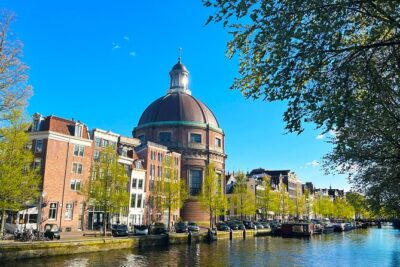
Walking Tour about Golden Age Architecture, private local guide
Read our review →Browse the lists this tour appears in