
Reviewed · DELFT TOURS
Delft – Step/scootertour in and around the city
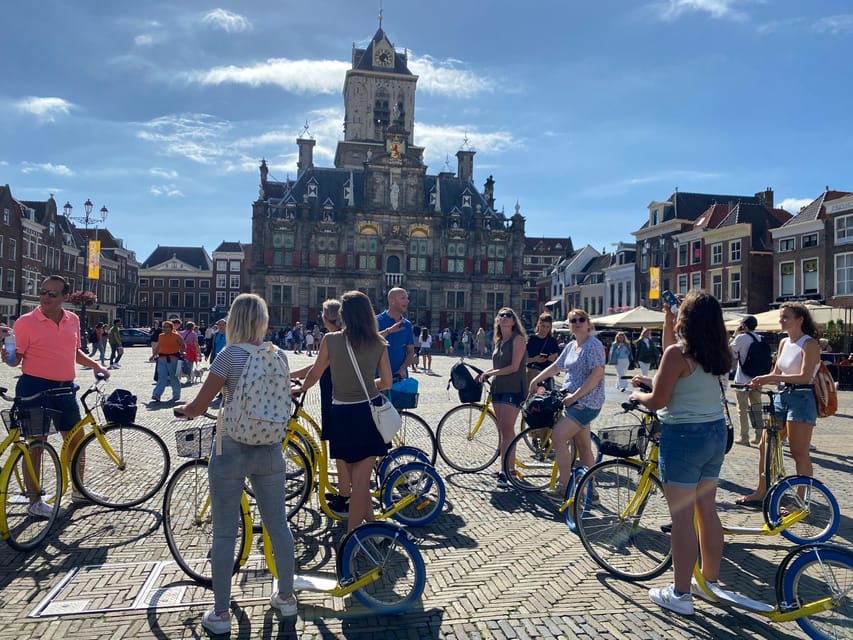
Delft looks different from the footpath when you move through it on a non-electric step scooter. This 1.5-hour outing links modern architecture, a working windmill, quiet Agnetapark, Hofje van Pauw, Markt, and the crooked tower of the Old Church. It is a good way to see more than the postcard center.
I like the route’s reach, especially the chance to visit Agnetapark, a planned garden village with an unusual social story, and Hofje van Pauw, a peaceful courtyard dating from 1707. I also like the small-group format, limited to 10 people, which leaves room for questions and for guides such as Frans and Kevin to add local detail.
The main catch is the equipment. These are not electric scooters, and one part of the ride can feel like work, especially in warm weather or if you are not used to stepping. You must be at least 16, able to ride a bicycle, and comfortable moving through city streets.
Key points to know before you book
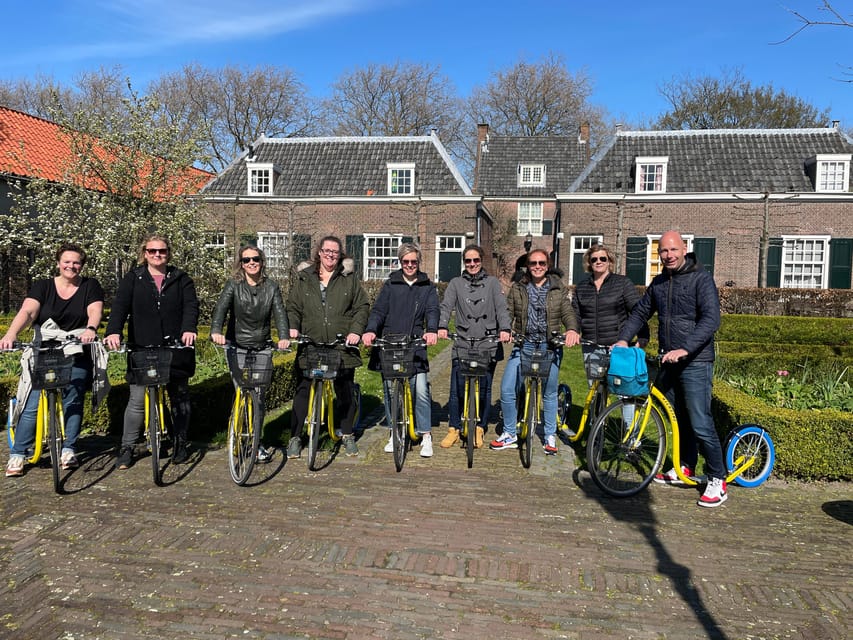
- Non-electric scooters change the pace: You ride in short stretches, then stop for stories and photographs.
- Agnetapark adds a side of Delft: Learn about Jacques van Marken and his forward-thinking garden village.
- Hofje van Pauw is a quiet 1707 courtyard: It offers a calm break from the main streets.
- The route reaches beyond the standard center: Modern Delft, Mill de Roos, the Eastern Gate, and older streets all fit into the tour.
- Small groups keep it personal: No more than 10 people join each outing.
- Guides bring their own character: Frans and Kevin are named guides connected with the tour, and the format allows questions and some flexibility.
Why this step scooter tour is different
Delft is easy to walk, but its sights are spread across a mix of old streets, newer building areas, residential districts, and formal squares. This tour gives you a way to cover more ground without turning the experience into a fast sightseeing dash.
The pace is important. You do not simply glide from monument to monument. You ride a short way, stop, hear a story, look around, and then continue. That suits Delft, where a small courtyard or an unexpected view can matter as much as the main church square.
The word scooter may cause confusion. In Dutch, a scooter for this activity is a step, meaning a kick scooter. These are not electric. You use your own leg to move, and the supplied rental is included in the $32 price. If you are expecting a motor-assisted ride, adjust your expectations before booking.
The tour starts at restaurant De Delf, at Oude Delft 113. From there, the route makes a loop and returns to the same place. The group size is capped at 10, which is useful on narrow streets and makes it easier to hear the guide.
A few more Delft half-days worth comparing
- Delft: Canal Cruise with Guided Commentary
★ 4.4 · 990 reviews - Royal Delft: Delftblue Factory and Museum
★ 4.6 · 588 reviews - Delft: Entrance Ticket for the Old and New Churches
★ 4.4 · 229 reviews
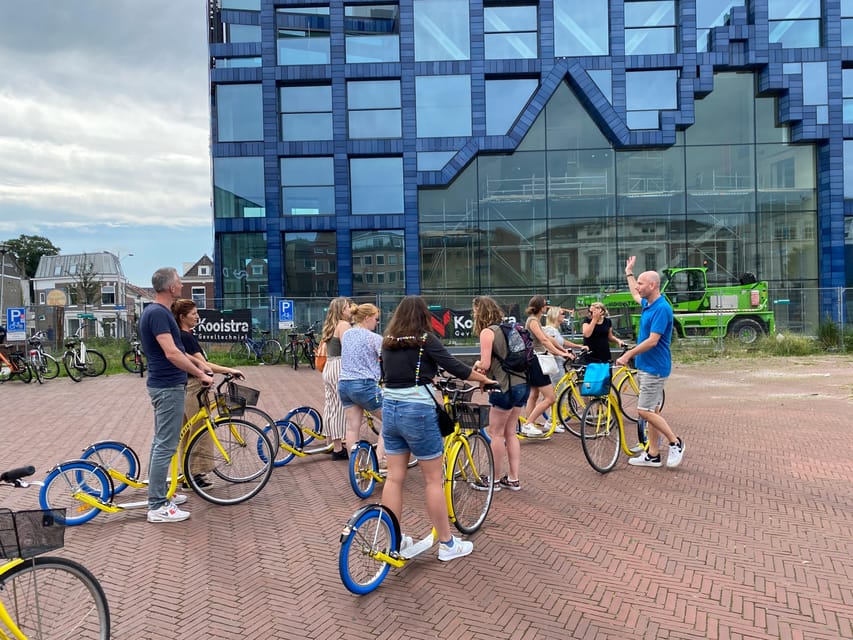
Starting in modern Delft
The first section heads toward the newer part of Delft. This is a useful choice because many short city tours rush straight to the old center and leave the modern city unexplained.
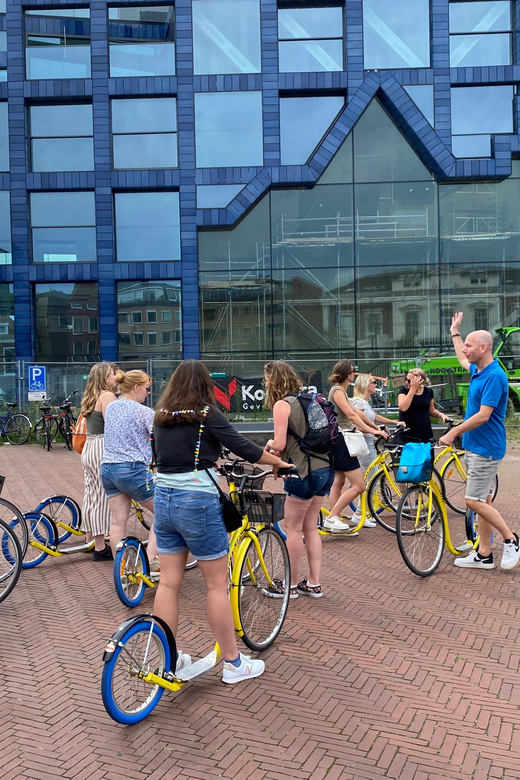
The city’s railway now runs beneath Delft, leaving room for new construction above. The tour uses this area to point out modern architecture and the changes that have shaped the city. You get a reminder that Delft is not only canals, old brick, and blue-and-white pottery. It is also a working city that has made room for new buildings and new ways of moving through town.
This opening section also gives you time to get used to the scooter. Since the riding is non-electric, you can learn how the step handles before the route reaches busier or older streets. The exact amount of riding depends on the group and the guide, but the overall format includes short stretches rather than a long continuous ride.
If you want a traditional old-town tour from the first minute, this modern opening may feel less dramatic. I see it as a strength, since it adds context and helps you understand present-day Delft.
Mill de Roos, still part of the city
The route next reaches Mill de Roos, Delft’s town mill. The important detail is that the mill is still in use. That gives the stop more meaning than a quick photograph of an old structure.
A working mill connects the city to older forms of production and daily life. You can look at the building as part of Delft’s skyline, but the guide also explains its role and why it remains relevant. The stop is brief, listed as a photo and guided-tour point, so do not expect a long museum visit or an extended interior tour.
This is one of the better stops for anyone who likes places that still serve a purpose. Delft’s historic buildings are not all frozen displays. Some continue to function, and Mill de Roos helps make that point.
Agnetapark and the ideas of Jacques van Marken
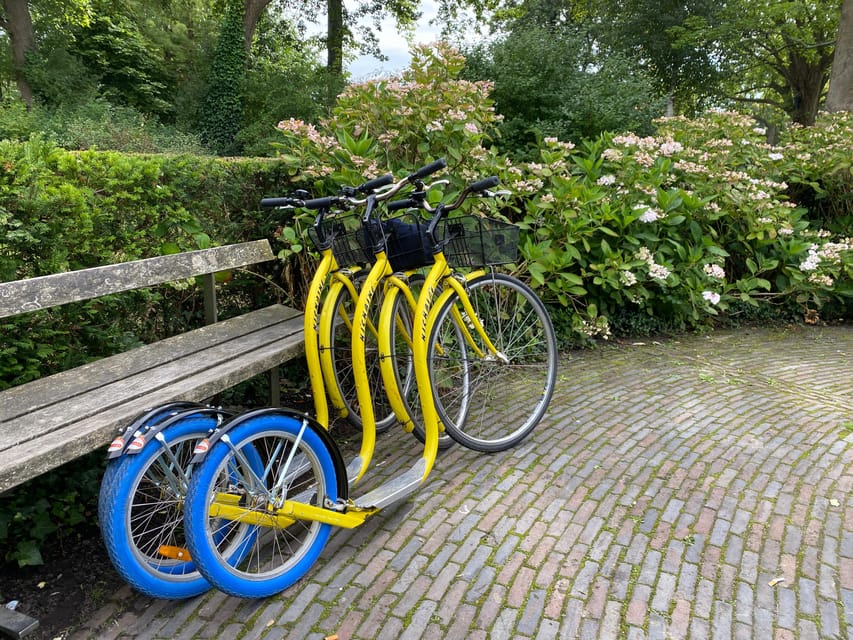
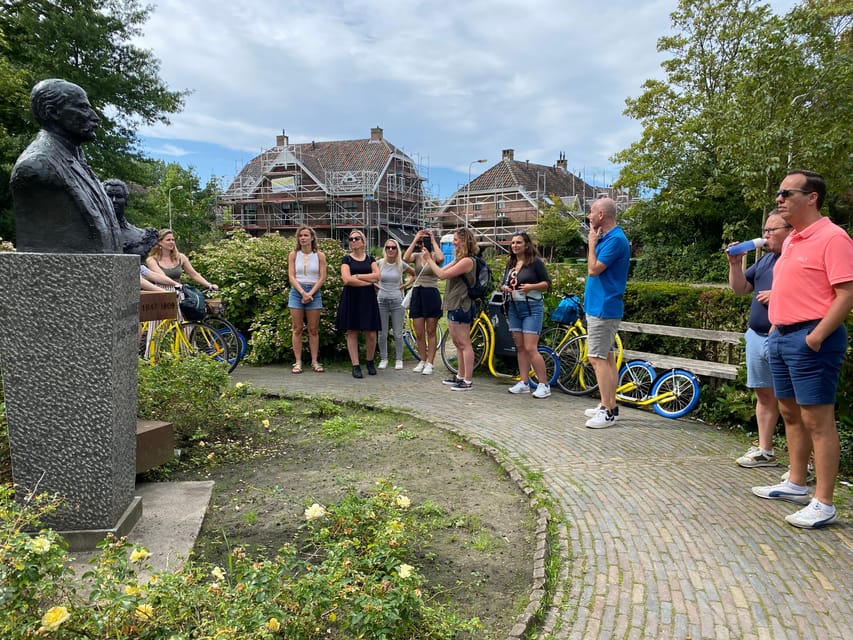
Agnetapark is likely the most distinctive stop on the route. It is a quiet garden village connected with Jacques van Marken and his wife, Agneta. The tour presents the couple as people who were ahead of their time in the way they thought about community and worker housing.
The setting matters. Instead of explaining the story in a crowded square, the guide takes you into a calmer neighborhood with gardens and residential streets. The peaceful surroundings help you picture the social experiment behind it.
You will spend about 15 minutes here for a guided visit and photographs. That is enough for a clear introduction, though not enough for every detail of the couple’s work. Listen for the connection between the physical layout and the social ideas behind it. The park is not just a pretty stop. Its design reflects an attempt to create a better setting for ordinary working families.
I especially like this part for repeat visitors to Delft. If you have already seen Markt and the canals, Agnetapark gives you a different story and a different mood. It also shows how local history can be found in a residential district, not only in grand civic buildings.
Same base, a completely different sort of day:
- Delft: Vermeer Centrum Delft Museum Entry Ticket
★ 4.6 · 189 reviews - Royal Delft: Delftblue Factory and Museum Admission Ticket
★ 4.5 · 145 reviews - Delft: City Center Walking Tour
★ 4.7 · 88 reviews - Delft: Craft Beer Tasting in Medieval Brewery with Snacks
★ 4.4 · 67 reviews
Hofje van Pauw, a quiet courtyard from 1707
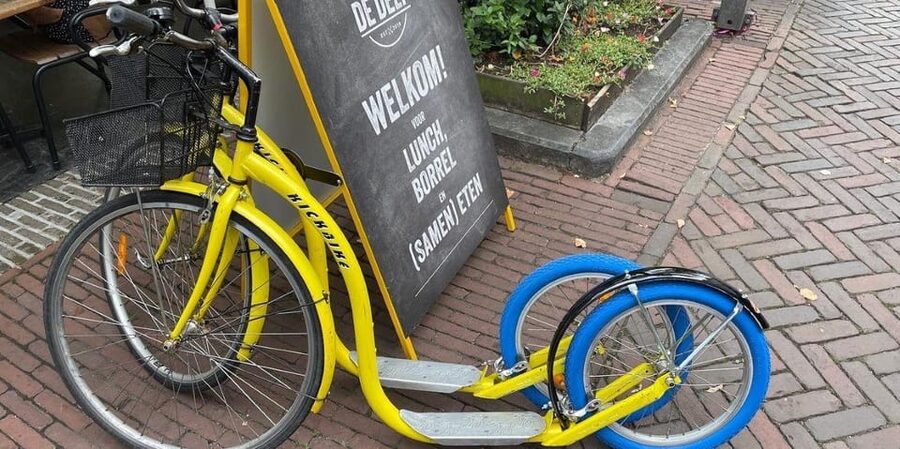
After Agnetapark, the group continues to Hofje van Pauw. A hofje is a courtyard housing complex, often created for older women or people in need. Hofje van Pauw dates from 1707 and is presented as one of Delft’s quieter places.
The contrast with the city’s main square is the point. You leave the movement of the streets and enter a more enclosed, orderly setting. The guide tells the story of the woman who founded the courtyard, giving the architecture a human connection.
The stop lasts about 15 minutes. You should treat it as a respectful look rather than a place to wander freely. Courtyards can be delicate spaces, and the tour’s short visit keeps the focus on the history and design.
This is a strong reason to choose the scooter tour over a simple central-city loop. Hofje van Pauw is easy to miss if you only follow Delft’s best-known sights. The stop also suits visitors who prefer small-scale architecture and personal stories to grand monuments.
The Eastern Gate and Delft’s old edges
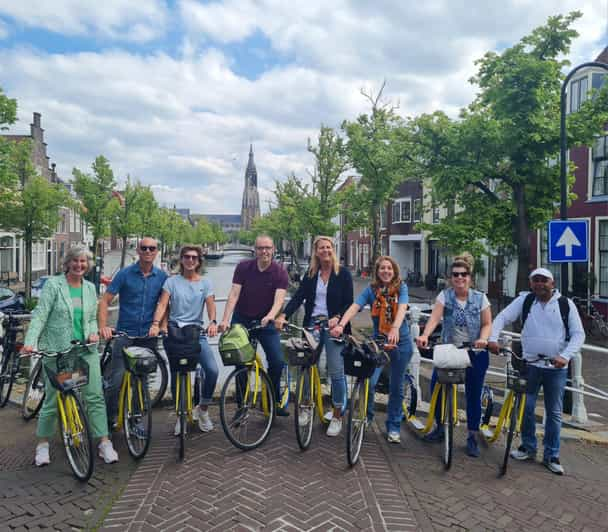
The route includes the Eastern Gate, one of Delft’s reminders of its former defensive boundary. The stop is another 15-minute photo and guide section.
The gate helps you think about Delft as a walled town rather than just a collection of attractive streets. Details such as gateways and old boundaries explain how people entered the city and how its shape developed. The guide can tie this stop to the older parts of the route as the group works back toward the center.
Because the tour includes several short stops, each location has a clear role. The Eastern Gate is not asked to carry the whole history of Delft. Instead, it adds one more piece to the picture, alongside the mill, the courtyard, the garden village, and the churches.
Markt, the New Church, and the town hall
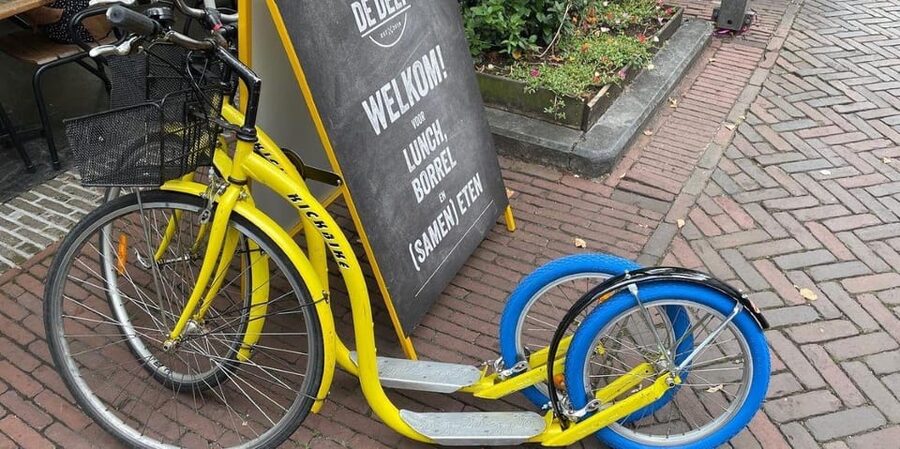
The return route passes through Markt, Delft’s central square. Here you see the New Church and the town hall, two buildings that define the square and make it one of the city’s essential stops.
The New Church is especially important to Delft’s identity, while the town hall gives the square its civic balance. Even if you have visited Delft before, seeing this space after touring quieter districts changes the way it feels. You have already seen parts of the city that many short visits skip, so the famous center becomes one chapter of a larger story.
The stop is planned as a photo and guided-tour point, not a church interior visit. If you want to climb a tower, study tombs, or spend time inside the buildings, you will need to arrange that separately. The value here is the guide’s explanation and the chance to see the square within the wider route.
Markt can be busy, and a scooter requires attention around pedestrians. Follow the guide’s pace and avoid treating this section as a race. The small group helps, but it is still a public square.
The leaning Old Church
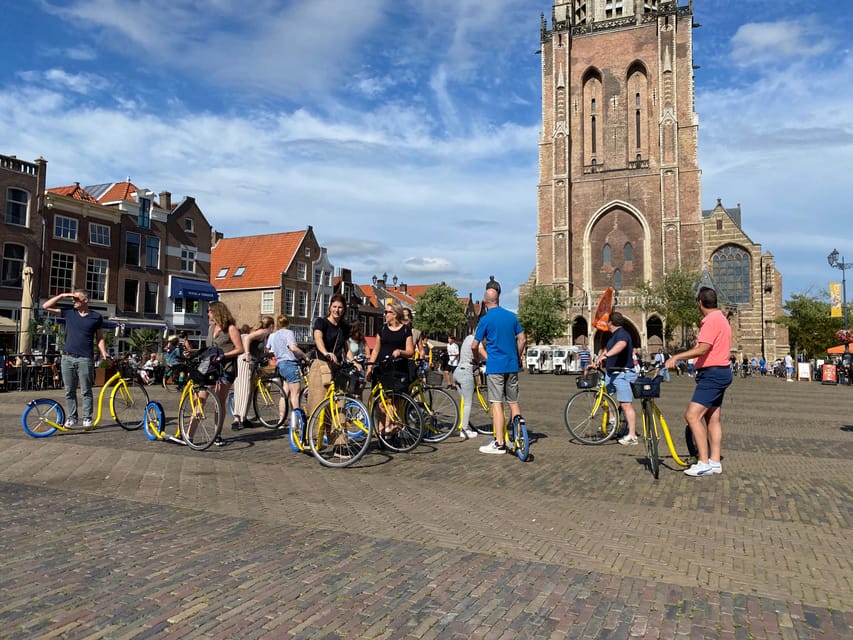
The final major sight is Delft’s Old Church, known for its leaning tower. The tower’s tilt gives the stop instant visual appeal, but the real value is the reminder that Delft’s historic buildings have changed, shifted, and been repaired over time.
You get a short guided visit and time for photographs. The tour does not include a separate tower climb or an extended interior visit. Still, the Old Church works well as the final historic marker before returning to Oude Delft 113.
The name can confuse first-time visitors because the church is old in appearance and history, while the New Church on Markt is also a major part of Delft’s identity. Seeing both on one route makes the distinction easier. One sits by the central square, while the other is known for its leaning tower and older character.
How the 1.5 hours feel in practice
The advertised duration is short enough to fit neatly into a half-day plan. You can take the tour early, use it to get your bearings, and then return to the places you want to explore on foot. You can also schedule it between other Delft activities without giving up a full afternoon.
The route includes roughly six main stops, each with a short explanation and photo opportunity. That means the experience is structured around movement and storytelling rather than long visits at any one sight.
You should be ready for some physical effort. One account of the outing specifically notes that the short riding sections are welcome because the scooters are not electric and take some getting used to. Warm weather can make the activity harder, too. Wear comfortable clothes and shoes, and do not book this as a passive sightseeing ride.
The group limit of 10 is a real advantage. A guide can pause for questions, adjust the explanation, and keep the group together without the feel of a large procession. The tour has been led by Frans and Kevin, and the supplied feedback gives both names a positive association with lively storytelling and a friendly approach.
The route can also allow small bits of flexibility. One participant described the guide showing the group useful places to eat on the way back. That is not a promised part of every departure, but it shows how a local guide may add practical Delft suggestions when time and route allow.
What the $32 price gets you
At $32 per person, the price includes the non-electric scooter rental and a live guide in English or Dutch. For 90 minutes, that is reasonable if you value local explanation and want to see districts beyond the central sights.
You are not paying only for transportation. The scooter lets the tour connect places that would feel scattered on foot, while the guide supplies the stories that turn a garden village, courtyard, mill, and city gate into a connected picture of Delft.
The value is less clear if you only want to see Markt, the New Church, and the Old Church. You can reach those central sights independently. The tour earns its price through the added route, the small group, and the background on Agnetapark and Hofje van Pauw.
A drink may be included at the end of some tour experiences, but the stated inclusions are the scooter rental and guiding service. If that matters to you, confirm the current arrangement when booking rather than counting on it.
Who should book this Delft tour
I would choose this for adults and older teens who can ride a bicycle and enjoy a guided city route with a little exercise. It suits first-time visitors who want an overview, as well as return visitors who have already seen Delft’s central postcard sights.
It is a particularly good fit if you like:
- Small groups rather than large walking tours
- Local stories about city planning and social ideas
- Historic courtyards and neighborhoods
- A mix of modern and old Delft
- Short stops with time for questions
- Seeing places beyond the standard center
I would think twice if you need an electric ride, dislike physical activity, or want long visits inside churches and monuments. The tour is not suitable for children under 16, wheelchair users, people who cannot ride a bicycle, or people with visual impairments.
You can cancel up to 24 hours before the start for a full refund, and the reserve-now, pay-later option keeps your plans flexible. Starting times vary, so check availability for your date.
Should you book it?
Book this tour if you want Delft to feel larger than Markt and its famous churches. The strongest parts are Agnetapark, Hofje van Pauw, the working Mill de Roos, and the chance to hear personal stories from guides such as Frans or Kevin.
Skip it if the idea of a non-electric step scooter sounds tiring or awkward. For the right rider, though, the $32 fee buys a lively route, a small group, and a useful look at the city beyond its main tourist streets.
FAQ
Where does the Delft step scooter tour start?
It starts at restaurant De Delf, at Oude Delft 113, and returns to the same location.
How long does the tour last?
The tour lasts 1.5 hours.
How much does the experience cost?
The listed price is $32 per person.
Are the scooters electric?
No. The scooters are non-electric steps, so you move them with your own leg.
Which languages are available?
The live guide is available in English and Dutch.
How large is the group?
The tour is limited to 10 participants.
What places does the route visit?
The route includes modern Delft, Mill de Roos, Agnetapark, Hofje van Pauw, the Eastern Gate, Markt, the New Church area, and the Old Church.
Who cannot join this tour?
The activity is not suitable for children under 16, people who cannot ride a bicycle, wheelchair users, or visually impaired people.
Can I cancel for a refund?
Yes. You can cancel up to 24 hours in advance for a full refund. You can also reserve now and pay later.
Just added around Delft
- Private Tour of Delft + Visit to Royal Delft Museum★ 5.0 · 4 reviews
- Delft: Private Historical and Cultural Guided Walking Tour★ 5.0 · 8 reviews
- Delft: Canal House Museum ‘Paul Tetar van Elven’ Ticket★ 4.5 · 6 reviews
- The Hague: One Way Boat Ticket to or from Delft★ 4.5 · 52 reviews
- Royal Delft: Delftblue Factory and Museum Admission Ticket★ 4.5 · 145 reviews
- Delft: Christmas Walk with Oliebollen and Glühwein★ 4.8 · 8 reviews
- Delft: Craft Beer Tasting in Medieval Brewery with Snacks★ 4.4 · 67 reviews
- Delft: City Center Walking Tour★ 4.7 · 88 reviews
Delft Tours, compared.



Royal Delft: Delftblue Factory and Museum Admission Ticket
Read our review →

Craft Beer Tasting in Medieval Brewery with Snacks
Read our review →
Browse the lists this tour appears in