
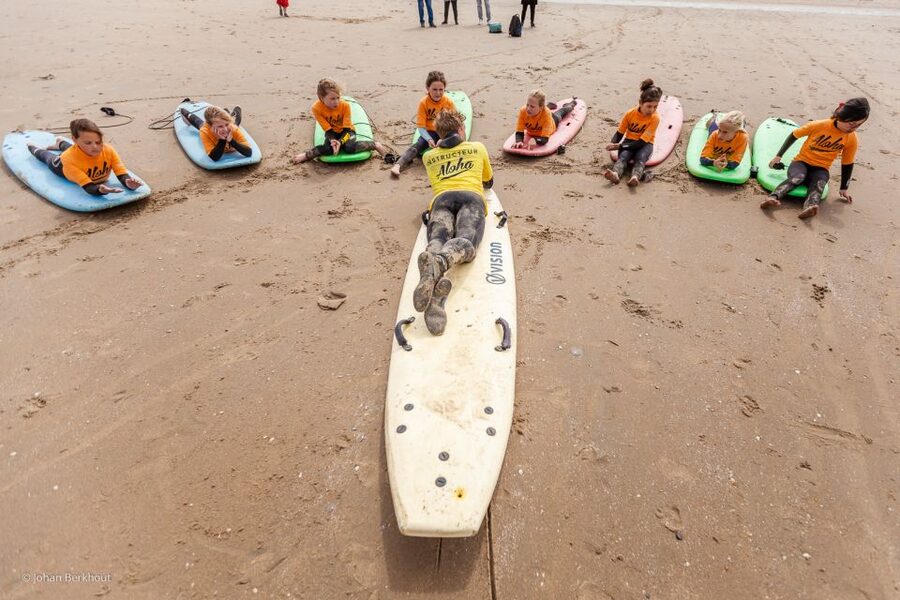
Reviewed · SURFING & PADDLEBOARDING
Scheveningen Beach: 1,5-Hour Surf Experience for kids
Scheveningen’s North Sea waves give children a friendly first taste of surfing, with plenty of spills, wet hair, and the satisfying moment when a board finally runs straight. The lesson begins at Aloha Surf, where an instructor explains safety and basic technique before taking the group into the water.
I like the built-in surf gear and the short 1.5-hour format, which keeps the lesson manageable for young beginners. I also like the small private option, limited to two participants. The main caution is language and supervision: most teaching is in Dutch or English, and a group of six or eight children may mean less individual help.
Key points at a glance
- A real first-surf lesson: Children learn how to handle a board, stand up, and steer left, right, or straight.
- Small private option: Private lessons allow a maximum of two participants, useful for children who need more attention.
- Group size matters: Group lessons can include up to eight surfers and continue only when at least four people are enrolled.
- Gear is supplied: Surf equipment is included, but you must bring swimwear, a towel, and biodegradable sunscreen.
- Weather can change plans: Storms or a lack of waves may lead to cancellation or a changed lesson.
- Friendly teaching matters: Instructor Luuk received special praise for adapting to a child with sensitive skin.
Meeting Aloha Surf beside Scheveningen Beach
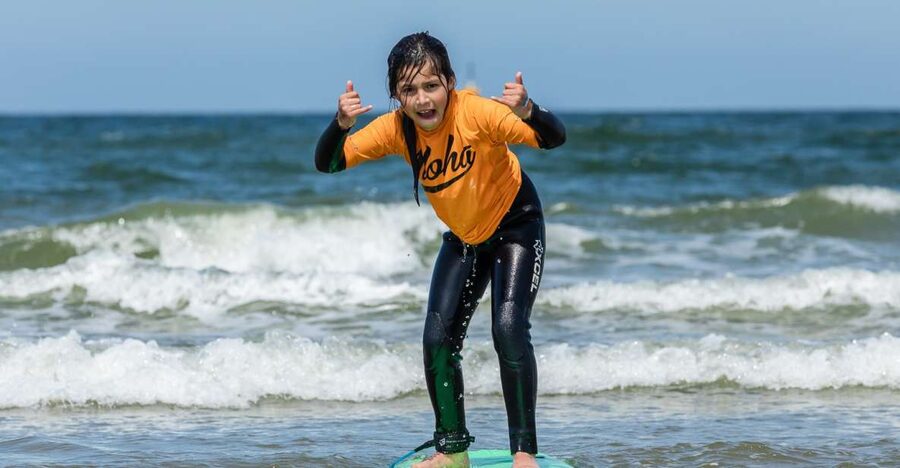
The meeting point is easy to identify: go to the blue building with the Aloha flag on top. That simple landmark matters at a busy beach, especially when you have children in tow and would rather not spend the first minutes wandering along the promenade.
The lesson takes place at Scheveningen, The Hague’s main beach. This is not a remote surf camp or a quiet coastal village. You are coming to a well-known beach area with the practical advantages of an established seaside base, including an attached restaurant and a place to organize your equipment before heading out.
Plan to arrive ready for the water. Bring swimwear and a towel, and pack biodegradable sunscreen. Surf gear is included, so you do not need to bring a board or other specialist equipment. The supplied information says the only essentials you need are a towel and swimwear, but biodegradable sunscreen is also specifically recommended.
Alcohol and drugs are not allowed. The lesson is not suitable for non-swimmers or pregnant women. For a children’s activity, the non-swimmer rule is especially important. A child does not need to arrive as a surfer, but must be able to swim before joining.
More surf and paddleboard sessions:
- The Hague: Beginner’s Surf Lesson
★ 4.7 · 78 reviews - Scheveningen Beach: 2-Hour Surf Experience for Adults
★ 4.8 · 50 reviews - Scheveningen Beach: 1,5 hour Surf experience for families
★ 5.0 · 11 reviews
The first 20 minutes: safety before surfing
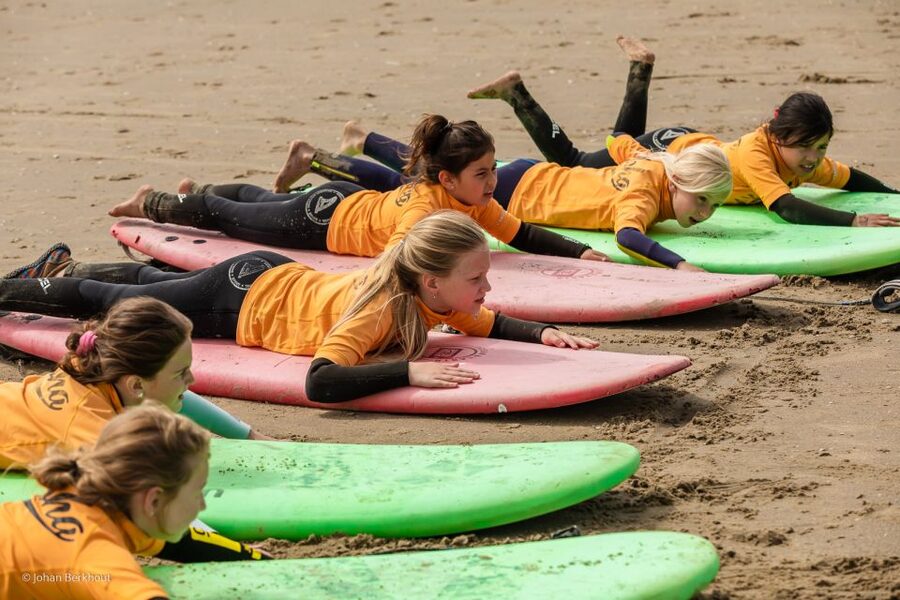
The lesson does not put children straight onto a board and hope for the best. At Aloha Surf, the instructor first explains the history of surfing, how to stay safe, and the basic ideas behind handling a surfboard.
That short classroom-style introduction can feel a little long to a child who has come to get wet. One parent found that there was quite a lot of theory in English at the start, and the children did not understand every part. This is worth noting if your child is young or has limited English.
Still, the safety talk has a clear purpose. Surfing is fun, but children need to understand where to place their hands, how to get on and off the board, and what to do when they fall. Knowing that falling is expected can help take away some of the worry before the first attempt.
The instructors are certified and teach in Dutch, English, or German, although German cannot be guaranteed at every lesson time. French and Spanish are not listed among the regular languages. If language is important for your child’s confidence or safety, contact Aloha Surf before booking rather than assuming that a requested language will be available.
The teaching language is one of the few areas where the experience may not work equally well for every family. English instruction can be perfectly workable for older children, but younger ones may miss some of the early explanations. The water time appears to be more universally understandable: watch, copy, try, fall, and try again.
Getting onto the board in the North Sea
Once the introduction is finished, the lesson moves into the part children usually remember: handling the board and trying to stand.
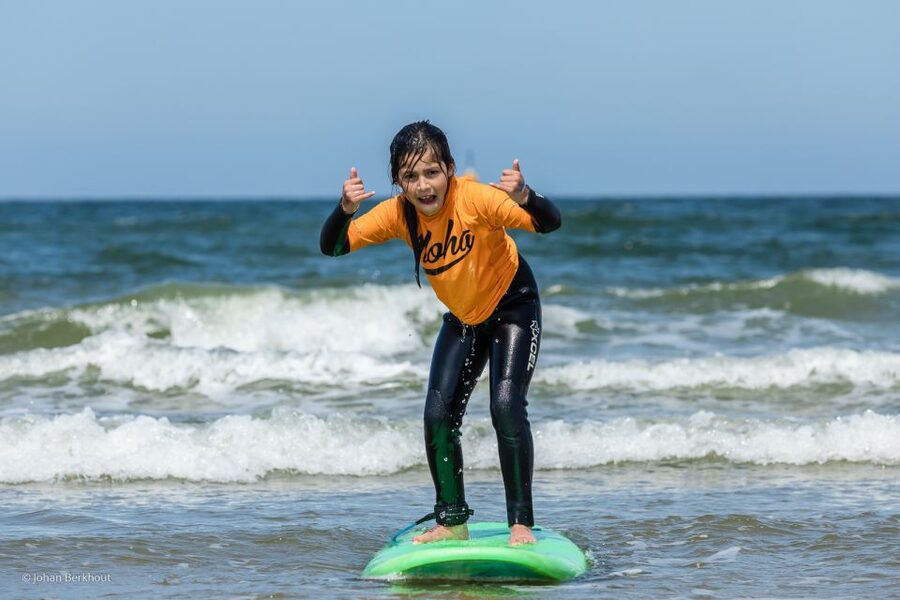
The goal is not advanced surfing. Children learn the basic movement of rising from the board and finding a stable stance as a wave carries them forward. They can try to steer left or right, or simply go straight while they build control.
That first successful glide is the point of the lesson. It may last only a short time, and it may end with a splash, but children get a physical sense of how a surfboard responds to a wave. They are not just watching an instructor demonstrate. They are learning through repeated attempts.
The North Sea is a practical setting for this kind of introduction. The activity is built around catching Dutch waves at Scheveningen, not around perfect surfing conditions or long rides. Some attempts will work better than others. That unpredictability is part of the fun, though it also means you should not measure the experience by how many clean rides your child completes.
The lesson encourages children to laugh when they fall. That is good teaching for beginners. Falling is not treated as failure, and the focus stays on confidence, basic movement, and enjoying time in the water. A child who leaves with more courage than technique may still have gained exactly what this short session is meant to provide.
Group lessons versus private teaching
The choice of lesson format can make a real difference.
A group lesson holds up to eight surfers and requires a minimum of four participants to continue. This format can feel social and playful. Children see other beginners making the same mistakes, which can make a first fall feel less embarrassing. They also share the energy of the group, and the cost is the same stated rate of $62 per person.
The tradeoff is instructor attention. One family found a ratio of five children to one instructor less than ideal for first-timers, since every child needs help with board position, timing, and standing. That is a fair concern. Surfing involves several small steps, and a child who needs repeated correction may spend time waiting while the instructor helps someone else.
A private lesson has a maximum of two participants. At the same price per person, if available under your booking conditions, it offers a more focused setting. This can suit siblings or two friends who want more direct coaching. It may also be the better choice for a child who is nervous, easily distracted, or still unsure about the water.
The private option does not guarantee perfect waves or a long ride. It simply gives the instructor fewer people to watch. If your child’s main goal is confidence, that extra attention may be more valuable than the social feel of a larger group.
Before booking, check the exact format shown for your chosen time. The activity information describes both group lessons and private lessons, with different participant limits. The lesson may be presented as a private group booking while still offering a group-surf format, so confirm what you are selecting.
A few more The Hague half-days worth comparing
- The Hague: Mauritshuis Entrance Ticket
★ 4.7 · 2,706 reviews - The Hague: City Canal Cruise
★ 4.6 · 2,024 reviews - The Hague: Madurodam Miniature Park Entry Ticket
★ 4.6 · 1,559 reviews - The Hague: The Pier SkyView Ticket with Drink and Snack
★ 4.4 · 1,398 reviews
A closer look at the 1.5-hour schedule
The full session lasts 90 minutes, including the introduction and the practical surf time. That is long enough to learn the basics without asking children to concentrate through an entire half-day sports course.
The first section covers surfing background and safety. This is followed by equipment handling and instruction on how to stand. The remaining time is used for repeated attempts in the water, with children trying to ride and steer the board.
The exact split between land and water is not stated, so you should not expect a fixed number of minutes for each part. The early explanation may take a meaningful portion of the lesson, especially for a group of beginners. If your child is eager to get into the water, explain beforehand that the safety briefing is part of the experience.
The 90-minute length is one of the better features for families visiting Scheveningen. Children get a real introduction rather than a quick photo opportunity, but the activity does not take over the whole day. You can pair it with other beach time or a meal nearby without committing to a long course.
Bring a dry change of clothes if your child is likely to remain at the beach afterward. Only a towel and swimwear are listed as required items, so extra clothing is not part of the formal equipment list, but it is a sensible comfort choice after a wet activity.
What the instructor can change for a child
The quality of a children’s surf lesson depends heavily on how the instructor reacts to different needs. One particularly useful example involved instructor Luuk, who took extra care with a child whose skin was sensitive to the wetsuit.
Rather than treating the problem as a reason to stop, he helped the child find a way to take part in the surf experience. That kind of calm adjustment matters more than a polished demonstration. Children may arrive with fear, skin sensitivity, limited confidence, or difficulty following every instruction. A good instructor notices those issues early.
You should still tell the school about any relevant concern before the lesson. The information confirms that the wetsuit caused difficulty for one child, but it does not promise a particular solution for every medical or skin condition. Parents need to judge what is suitable for their own child.
The main teaching languages are Dutch, English, and German. German-speaking instructors are not guaranteed at every time, so families booking in German should contact the provider directly. A child who understands only a little English may struggle with the land-based explanation, even if the physical part becomes easier to follow.
Is $62 a fair price?
At $62 per child, the value depends on what you want from the session. The fee includes surf equipment and a certified instructor, so you are not paying only for access to the beach. You are paying for instruction, safety guidance, and the chance to use the right gear without buying or renting it separately.
For a first try, the 1.5-hour length is sensible. A longer session might sound like better value, but young children can tire quickly in cold water and unfamiliar equipment. Ninety minutes gives them enough time to make several attempts while keeping the commitment manageable.
The price becomes more attractive when you choose the private option for two children who need individual help. In a full group of eight, the value is more dependent on how much direct instruction your child receives. The experience can still be enjoyable, but you should be realistic about the amount of one-to-one coaching available.
The strongest value comes for families who want a memorable beach activity without buying a board, arranging an instructor, or learning the basics alone. It is less compelling if your child is a non-swimmer, dislikes cold water, or is likely to lose interest during the safety introduction.
Weather, waves, and the North Sea factor
Surfing cannot happen without suitable conditions. The lesson may be canceled if there are no waves or if a storm reaches Scheveningen. The surf school contacts you if the session is canceled or changed because of weather.
That policy is sensible, but it means you should keep some flexibility in your beach plans. A booking does not guarantee that the sea will cooperate on the chosen day. The weather may also affect how comfortable children feel in the water, even when the lesson goes ahead.
The activity is built around real Dutch waves rather than a controlled indoor pool. That makes it more exciting, but also less predictable. Some children may stand up quickly, while others may spend most of the session learning how to balance and recover after a fall.
Free cancellation is available up to 24 hours in advance for a full refund, and the reserve-now, pay-later option can help you keep plans flexible. Weather cancellations are handled by the surf school, not by your child’s enthusiasm or ability.
Who will enjoy this lesson most?
This experience suits children who can swim, enjoy active play, and do not mind falling into the water. It is a good choice for a child who likes trying something new and can accept that success may come after several attempts.
It is also well suited to siblings or friends who want to share an activity. A group setting can turn mistakes into a joke and give children the courage to keep trying.
Choose carefully for very young children or those who need detailed explanations in German. The early teaching may be in English, and the group format may offer less individual attention than some parents expect. A private lesson for two is the stronger choice when confidence or close supervision matters.
The lesson is not suitable for non-swimmers or pregnant women. Children with sensitive skin may need extra discussion about the wetsuit and should have their parents speak with the school before the session.
Should you book Aloha Surf?
Book this lesson if your child can swim, wants to try surfing, and would enjoy a lively first experience rather than a polished ride every time. The supplied gear, certified instructors, manageable 90-minute length, and choice between group and private formats make it a practical introduction.
I would favor the private option for a nervous beginner or a child who needs close help. I would choose the group lesson for children who enjoy company and do not mind sharing the instructor’s attention.
The main things to confirm are the language at your chosen time, the lesson format, and the weather forecast. If you accept that the sea may cancel the session and that falling is part of the plan, Aloha Surf offers a cheerful, hands-on way for children to meet Scheveningen’s waves.
FAQ
How long is the children’s surf lesson?
The lesson lasts 1.5 hours, or 90 minutes.
What does the lesson include?
Surf gear and certified instructors are included.
What should children bring?
Bring swimwear, a towel, and biodegradable sunscreen.
How many children can join a group lesson?
A group lesson can include a maximum of eight surfers and needs at least four surfers to continue.
How many people can join a private lesson?
Private lessons have a maximum of two participants.
Which languages are available?
Instruction is available in Dutch, English, and German. German cannot be guaranteed at every lesson time, and the school should be contacted directly about language options.
Can the lesson be canceled because of the weather?
Yes. The lesson can be canceled if there are no waves or if there is a storm in Scheveningen. The surf school contacts you if weather causes a cancellation or change.
Just added around The Hague
- The Hague Tower Guided Tour★ 4.5 · 45 reviews
- The Hague: Powerboat Tour Scheveningen★ 4.5 · 15 reviews
- The Hague Walking Tour★ 4.5 · 16 reviews
- The Hague: Ping Pong Table Rental at a Secret Ping Pong Bar★ 4.5 · 7 reviews
- The Hague: Private Boattour up to 10 persons★ 4.9 · 37 reviews
- The Hague: Prison Gate Museum★ 4.5 · 58 reviews
- The Hague : Must-See attractions Private Walking Tour★ 4.8 · 9 reviews
- The Hague: Private Custom Walking Tour With A Local Guide★ 4.5 · 13 reviews
Surfing & Paddleboarding, compared.
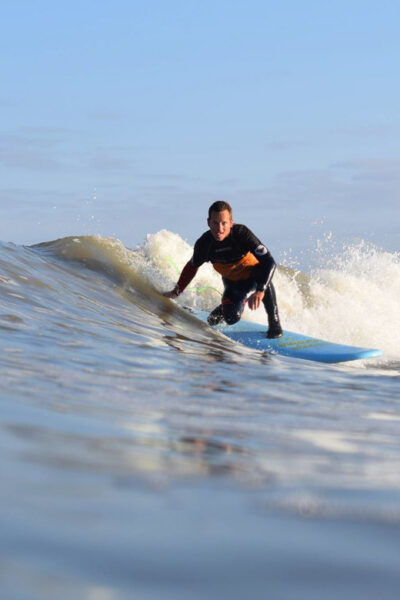
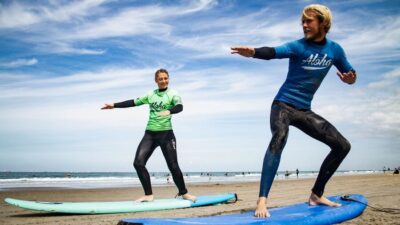
Scheveningen Beach: 2-Hour Surf Experience for Adults
Read our review →
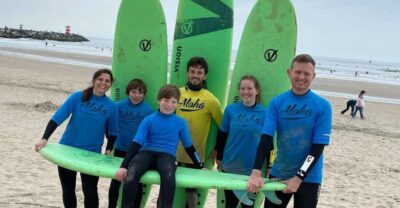
Scheveningen Beach: 1,5 hour Surf experience for families
Read our review →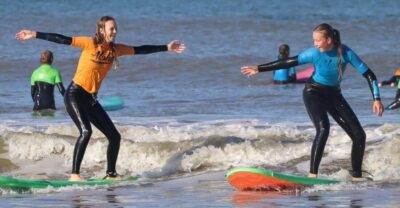
Browse the lists this tour appears in