
Reviewed · ESCAPE GAMES
The Blue’s Clues in Delft Exploration Game and Tour
Delft turns sightseeing into a small outdoor escape room on this self-guided puzzle walk. You follow an offline app from the surviving Oostpoort through canals, churches, market squares, Vermeer country, and the Prinsenhof before finishing at De Roos windmill. The route gives you a reason to look closely instead of simply marching from one photo stop to the next.
I like the freedom to start at any hour and pause whenever you need a coffee, lunch, or museum visit. I also like the low price and the fact that each person in your group can use their own phone at no extra charge, with kids included free. The main drawback is the app setup. One purchaser reported never getting the game to work because the process between booking and the Questo app became confusing, so download and test the app before you set off.
Key points to know before you go
- Oostpoort to De Roos: The route crosses Delft from the eastern city gate to its last surviving windmill.
- About 90 minutes: Allow extra time if you stop for photos, food, or a museum.
- Offline play: The game is designed to work without an internet connection once properly accessed in the app.
- Private and flexible: Play alone or with your own group, start whenever you like, and pause along the way.
- A history lesson with a task: Each stop asks you to inspect the surroundings for an answer before sending you onward.
- Good value for families: The listed price is $7.53 per person, and children play free.
Starting at Delft’s surviving Oostpoort
Your starting point is Oostpoort 15, at the eastern gate of Delft. This is a useful place to begin because the gate gives the walk a clear sense of place before the route leads you toward the center.
Built around 1400, Oostpoort is a fine example of northern European Brick Gothic design. Around 1510, its towers gained an extra octagonal level and tall spires. It is also Delft’s only remaining city gate. The other gates disappeared during nineteenth-century demolition, so this first stop gives you a quick look at the old city’s former defenses.
Here, the app asks you to look around and find an answer. That format matters. You are not just reading a paragraph on your phone. You must inspect the building and its surroundings, then enter the answer to continue. I like this setup for families and small groups because it gives children a job to do, though people who prefer a traditional guide may find the lack of live explanation limiting.
The start and finish are not the same place. You begin at Oostpoort and end at Delft Windmill de Roos on Phoenixstraat. The app guides you step by step, so follow each instruction closely rather than relying on a separate map.
More Self-Guided Tours in The Hague
- Discover The Hague with a self-guided Outside Escape city tour
★ 4.5 · 35 reviews - Discover Delft with a self-guided Outside Escape city game tour!
★ 5.0 · 32 reviews - Hague: The Heart of Old Town Exploration Game and Tour
★ 3.5 · 25 reviews
Koornmarkt and the clues along Delft’s canals
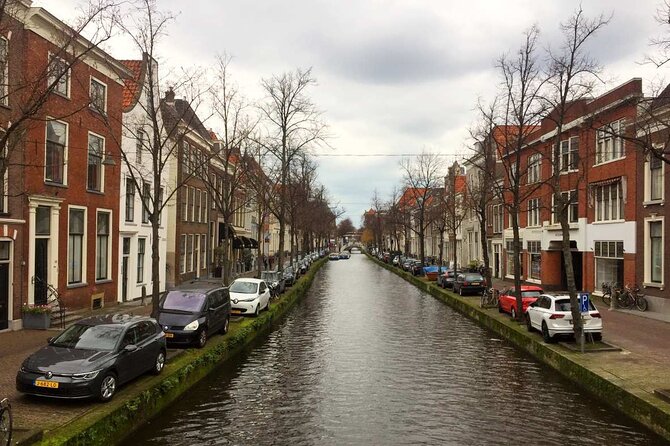
The route continues to Koornmarkt, or Corn Market, one of Delft’s well-known streets and canals. This is the sort of stop that can slip past you on a standard sightseeing walk. The puzzle encourages you to study the street, water, and nearby buildings for the detail that answers the challenge.
The route does not promise a full architectural lecture at every corner. Instead, each location gives you a short story and a task. That keeps the pace moving and helps you cover a good portion of central Delft in roughly an hour and a half.
If you are playing with friends, decide who enters the answer and who searches the surroundings. The activity works solo, but a small group can make the puzzle solving more social. Since group members may play on their own phones free of charge, everyone can follow along instead of crowding around one screen.
The medical museum and Delft’s older church buildings
One stop brings you to the Medisch Farmaceutisch Museum, which displays antique medical and pharmaceutical instruments. The museum adds a change of subject after the canals and medieval defenses. It also shows how the route mixes major sights with places you might not put on a first-time Delft checklist.
The information provided does not say that admission to the museum is included, so treat this as an exterior stop unless you arrange entry separately. That is an important distinction. The game is an outdoor exploration activity, not a package of museum admissions or a guided interior tour.
Another stop takes you to one of Delft’s oldest buildings, a Gothic church on the east side of the Oude Delft. It was built around 1400 and has held Rijksmonument status since 1967. The app asks you to examine the setting for another answer before moving on.
These stops reward travelers who enjoy small details. If your goal is to rush straight to the Nieuwe Kerk and take a few photos, the puzzle may feel like extra work. If you want a broader sense of Delft’s streets and lesser-known corners, the structure gives you a useful reason to slow down.
Markt, City Hall, and the Nieuwe Kerk
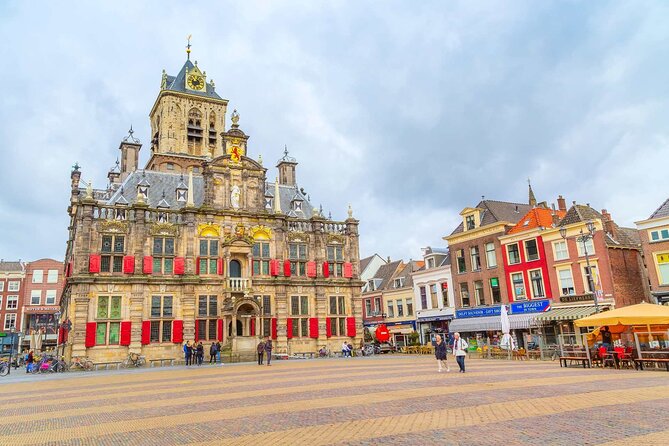
The route then reaches Delft’s Markt, a large historic square measuring about 120 by 50 meters. The square is bordered by the Nieuwe Kerk on one short side and the Renaissance City Hall on the other. The surrounding side streets are also considered part of the Markt area.
This is the visual center of the walk. The square’s position is not accidental. It sits on a raised creek ridge formed by the silted channel of the Gantel, making it one of the higher parts of central Delft. You do not need a geology lesson to enjoy the space, but that detail helps explain why this broad square became such an important civic setting.
City Hall faces the Nieuwe Kerk and remains a civic building, though most administrative work moved to offices inside the Delft railway station building. The building is also used for civic wedding ceremonies. At this stop, the game asks you to find another answer by looking carefully at the square.
The nearby tower was built between 1396 and 1496 by Jacob van der Borch, who also worked on Utrecht’s Dom. A monument to Hugo de Groot was added in 1781. The mechanical clock has 18 bells made by François Hemony in 1659, along with 30 modern bells.
You may find the Markt crowded at certain times, but the supplied information does not give a specific crowd pattern or market schedule. The practical point is simple: allow enough room to stop without blocking foot traffic, and keep your phone ready for the clue.
More Escape Games in The Hague:
- Rotterdam Highlights & Spies: Interactive City Game
★ 4.0 · 51 reviews - Discover Utrecht with a self-guided Outside Escape city game tour
★ 4.5 · 51 reviews - Discover the best spots in Eindhoven with Outside Escape
★ 4.5 · 40 reviews - Discover Maastricht with a self-guided Outside Escape city game
★ 5.0 · 29 reviews
Vermeer Centrum and the Old Church
The Vermeer Centrum Delft is one of the route’s strongest cultural stops. It occupies a building that once housed the St. Lucasgilde, a guild for painters and glassmakers in the seventeenth and eighteenth centuries. Johannes Vermeer joined the guild in 1653.
That connection gives the stop more weight than a simple artist-themed photo opportunity. You are looking at a building tied to the working structure of Delft’s art world. The app uses the location as another puzzle point, so you combine a small piece of art history with a close look at the building itself.
The route also visits the Old Church, whose origins are traditionally placed in 1246. That was the year Count William II granted Delft its own charter. The church was first associated with Saint Bartholomew, the patron saint of its founder, and later developed into a large Gothic basilica.
You should think of these two stops as a pair. The Vermeer Centrum connects Delft with its seventeenth-century painters, while the Old Church reaches back to the city’s medieval growth. The game does not replace a full museum visit or a guided church tour, but it gives you a well-shaped introduction to both subjects.
Prinsenhof and the story of William the Silent

At the Prinsenhof, the route shifts from art and religion to political violence. The building began life as a medieval monastery and later became a residence for William the Silent. William was murdered here in 1584.
The bullet holes in the wall by the main stairs are still visible. That physical detail gives the story a direct quality. You are not simply hearing that an important person died in Delft. You are standing at the place where the event happened and looking for the marks connected with it.
As with the other stops, the game asks you to search for an answer and then continue. The Prinsenhof is likely to be one of the most memorable points on the route because the building’s use changed so sharply over time, from religious house to palace to site of assassination.
The supplied details do not confirm whether an interior admission is included. Plan on the outdoor game using the surrounding building and visible clues, and arrange any museum entry separately if you want more time inside.
Finishing at De Roos, Delft’s last windmill

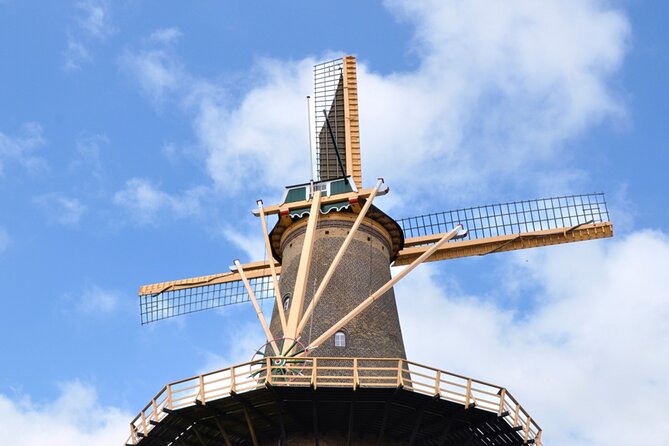
The final destination is De Roos, or The Rose, at Phoenixstraat 111 and 112. Built in 1679, it was used to grind corn. The site had a mill as early as 1352, but De Roos is now the only surviving windmill of the fifteen that once stood in the Delft region.
This is a satisfying finish because the route ends with a working piece of Delft’s industrial past rather than another church or civic building. The windmill also gives the walk a clear endpoint. You are guided there by the app, so read the directions carefully as you leave the central sights.
The listed opening hours for the experience run from midnight to 11:30 p.m. every day through June 17, 2026. That means you can choose a morning, afternoon, or evening start, though daylight will make it easier to inspect building details and solve visual clues. The activity itself is listed as available around the clock, not as a staffed tour with a guide waiting at the start.
How the app works, and where things can go wrong

The game uses the Questo app on your smartphone. It is intended to work offline while you explore, which is helpful if your mobile signal is weak or you want to avoid using much data. You still need to get the game properly loaded before heading out.
The booking code supplied through Viator should unlock the game in the Questo app. You should not need to pay again. One serious practical warning is that the access process has caused confusion for at least one purchaser, who found the steps circular and never managed to start the game.
I would handle this before the day of your visit. Install Questo, enter the supplied code, and confirm that the Delft game appears on your phone. If it does not, use the app or website chat, or contact Questo at [email protected]. The support information says help is available 24 hours a day, seven days a week.
Once the game is running, the appeal is clear. You can pause at any time, resume later, and take the route at your own speed. That flexibility is better than a fixed walking tour if you want to stop for lunch, visit a museum, or split the route across different parts of your day.
Price, group value, and who will enjoy it
At $7.53 per person, this is inexpensive for a ninety-minute activity, especially when you compare it with a private guided walk. Children play free, and each group member can use their own phone without another charge. For a family or group of friends, that makes the price especially attractive.
The value depends on what you want. You are paying for a route, a set of puzzles, and app-based stories, not a human guide, admissions, transport, or a full historical lecture. The experience is best viewed as a low-cost add-on that gives shape to your Delft sightseeing.
I would recommend it to independent visitors, families with children, couples who enjoy solving clues, and repeat visitors who want to see less obvious corners. It also suits people who dislike being tied to a departure time.
I would be more cautious if you need a guide to answer questions as you go, have limited phone confidence, or want to spend serious time inside the museums and churches. The walk covers plenty of ground, but the puzzle format means you may focus more on finding the answer than on reading every plaque or studying every façade.
The activity is private, so only your group participates. Service animals are allowed, the route is near public transportation, and most travelers can take part. The information does not promise a fully step-free route, so anyone with specific mobility needs should check the path and individual sites before booking.
Free cancellation is available if you cancel at least 24 hours before the local start time. Cancellations or changes within that window are not refunded or accepted.
Should you book the Delft exploration game?
Book it if you want a cheap, flexible way to organize a first look at Delft and enjoy solving location-based puzzles. The route links Oostpoort, Markt, the Nieuwe Kerk area, Vermeer Centrum, the Old Church, Prinsenhof, and De Roos in a useful east-to-west line.
Before paying, make sure you are comfortable with a phone-led activity and check that the Questo code works. If the app loads correctly, this is a smart choice for families and independent visitors. If you want deep interpretation, personal conversation, or guaranteed help at every stop, choose a live walking guide instead.
FAQ
Where does the Delft exploration game start?
It starts at Oostpoort 15, 2611 RZ Delft, Netherlands.
Where does the activity finish?
The route ends at Delft Windmill de Roos at Phoenixstraat 111 and 112, 2611 AK Delft, Netherlands. The app guides you there step by step.
How long does the game take?
The estimated duration is about 1 hour and 30 minutes.
Can I start the game at any time?
Yes. The experience is available every day of the year, around the clock, and you can start at any hour. The listed hours run from 12:00 a.m. to 11:30 p.m.
Do I need an internet connection during the walk?
No. The game is designed for offline play while you explore, though you need to access the game properly in the Questo app before starting.
Is the activity guided by a person?
No. There is no physical tour guide. You play through the app, which gives directions, challenges, and information at each stop.
Just added around The Hague
- The Hague Tower Guided Tour★ 4.5 · 45 reviews
- The Hague: Powerboat Tour Scheveningen★ 4.5 · 15 reviews
- The Hague Walking Tour★ 4.5 · 16 reviews
- The Hague: Ping Pong Table Rental at a Secret Ping Pong Bar★ 4.5 · 7 reviews
- The Hague: Private Boattour up to 10 persons★ 4.9 · 37 reviews
- The Hague: Prison Gate Museum★ 4.5 · 58 reviews
- The Hague: Highlights Bike Tour★ 4.6 · 135 reviews
- The Hague : Must-See attractions Private Walking Tour★ 4.8 · 9 reviews
Escape Games, compared.

Rotterdam Highlights & Spies: Interactive City Game
Read our review →
Discover Utrecht with a self-guided Outside Escape city game tour
Read our review →
Discover The Hague with a self-guided Outside Escape city tour
Read our review →
Discover Delft with a self-guided Outside Escape city game tour!
Read our review →
Discover Maastricht with a self-guided Outside Escape city game
Read our review →
Maastricht Medieval Mystery: Interactive City Game & Tour
Read our review →
Hague: The Heart of Old Town Exploration Game and Tour
Read our review →Browse the lists this tour appears in