
Reviewed · CASTLES & PALACES
The Hague: Escher in The Palace Museum Ticket
Escher in Het Paleis turns a former royal winter palace into a playground for the eye. You’ll see more than 130 original prints, from early work to the famous impossible staircases and tessellations, then meet the showstopper: the 7-meter Metamorphosis III, displayed in a way that makes time and space seem to flow together. I like the mix of serious art and hands-on puzzles, and I like that the palace itself is part of the visit.
The museum is a good size for roughly an hour, though careful readers can spend closer to two hours. The main consideration is that some rooms are fairly small, and the lighting can feel dark. Large bags and luggage are not allowed, so plan to use the museum’s free storage facilities if available.
Key points to know before you go
- Metamorphosis III is the visual centerpiece: The enormous 7-meter woodcut gives you a different way to experience Escher’s repeating forms.
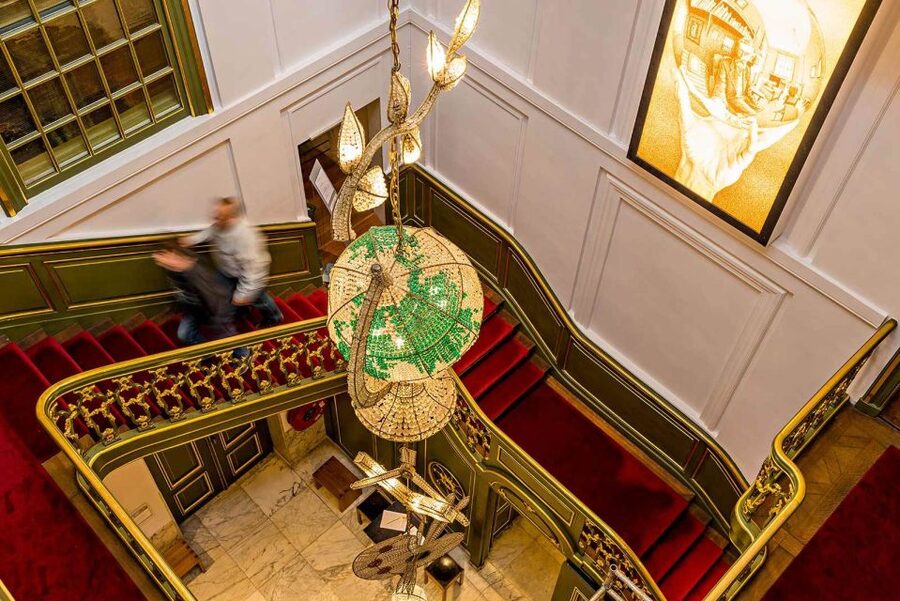
- The palace is part of the attraction: Queen Mother Emma’s former Winter Palace retains its royal atmosphere, down to decorative ceilings and unusual chandeliers.
- You see much more than impossible staircases: The collection follows Escher’s artistic development and includes tessellations, landscapes, portraits, and lesser-known work.
- The upper-floor activities suit families: Optical puzzles, hands-on challenges, and a free treasure hunt make the visit more active for children.
- An audio guide is included: Commentary is available in English, Dutch, German, French, Chinese, Japanese, Ukrainian, and Korean.
- The ticket stays valid for 365 days: Check the available entry times, but this long validity gives you unusual flexibility if your plans change.
Escher’s impossible world inside a former palace
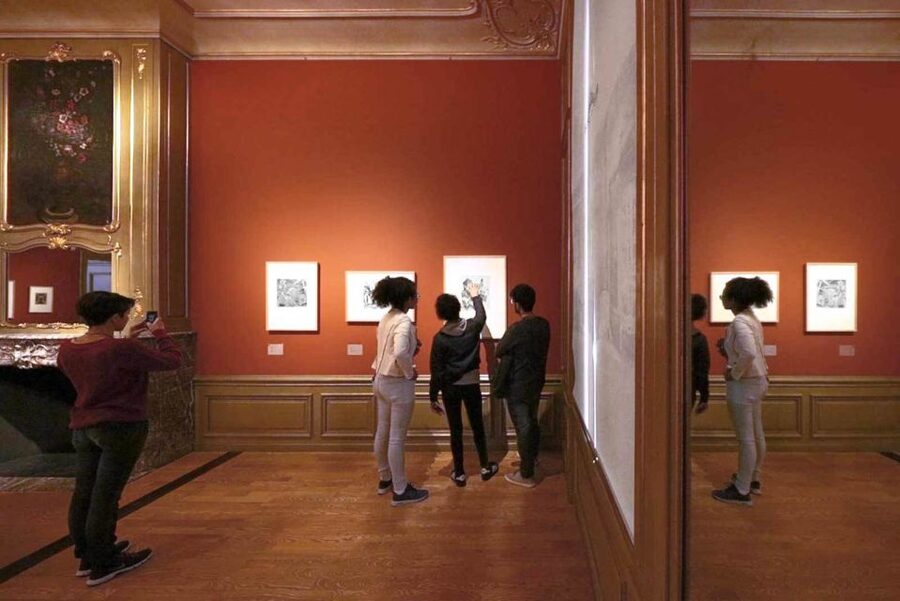
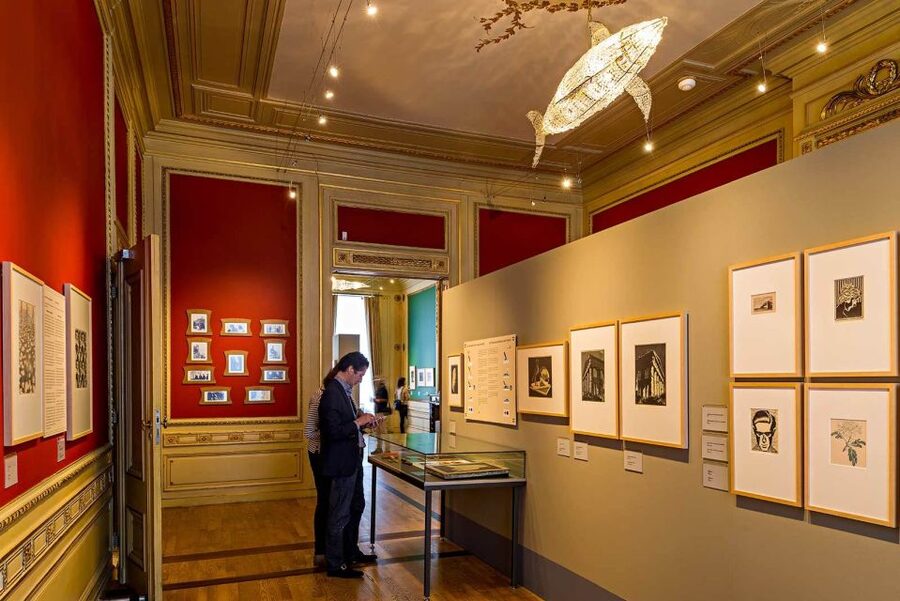
The first surprise is the setting. Escher in Het Paleis occupies the former Winter Palace of Queen Mother Emma of the Netherlands on Lange Voorhout, one of The Hague’s most elegant central streets. This is not a plain gallery with white walls and spotlights. The building keeps its royal character, so you are looking at Escher’s precise black-and-white worlds inside rooms that once served the Dutch royal household.
That contrast works well. Escher’s art can feel mathematical, remote, and almost computer-generated, yet the palace gives it a human setting. Look up as you move through the rooms. The floors, ceilings, lamps, and chandeliers are not just background decoration. The chandeliers in particular deserve attention, and one visitor specifically found that the building offered something to examine from ceiling to floor.
The collection covers more than 130 prints and follows Escher beyond the images most often reproduced on posters and book covers. You will encounter the repeating birds and fish, interlocking patterns, reflections, staircases, and scenes that seem to contradict ordinary space. You will also see work that reveals his development as an artist, including pieces that are less familiar than his later optical illusions.
That progression matters. If you know Escher mainly from Relativity or Ascending and Descending, the early and less famous work helps explain how he arrived at those visual puzzles. You can see recurring interests return in different forms, rather than treating the artist as someone who simply produced one clever trick after another.
More Attraction Tickets in The Hague
- The Hague: Mauritshuis Entrance Ticket
★ 4.7 · 2,706 reviews - The Hague: Madurodam Miniature Park Entry Ticket
★ 4.6 · 1,559 reviews - The Hague: The Pier SkyView Ticket with Drink and Snack
★ 4.4 · 1,398 reviews
Starting with Escher’s life and artistic development
A short introductory film helps set the tone before you get absorbed in the prints. It gives you a useful starting point for understanding the artist’s life, interests, and changing approach to the world around him. The film is especially helpful if you arrive knowing the images but not much about the person behind them.
The museum also explains Escher’s growing interest in mathematics and ordered patterns. He was not simply drawing strange staircases for amusement. His work tests how the brain interprets space, repetition, symmetry, movement, and transformation. Once you see that thread, familiar works become more interesting.
The displays are arranged across several levels of the palace, and the visit gradually shifts from biography and original artwork to more interactive material. You can move at your own pace, stopping to read the descriptions or using the included audio guide.
The audio guide is available in eight languages: English, Dutch, German, French, Chinese, Japanese, Ukrainian, and Korean. That is useful here because Escher’s work benefits from a little explanation. You can look at a repeating pattern and enjoy it immediately, but a short note about how it was built can change what you notice next.
Metamorphosis III and the pleasure of taking your time
The largest work in the collection is Metamorphosis III, a woodcut stretching about 7 meters. It is displayed in an unconventional format that lets you follow Escher’s gradual changes between forms. Instead of viewing a single fixed image, you watch one idea turn into another as patterns, letters, animals, buildings, and geometric structures connect.
This is the piece that rewards patience. Give yourself time to follow the full length rather than glancing at it and moving on. The work shows Escher’s interest in combining time and space as one continuous visual experience.
Other famous pieces include Day and Night, in which a Dutch countryside transforms into a flock of birds, and Ascending and Descending, with figures endlessly climbing and descending a staircase. These images are familiar enough to seem almost like visual jokes, but seeing the original prints in context reveals the careful structure behind them.
The collection also includes Escher’s tessellations and intricate designs. These are among the best works for close viewing because the pattern may first look decorative, then reveal a chain of repeated forms. I would not rush through these rooms. The strongest part of the visit is often the moment when you notice how one shape becomes another without a clear starting point.
The palace rooms add a second layer
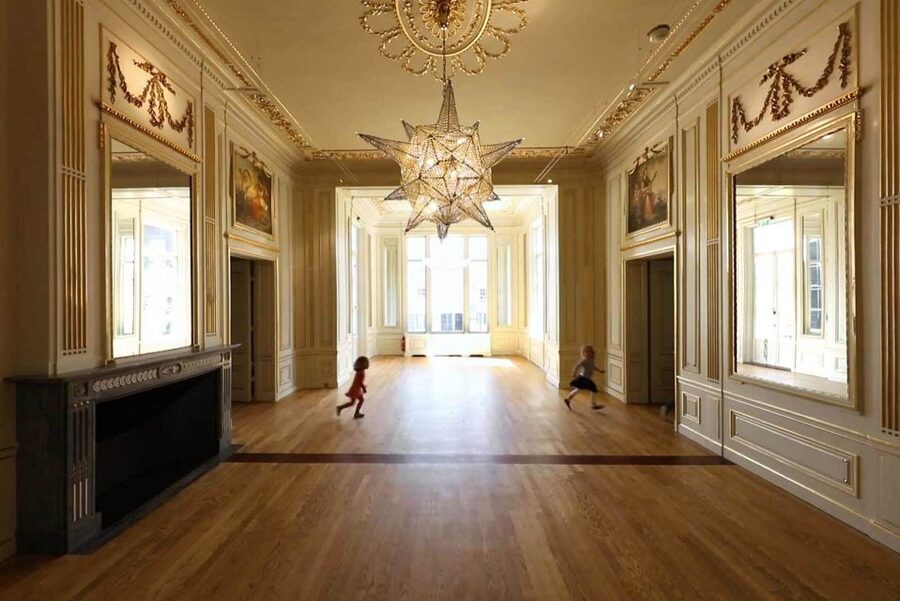
Escher’s prints are the main reason to come, but the palace keeps the visit from feeling like a single-subject art lesson. The rooms provide a glimpse of how the Dutch royal family once used the building, while the preserved interiors create a formal frame for Escher’s restless designs.
The result is a two-part experience. You learn about a major Dutch artist, and you also see a royal residence that is open to the public in a way many former palaces are not. The building’s atmosphere remains intact, making the museum feel more distinctive than a standard exhibition hall.
The setting is also helpful for families. Children may not want to read every label about Escher’s development, but they can still enjoy the unusual rooms, decorative details, and visual challenges. Adults can focus on the prints while younger visitors look for patterns overhead or work through the activities upstairs.
The main drawback is physical rather than artistic. Some rooms are small, and the overall lighting can be subdued. A small screening area for the biography film may feel stuffy when several people are watching at once. If you prefer bright, spacious galleries, this museum may feel a little enclosed.
More Castle Tours in The Hague:
- Amsterdam: Royal Palace Entry Ticket and Audio Guide
★ 4.6 · 6,475 reviews - Utrecht: De Haar Castle & Park Entry Ticket
★ 4.7 · 1,350 reviews - Apeldoorn: Het Loo Palace Entry Ticket
★ 4.4 · 277 reviews - Muiden: Entry Ticket to Muiderslot Castle
★ 4.7 · 173 reviews
Looking as Escher Does: puzzles for eyes and hands
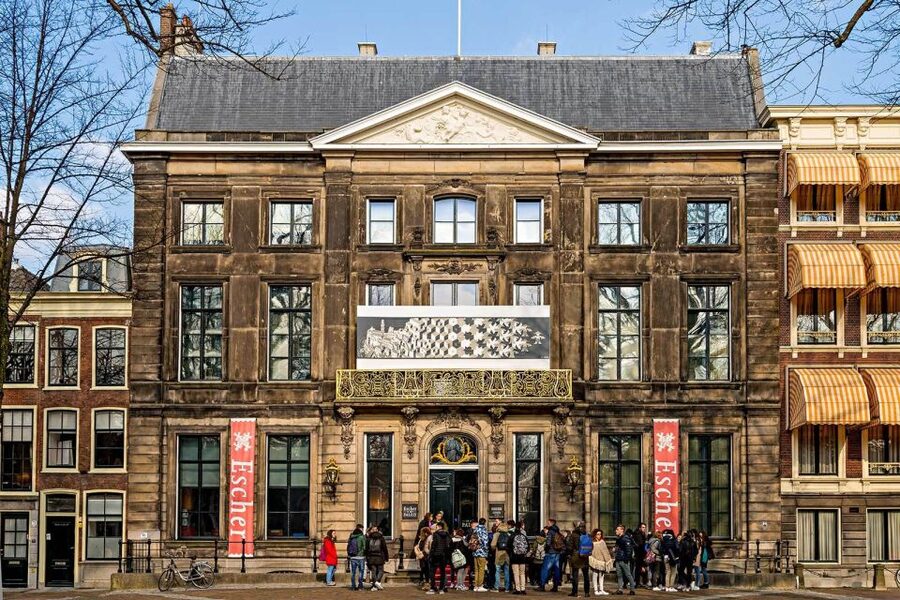
The interactive exhibition, called Looking as Escher Does, is located on an upper floor. This is where the visit becomes more playful. Instead of only looking at finished prints, you can test the visual ideas yourself through puzzles involving perception, repetition, and optical illusion.
The activities are designed for both eyes and hands. You may find yourself trying to work out why a shape appears to change, how a pattern fits together, or how a familiar object can be represented in an unfamiliar way. The point is not just to press buttons and move on. These activities show how Escher turned visual problems into art.
This section is a major reason to include the museum in a family day in The Hague. A free treasure hunt gives children a clear reason to pay attention as they move through the building. Older children and adults can enjoy the puzzles too, especially if they like logic games, drawing, graphic design, or mathematics.
I would save enough time for this area rather than treating it as a quick final stop. The upper-floor activities can be the liveliest part of the museum, and it is easy to spend longer there than expected. The museum’s closing time matters if you arrive late, since the interactive rooms are often the place you will want to linger.
How long to allow and how to plan the visit
For a quick look, allow about an hour. That is enough to see the main rooms, the major prints, the palace interiors, and the interactive material without reading every label.
I would allow closer to two hours if you want to follow Escher’s development, use the audio guide, study Metamorphosis III, and complete the hands-on activities. Families may need extra time for the treasure hunt. The museum is compact enough to fit neatly into a day in The Hague, but it is not so small that you should squeeze it into a rushed half-hour.
The museum is at Het Paleis, Lange Voorhout 74 in The Hague. From The Hague Central Station, take tram 9 to Korte Voorhout or tram 17 to Kneuterdijk. Its location works well with other central sights, and the surrounding area gives you a pleasant place to continue walking afterward.
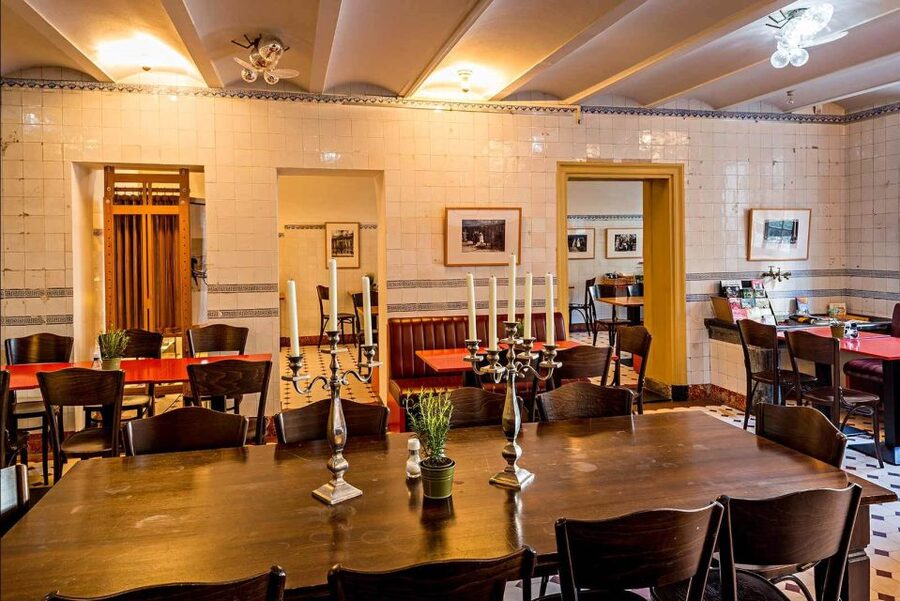
There is also a museum café in the former palace kitchen. That detail adds to the building’s character and gives you a simple place to pause after the galleries. Nearby, you can combine the museum with a walk around the lake and views of the Parliament buildings, along with lunch in the surrounding area.
Large bags and luggage are not allowed inside. Travel light, or plan around the museum’s storage arrangements. This is particularly important if you are arriving from a train station with suitcases.
Is the $15 ticket good value?
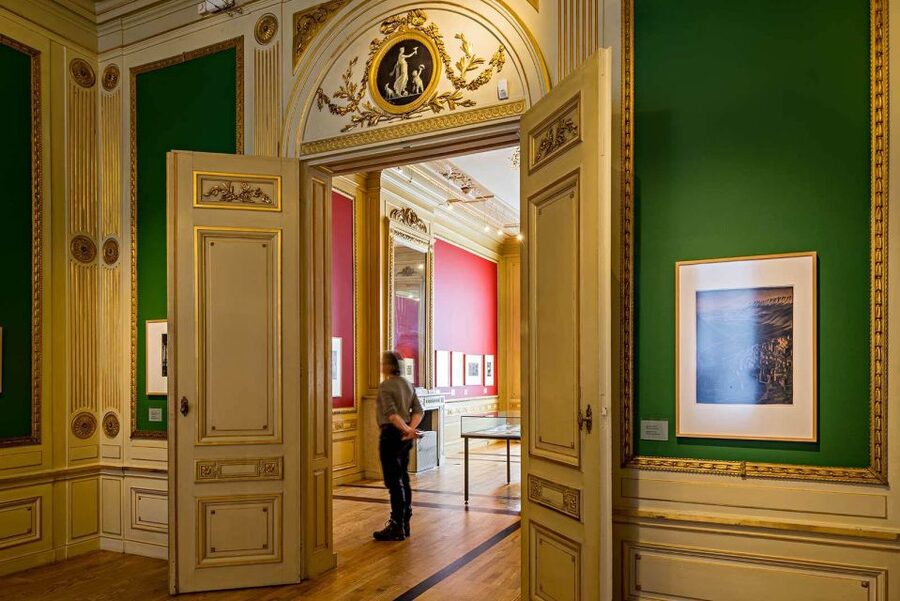
At about $15 per person, admission is reasonable for a permanent collection housed in a historic palace, especially when you plan to use the audio guide and interactive section. You are not paying only to see a handful of famous prints. The ticket covers the wider collection, the royal rooms, the large Metamorphosis III display, and the hands-on exhibits.
The value is strongest for three types of visitors. Escher fans will appreciate seeing original works and lesser-known pieces in one place. Families get a museum with activities that go beyond reading labels. Art, design, and mathematics students can follow the development of ideas that later became central to graphic art and visual culture.
If you know very little about Escher, the price still makes sense, but your expectations should be realistic. This is not a huge national museum with a full day of galleries. It is a focused visit, usually lasting around one to two hours. If your schedule is tight, that compact size is an advantage. If you want an all-day art museum, you will need to pair it with another attraction.
The ticket can be cancelled up to 24 hours before the visit for a full refund, and you can reserve now and pay later. Its stated validity is 365 days, with available starting times shown during booking. That flexibility is useful if your Hague plans are still shifting, though you should still check the current opening schedule before setting out.
The Palace is closed on Christmas Day and January 1. It remains open on Easter, King’s Day, Ascension Thursday, Whitsun, and Whit Monday. Children up to age six enter free when accompanied by a paying adult.
Who should book Escher in Het Paleis?
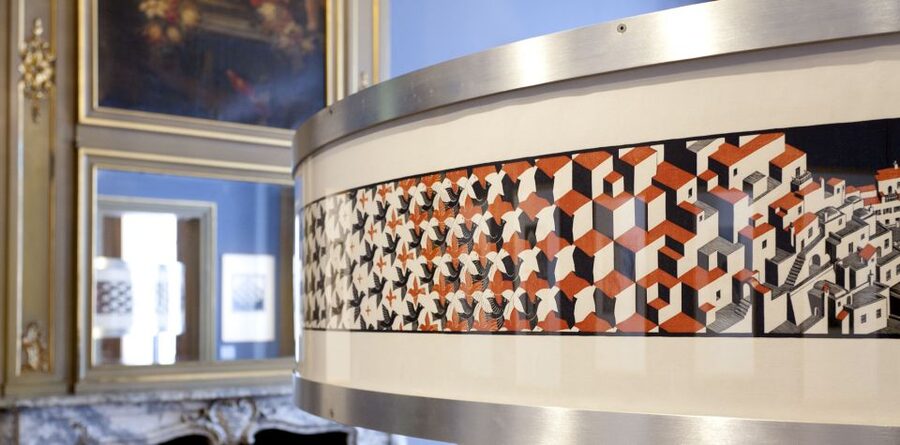
I would book this museum if you already admire Escher, especially if you have only seen reproductions of his work. The chance to examine original prints and follow his changing methods gives the familiar images more weight.
I would also recommend it to families looking for an indoor activity that does not depend on children sitting quietly for hours. The treasure hunt and interactive upper floor give younger visitors something concrete to do, while the adults can focus on the art and palace.
It is a good choice for anyone interested in graphic design, mathematics, optical illusions, or the way artists use pattern. The audio guide helps if you want more context, but the exhibits remain approachable even without an expert background.
You may want to skip it if you dislike small galleries, subdued lighting, or museums where close attention matters. The building is historic and attractive, but it is not designed as a broad, open modern gallery. Also, if you have only a few hours in The Hague and prefer paintings, grand government buildings, or a larger art collection, another museum may better match your interests.
Should you book it?
Book Escher in Het Paleis if you want a focused, affordable museum with genuine visual surprises. The combination of original Escher prints, the former royal interiors, Metamorphosis III, and hands-on puzzles gives you more variety than the name alone suggests.
Plan for about 90 minutes, add time for the café or nearby sights, and do not rush the interactive floor. For Escher fans, families, and curious first-time visitors, this is one of the easiest cultural stops to fit into a day in The Hague.
FAQ
Where is Escher in Het Paleis?
The museum is at Het Paleis, Lange Voorhout 74 in The Hague, South Holland.
How do I get there from The Hague Central Station?
Take tram 9 and get off at Korte Voorhout, or take tram 17 and get off at Kneuterdijk.
How long is the ticket valid?
The ticket is valid for 365 days. Check availability for the current starting times.
What is included with admission?
Admission to Escher in Het Paleis is included. An audio guide is also included, with options in English, Dutch, German, French, Chinese, Japanese, Ukrainian, and Korean.
Is there a guided tour?
A guided tour for groups of up to 20 people is available for EUR 60 per guide, but it must be reserved in advance.
Are children admitted free?
Children up to six years old enter free when accompanied by a paying adult. The museum also offers a free treasure hunt for children.
Can I bring luggage or a large bag?
Luggage and large bags are not allowed inside. Plan to use the museum’s storage facilities if available, and travel with a smaller bag when possible.
More Museum Tickets in The Hague
- The Hague: Panorama Mesdag Museum Entry Ticket
★ 4.8 · 143 reviews - The Hague: Prison Gate Museum
★ 4.5 · 58 reviews - Amsterdam: Van Gogh Museum Ticket
★ 4.7 · 52,054 reviews - Moco Museum Amsterdam Entrance Tickets with Banksy & More
★ 4.4 · 10,088 reviews
Just added around The Hague
- The Hague Tower Guided Tour★ 4.5 · 45 reviews
- The Hague: Powerboat Tour Scheveningen★ 4.5 · 15 reviews
- The Hague Walking Tour★ 4.5 · 16 reviews
- The Hague: Ping Pong Table Rental at a Secret Ping Pong Bar★ 4.5 · 7 reviews
- The Hague: Private Boattour up to 10 persons★ 4.9 · 37 reviews
- The Hague: Prison Gate Museum★ 4.5 · 58 reviews
- The Hague: Private Custom Walking Tour With A Local Guide★ 4.5 · 13 reviews
- The Hague: Highlights Bike Tour★ 4.6 · 135 reviews
Castles & Palaces, compared.
Castle De Haar Small-Group Tour from Amsterdam
Read our review →
Browse the lists this tour appears in