
Reviewed · VAN GOGH MUSEUM TICKETS
Amsterdam: Van Gogh Museum Guided Tour & Entry Ticket (Max 6 ppl)
Van Gogh’s paintings become more affecting when you see how closely they track his life. This 90-minute guided visit moves from The Potato Eaters and Van Gogh’s dark Brabant period to the bright, restless work he made in Paris and Arles.
I like the maximum group of six, which gives you room to ask questions without shouting across a crowd. I also like the focus on Theo, Vincent’s brother, and the people around the artist. That keeps the story from becoming a simple tale of lonely genius.
The main caution is the price: $168.09 per person is a serious outlay for an hour and a half. You are paying for museum admission, a small group, and a guide who can shape the visit around the key works. If you prefer to wander at your own pace, the premium may not suit you.
Key points to know before you book

- Six people maximum: This is a semi-private museum visit, not a large group following a flag.
- A Dutch art historian leads the tour: Guides named in past bookings include Titia, Lucien, Anke, Cécile, Lucy, Liz, Mercedes, and Genevieve. The specific guide is not guaranteed.
- The story follows Van Gogh’s changing art: Expect discussion of Brabant, Paris, Arles, Gauguin, Theo, family, love, and mental health.
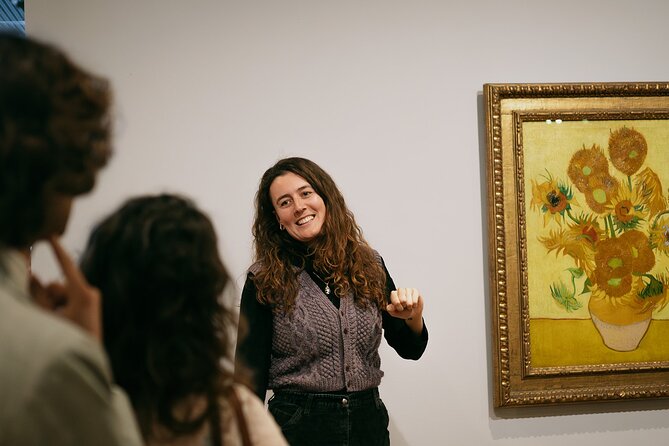
- The main masterpieces get priority: The route includes The Potato Eaters, Sunflowers, The Yellow House, and Almond Blossom.
- You may remain afterward: The guided portion ends at the Van Gogh Museum, but you can stay inside for as long as you want.
- Book early for the best chance at your preferred time: Museum time slots are released only three months ahead, so an earlier booking cannot guarantee the exact hour.
Why a guide changes the Van Gogh Museum

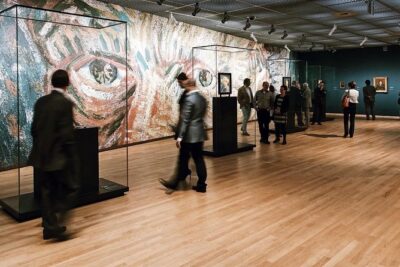
The Van Gogh Museum is easy to admire and surprisingly easy to misunderstand. You can look at a bright vase of sunflowers, a dark peasant interior, or a swirling self-portrait and move on in seconds. A good guide slows the story down without turning the museum into a lecture hall.
This tour gives you a clear thread to follow: Van Gogh’s life through his paintings. You learn why he did not begin painting seriously until age 27, how Theo supported him, and how his work shifted as his surroundings and state of mind changed.
That approach matters because the museum’s collection is arranged around the artist’s development. The paintings are not just isolated stars. They show a young man searching for a purpose, learning technique, testing new ideas, and pushing himself far beyond what his early work suggests.
The guide also helps separate fact from the familiar legend. Van Gogh was not simply an unrecognized genius who painted in a burst of emotion. He studied, experimented, wrote extensively to Theo, looked closely at other artists, and worked hard at his craft. His mental difficulties are part of the story, but they are not the whole story.
More Attraction Tickets in Amsterdam
- Amsterdam: Van Gogh Museum Ticket
★ 4.7 · 52,054 reviews - Amsterdam: Heineken Experience Ticket
★ 4.6 · 30,055 reviews - Amsterdam: Rijksmuseum Entry Ticket
★ 4.7 · 25,535 reviews
Starting near Museumplein
The meeting point is Paulus Potterstraat 7, in the Museumplein area. The tour finishes at the Van Gogh Museum, Museumplein 6, so you do not need to arrange a separate return transfer or find your guide inside the museum.
The mobile ticket format is useful for a museum visit in Amsterdam, where timed entry matters. You should still arrive with enough time to locate Paulus Potterstraat and meet the guide before the start. The supplied information does not give a specific arrival requirement, so check your confirmation for the exact meeting instructions.
The area is near public transportation, which makes the start practical from other parts of Amsterdam. Service animals are allowed, and most people can take part. The activity is offered in English.
The Potato Eaters and the dark Brabant years
The tour begins with Van Gogh’s early work, including The Potato Eaters. This painting is a useful starting point because it looks nothing like the sunny, quick-brushed images most people associate with him.
The scene is dark and earthy. Van Gogh wanted to show rural people as he believed they truly lived, with rough hands and tired faces shaped by hard work. The painting is not polished in the academic way, and that roughness tells you something about his ambitions at the time.
I find this early period valuable because it shows Van Gogh learning in public. He had not yet found the colors, loose brushwork, or confident line that would define his later art. A guide can point out what he was trying to achieve rather than letting you dismiss the work as simply gloomy.
The discussion also reaches his family and relationships. His bond with Theo is central from the start. Theo was not just a sympathetic brother. He helped Vincent financially, encouraged his work, and remained tied to the art world that Vincent struggled to enter.
Paris brings new color and fresh pressure
The next major shift comes with Paris. Van Gogh’s work changed sharply as he encountered new artistic ideas and a brighter palette. The move from the dark Brabant paintings to the lighter, more experimental Paris pictures gives the museum visit its strongest sense of progress.
You may hear about the influence of other artists and the way Van Gogh tested color, brushwork, and composition. The point is not just that his pictures became brighter. He was actively seeking a new visual language.
This is where a small group earns its keep. You can ask why one painting looks calm while another feels jumpy, or how a particular color works beside its neighbor. Guides such as Lucy, Liz, Cécile, Mercedes, and Genevieve have been praised for answering questions and connecting technique with biography.
The museum can be crowded, and a guide who knows the rooms can help you reach the important works without wasting half the visit finding them. One guide, Liz, has been singled out for moving efficiently through a busy museum while still explaining the major paintings.
The tradeoff is that efficiency can mean less time in some rooms. One past participant wanted more art and less standing still, and felt that the second floor was skipped. That is a useful warning: the tour is designed to select highlights, not provide a slow look at every picture.
More Museum Tickets in Amsterdam
- Moco Museum Amsterdam Entrance Tickets with Banksy & More
★ 4.4 · 10,088 reviews - Amsterdam: The Upside Down Museum Entrance Ticket
★ 4.4 · 9,506 reviews - Amsterdam: Red Light Secrets Museum Entry Ticket
★ 4.2 · 5,722 reviews - Amsterdam’s Weirdest Museum: Believe It or Not!
★ 4.5 · 4,086 reviews
Sunflowers, The Yellow House, and Gauguin
Van Gogh’s time in Arles brings the tour to the paintings most people are eager to see. Sunflowers and The Yellow House belong to a period of intense hope, ambition, and strain.
Van Gogh imagined the yellow house as a place where artists could work together. His relationship with Paul Gauguin became especially important, both creatively and personally. Their time together was productive but turbulent, and the paintings from this period carry both the joy of strong color and the pressure of emotional instability.
A guide can help you see that the famous yellow tones are not simply cheerful. Color, repeated brushstrokes, and distorted forms can express excitement, urgency, loneliness, or exhaustion. The story becomes stronger when the paintings are placed beside the letters, relationships, and plans that shaped them.
The focus on Gauguin is also a reminder that Van Gogh did not work in isolation. He responded to other artists, borrowed ideas, argued, admired, and changed course. His originality grew out of conversation as much as solitude.
Almond Blossom and Van Gogh’s final years
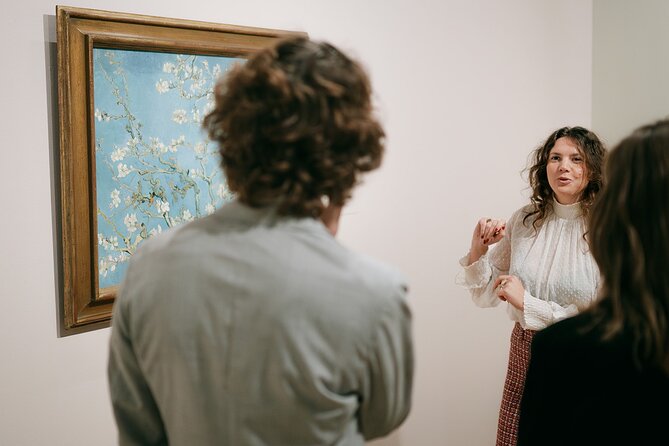
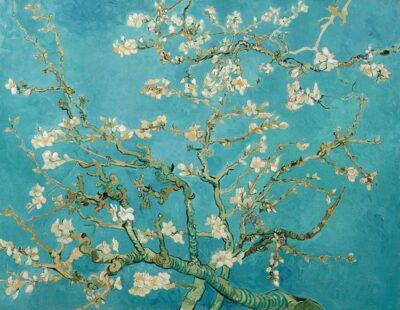
Almond Blossom offers a different mood. Its pale flowers and clear blue background are more open and graceful than the dark rural interiors from the beginning of the tour. The work was made for Theo’s newborn son, giving it a direct family connection.
That link to Theo helps the guide bring the personal story back into view. Vincent’s life was not only about studios, hospitals, and paintings. It also included affection, disappointment, family tension, and a lasting dependence on his brother.
The final part of the story is handled through both art and biography. Van Gogh died by suicide at 37, and Theo died a few months later. The tour then asks who helped make Vincent famous after his death, bringing attention to the woman behind that success story.
That final note is important, since Van Gogh’s reputation did not become fully established during his lifetime. The people who preserved, promoted, and interpreted his work mattered. The precise emphasis can vary by guide, but the tour promises to look beyond Vincent alone.
Some past bookings describe an emotional response to the final paintings and the guide’s narration. You should not expect a theatrical performance, but the subject can be heavy. If you prefer to study the art without personal storytelling, a self-guided visit may feel more comfortable.
What the 90-minute format really means
Ninety minutes is enough to give you a framework, not enough to see every corner of the museum at leisure. That is the central bargain.
You will likely move through the key stages of Van Gogh’s career, with selected works used to explain the changes. The guide may spend several minutes on one painting, then move quickly through another room. This keeps the story coherent but limits your freedom to stop wherever you wish.
The good news is that your museum visit does not have to end with the tour. Once the guided portion is over, you can remain inside as long as you like. That makes the format more useful than a strict 90-minute exit, especially if you want to return to a favorite painting or explore rooms the guide passed by.
I would treat the tour as an introduction and orientation. Listen closely during the main route, note the works that catch your eye, then use your remaining time for a slower second look. The ability to stay afterward helps balance the fast pace.
Is $168.09 good value?
At $168.09 per person, this is not a budget museum ticket. The value depends on how much you want interpretation and how much you dislike navigating a popular museum alone.
You are paying for three things:
- Museum admission
- A 90-minute English-language tour
- A group limited to six people
That small group is the strongest value point. In a large group, even an excellent guide can be hard to hear and questions can become awkward. With six people, the experience is closer to a private visit, though it is not a fully private tour unless your booking fills the group.
The guide quality matters enormously. Past guides named Titia, Lucien, Anke, Cécile, Lucy, Liz, Mercedes, and Genevieve have been praised for clear storytelling, art knowledge, warmth, humor, and good answers. You cannot select one of them based on the information provided, so book this for the small-group format and subject, not for a guaranteed personality.
If you already know Van Gogh well and prefer independent looking, the cost will be harder to justify. If this is your first visit, or if biography helps you understand art, the guide can make the collection far easier to read.
Who should book this experience?
I would recommend it most strongly to you if you:
- Are visiting the Van Gogh Museum for the first time
- Want the main works explained in a clear order
- Have only a short period available for the museum
- Like asking questions in a small group
- Want to connect Van Gogh’s family, mental health, and relationships to his art
- Feel overwhelmed by crowded museums or large guided groups
Families and mixed-interest groups may also find the structure helpful, since the story gives younger visitors a reason to look closely. One past booking described a child remaining engaged and continuing to discuss the experience afterward, though the tour is not specifically advertised as a children’s program.
I would hesitate if you want complete freedom to linger at every painting. The tour is selective, and one past participant felt the guide talked too long in places and did not cover enough art. That criticism points to the basic choice: more context and direction, or more independent time.
Booking timing, tickets, and cancellation
Museum time slots are released only three months ahead. If you book earlier, your chosen time is treated as a preference rather than a guarantee. The operator will try to accommodate it once the museum releases its schedule, but cannot promise the exact slot.
The tour is often booked well ahead, with an average booking point of about 53 days. If your Amsterdam dates are fixed, early planning is sensible, but remember that an early reservation does not remove the three-month time-slot limitation.
Confirmation is provided at booking, and the ticket is mobile. Free cancellation is available up to 24 hours before the start time for a full refund. Cancellations or changes made within 24 hours are not accepted for a refund, and the cut-off uses Amsterdam local time.
My verdict: book it for context, not just entry
This is a strong choice if you want Van Gogh’s paintings arranged into a human story. The small group, English-speaking Dutch art historian, included entry, and option to remain in the museum afterward make the format practical.
The price is high, and the 90-minute route cannot cover everything. Still, I like the attention to Theo, the movement from Brabant to Paris and Arles, and the effort to show how Van Gogh’s technique changed alongside his life.
Book it if you want help seeing connections. Skip it if you mainly want a quiet, unhurried look at the collection and are happy to make your own route.
FAQ
How long does the guided tour last?
The tour lasts approximately 1 hour and 30 minutes.
How many people can join the tour?
The group has a maximum of six travelers.
Is museum admission included?
Yes. The Van Gogh Museum admission ticket is included.
What language is the tour offered in?
The tour is offered in English.
Who leads the tour?
A Dutch art historian leads the tour. Guides named in past bookings include Titia, Lucien, Anke, Cécile, Lucy, Liz, Mercedes, and Genevieve, but a specific guide is not guaranteed.
Where does the tour start?
The meeting point is Paulus Potterstraat 7, 1071 CX Amsterdam, Netherlands.
Where does the tour end?
The tour ends at the Van Gogh Museum at Museumplein 6, 1071 DJ Amsterdam, Netherlands.
Can I stay in the museum after the tour?
Yes. You can remain in the museum for as long as you want after the guided portion ends.
Can I book a preferred time more than three months ahead?
You can request a preferred time, but the museum releases time slots only three months ahead. The requested time cannot be guaranteed when booking earlier.
What is the cancellation policy?
You can cancel up to 24 hours before the start time for a full refund. Cancellations or changes made less than 24 hours before the experience are not accepted for a refund.
More Van Gogh Tickets
- Amsterdam: Van Gogh Museum Ticket and City Canal Cruise
★ 4.6 · 3,899 reviews - Amsterdam: Van Gogh Museum Ticket & Canal Cruise
★ 4.5 · 3,304 reviews - Van Gogh Museum Amsterdam Exclusive Tour w/ Reserved Entry
★ 5.0 · 1,760 reviews - Van Gogh Museum Tour Reserved Entry Semi Private
★ 5.0 · 1,437 reviews
Just added around Amsterdam
- Private sightseeing tour to Bruges and chocolate from Amsterdam★ 5.0 · 11 reviews
- Amsterdam: Rijksmuseum (Private Tour & Priority Access)★ 5.0 · 27 reviews
- Amsterdam: Private Romantic Evening Canal Cruise + Bubbles/Snacks★ 5.0 · 46 reviews
- Amsterdam Private Shopping Experience★ 5.0 · 7 reviews
- Rijksmuseum Amsterdam Private Guided Tour★ 5.0 · 57 reviews
- Amsterdam Rijksmuseum PRIVATE TOUR with a Local Private Guide★ 5.0 · 159 reviews
- Private Photo Session in Amsterdam★ 5.0 · 15 reviews
- Private One way Transfer Amsterdam Airport to Amsterdam★ 3.5 · 42 reviews
Van Gogh Museum Tickets, compared.

Van Gogh Museum Amsterdam Exclusive Tour w/ Reserved Entry
Read our review →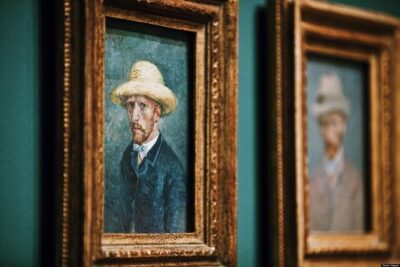
Van Gogh Museum Tour Reserved Entry Semi Private
Read our review →
Combo Ticket: Van Gogh Museum Ticket and 1-Hour Canal Cruise
Read our review →
Browse the lists this tour appears in